
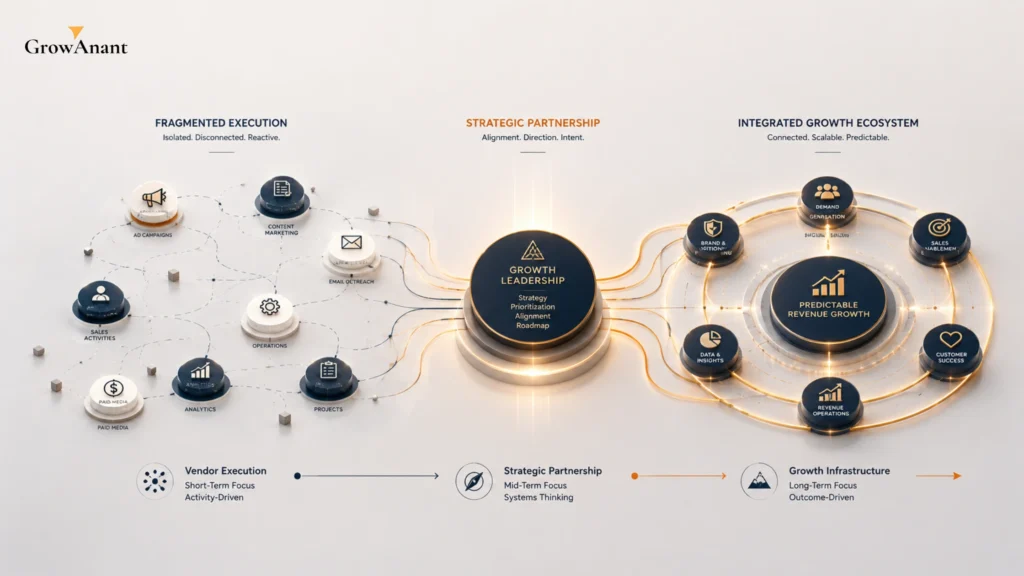
Many companies begin their growth journey by hiring vendors.
A vendor manages a project.
A vendor executes a campaign.
A vendor delivers a service.
There is nothing inherently wrong with this model. In fact, vendors often play an important role in helping businesses execute specific initiatives.
However, as companies mature, growth challenges become more complex.
Revenue becomes less predictable.
Customer acquisition costs increase.
Lead quality declines.
Marketing, sales, and operations become increasingly disconnected.
At this stage, the challenge is rarely execution alone.
The challenge is alignment.
This is where the conversation shifts from hiring a vendor to finding a long-term growth partner.
Organizations seeking a business growth agency USA, growth strategy consulting, or business growth consulting solution often discover that sustainable growth requires more than campaign execution. It requires a partner capable of helping leadership make better decisions, prioritize investments, improve demand generation systems, and align growth activities with revenue outcomes.
A long-term growth partner does not simply ask:
“What campaign should we launch next?”
They ask:
“What growth system should we build?”
This distinction changes everything.
Vendor vs Partner Mindset
The easiest way to understand a growth partner is to compare the relationship to a traditional vendor relationship.
A vendor focuses on deliverables.
A partner focuses on outcomes.
Vendor mindset
Vendors are typically engaged to complete specific tasks.
Examples include:
- Website redesign projects
- Paid advertising campaigns
- SEO initiatives
- Content production
- Marketing automation implementation
Success is often measured by:
- Project completion
- Campaign metrics
- Delivery timelines
- Activity levels
A digital growth agency operating purely as a vendor may execute effectively but remain disconnected from broader business objectives.
This creates a common founder frustration.
Marketing activity increases.
Reports look positive.
Revenue impact remains unclear.
Partner mindset
A true growth partner approaches the relationship differently.
The focus shifts toward:
- Business outcomes
- Revenue growth
- Pipeline quality
- Demand generation effectiveness
- Customer acquisition efficiency
- Long-term scalability
Instead of operating as an external service provider, the partner becomes an extension of leadership.
For example, a company investing in growth consulting services may expect guidance on:
- Market positioning
- Growth prioritization
- Demand generation systems
- Revenue planning
- Sales and marketing alignment
The conversation expands beyond tactics.
It becomes strategic.
Vendor vs Partner Comparison
| Area | Vendor | Growth Partner |
| Focus | Deliverables | Outcomes |
| Success Metrics | Activity | Revenue Impact |
| Time Horizon | Short-Term | Long-Term |
| Scope | Specific Projects | Growth System |
| Strategic Input | Limited | Significant |
| Accountability | Task Completion | Business Performance |
This distinction becomes increasingly important for businesses facing growth plateaus, rising acquisition costs, or inconsistent lead generation.
Why founders seek partners
Most founders are not searching for more marketing.
They are searching for:
- Predictability
- Clarity
- Accountability
- Scalability
This is why organizations frequently move beyond isolated digital marketing consulting services engagements and begin exploring growth consulting services USA, revenue growth consulting, and strategic growth partnerships.
How Partnerships Scale
One of the biggest differences between a vendor and a growth partner is how value compounds over time.
Campaigns often create temporary results.
Growth systems create long-term leverage.
Stage 1: Understanding the business
The first stage of a partnership focuses on diagnosis.
A growth partner seeks to understand:
- Revenue model
- Customer acquisition process
- Market positioning
- Demand generation challenges
- Growth constraints
For example, a SaaS company may appear to have a lead generation problem.
A deeper analysis may reveal:
- Weak positioning
- Poor onboarding
- Low activation rates
- Inefficient qualification processes
This is why SaaS growth consulting often begins with understanding the business before recommending solutions.
Stage 2: Creating alignment
As the partnership develops, attention shifts toward alignment.
Growth challenges frequently emerge because:
- Marketing optimizes for leads
- Sales optimizes for deals
- Leadership focuses on revenue
- Operations focuses on delivery
Each team works toward different objectives.
A growth partner helps establish shared priorities.
This often includes:
- Pipeline goals
- Revenue targets
- Qualification criteria
- Funnel metrics
- Reporting frameworks
Organizations pursuing B2B marketing strategy consulting frequently discover that alignment alone can improve performance without increasing marketing spend.
Stage 3: Building systems
The most effective partnerships eventually focus on systems.
Examples include:
- Demand generation systems
- Revenue operations frameworks
- Customer acquisition models
- GTM processes
- Growth roadmaps
Unlike campaigns, systems continue generating value long after implementation.
This is where partnerships begin to scale.
Growth System Framework
| Growth System | Business Outcome |
| Demand Generation | Consistent pipeline |
| Revenue Operations | Better forecasting |
| Positioning Strategy | Higher conversion efficiency |
| GTM Framework | Faster market adoption |
| Growth Roadmap | Execution clarity |
Businesses investing in go to market strategy consulting, growth roadmap consulting, or startup growth strategy consulting often achieve stronger outcomes when these systems work together rather than independently.
Scaling through strategic guidance
A growth partner also helps leadership avoid common mistakes such as:
- Over-investing in acquisition too early
- Expanding channels without attribution
- Scaling before achieving positioning clarity
- Prioritizing lead volume over pipeline quality
This strategic perspective often becomes more valuable as complexity increases.
Many growth-stage businesses work with firms such as GrowAnant because they need guidance that extends beyond execution and into long-term growth leadership.
Realistic Expectations
One of the most important aspects of a successful growth partnership is expectation management.
Many growth initiatives fail because expectations are unrealistic from the beginning.
Growth is not linear
Business growth rarely follows a straight line.
Periods of acceleration are often followed by:
- Learning phases
- Optimization cycles
- Market shifts
- Strategic adjustments
A long-term partner understands this reality.
The objective is not to eliminate uncertainty.
The objective is to improve decision-making within uncertainty.
What partnerships can realistically improve
Strong growth partnerships often contribute to:
- Better growth prioritization
- Improved demand generation
- Stronger pipeline visibility
- Enhanced customer acquisition efficiency
- Greater revenue accountability
- Better cross-functional alignment
These improvements create the conditions for sustainable growth.
What partnerships cannot guarantee
No responsible growth partner can guarantee:
- Specific revenue outcomes
- Fixed growth rates
- Immediate market dominance
- Instant lead generation success
Growth depends on many variables, including:
- Market conditions
- Competitive landscape
- Product-market fit
- Sales execution
- Organizational readiness
A realistic partnership acknowledges these variables while focusing on controllable factors.
Long-Term Partnership Checklist
Before entering a growth partnership, leadership teams should evaluate:
✓ Strategic alignment exists
✓ Business objectives are clearly defined
✓ Revenue metrics are agreed upon
✓ Internal ownership is established
✓ Expectations are realistic
✓ Growth constraints are understood
✓ Communication processes are clear
Organizations seeking a growth marketing agency USA, B2B growth marketing agency, professional services marketing agency, or business strategy consulting USA partner often achieve stronger results when these foundations are established early.
The role of trust
Ultimately, long-term partnerships are built on trust.
Not because a partner executes campaigns.
Not because a partner creates reports.
But because they consistently help leadership make better growth decisions.
The strongest partnerships create a shared commitment to improving:
- Revenue outcomes
- Customer acquisition
- Demand generation
- Strategic clarity
- Business scalability
That is what separates a vendor relationship from a true growth partnership.
FAQs
The duration depends on business objectives, growth stage, and complexity. Many companies begin with a focused engagement and expand the relationship as growth systems mature. Long-term partnerships are most valuable when ongoing strategic guidance, demand generation optimization, and revenue alignment remain important priorities.
The most important outcomes typically include pipeline quality, customer acquisition efficiency, revenue visibility, demand generation effectiveness, conversion performance, and alignment between marketing, sales, and business objectives. These indicators provide a stronger view of business growth than isolated campaign metrics.
References
Source: Harvard Business Review