
Growth is one of the few business priorities that never disappears.
Whether a company is a venture-backed startup pursuing rapid expansion or an established small business seeking more predictable revenue, growth remains a constant objective.
What changes is the nature of the challenge.
Many founders assume growth consulting follows a standardized formula. They expect the same frameworks, marketing channels, and growth recommendations to apply across every company stage.
In reality, effective startup growth strategy consulting and small business growth consulting look very different.
The constraints are different.
The resources are different.
The timelines are different.
The risks are different.
Most importantly, the decisions that create growth at one stage often create problems at another.
This is why businesses investing in growth consulting services, business growth consulting, revenue growth consulting, or growth consulting services USA should first understand which growth challenges they are actually trying to solve.
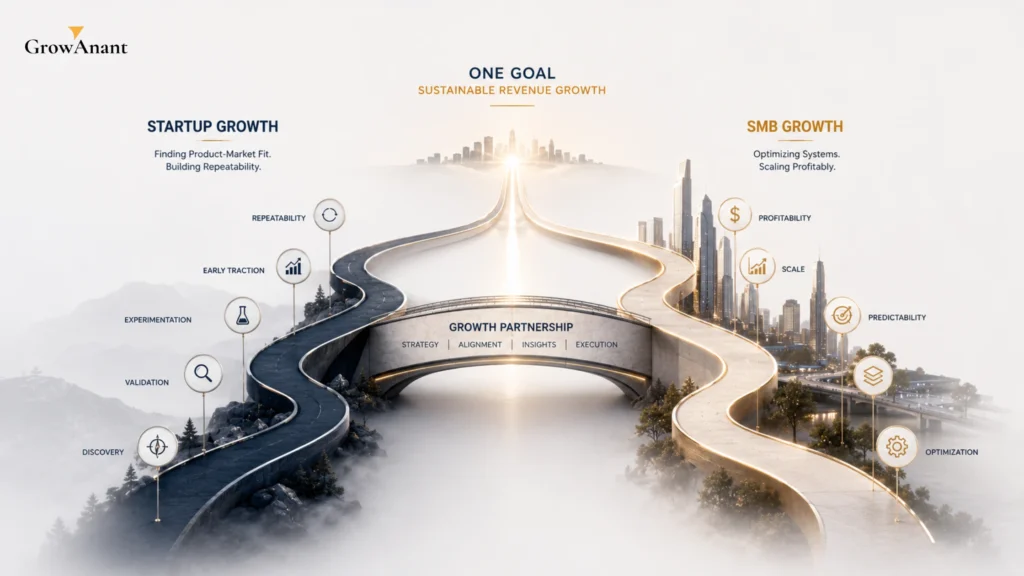
A startup searching for product-market fit requires a different growth system than an SMB seeking operational efficiency and scalable demand generation.
Understanding these differences allows leadership teams to allocate resources more effectively, improve customer acquisition performance, and create a clearer path toward sustainable revenue growth.
Growth constraints by company stage
Growth consulting is ultimately about removing constraints.
The challenge is that those constraints evolve as companies mature.
The same recommendation can be highly effective for one business and completely ineffective for another.
Startup growth constraints
Startups typically struggle with uncertainty.
The most common questions include:
- Who is the ideal customer?
- What positioning resonates?
- Which acquisition channels work?
- Is there product-market fit?
- What messaging drives adoption?
- Which market segment should be prioritized?
This is why startup growth strategy consulting often focuses heavily on experimentation and validation.
Before scaling marketing investments, startups must establish confidence that customers genuinely want the solution.
For example, a B2B SaaS startup entering the U.S. market may require:
- go to market strategy consulting
- Customer discovery research
- ICP development
- Positioning refinement
- Demand generation testing
The objective is not immediate scale.
The objective is repeatability.
Many SaaS founders mistakenly increase marketing spend before validating acquisition economics. This often results in higher costs without predictable growth.
This is where SaaS growth consulting becomes particularly valuable.
SMB growth constraints
SMBs face a different reality.
Unlike startups, most SMBs already understand:
- Their customers
- Their services
- Their market
- Their revenue model
The challenge is usually operational rather than exploratory.
Common SMB growth constraints include:
- Revenue plateaus
- Weak demand generation systems
- Inconsistent lead quality
- Rising customer acquisition costs
- Poor marketing attribution
- Sales and marketing misalignment
This is why small business growth consulting frequently focuses on optimization.
Instead of validating a business model, the goal is improving performance.
For example, a professional services firm generating $5 million annually may struggle with inconsistent lead flow despite strong client retention.
The issue is not market demand.
The issue is creating a repeatable growth engine.
Growth Constraint Comparison
| Area | Startup | SMB |
| Primary Challenge | Uncertainty | Scalability |
| Revenue Stability | Low | Moderate |
| Growth Focus | Validation | Optimization |
| Marketing Priority | Learning | Efficiency |
| Sales Process | Evolving | Established |
| Key Objective | Product-Market Fit | Predictable Revenue |
Growth stage decision framework
Before pursuing any consulting engagement, leadership teams should ask:
✓ Is the business validating a market?
✓ Is the business scaling an existing model?
✓ Is customer acquisition repeatable?
✓ Are revenue forecasts reliable?
✓ Is growth constrained by strategy or execution?
The answers help determine whether growth strategy consulting should focus on discovery, optimization, or scale.
Budget, team, and timeline differences
Growth decisions are heavily influenced by available resources.
A strategy that works for a funded startup may be unrealistic for a small business operating with tighter margins.
Understanding these differences helps leaders prioritize effectively.
Budget considerations
Startups often invest heavily in future growth.
Funding may be allocated toward:
- Customer acquisition experiments
- Market validation
- Product adoption
- GTM development
The emphasis is often speed.
Many startups accept short-term inefficiency in exchange for accelerated learning.
By contrast, SMBs usually prioritize efficiency.
Their investments tend to focus on:
- Revenue predictability
- Lead quality
- Marketing ROI
- Operational scalability
This distinction influences consulting recommendations significantly.
For example:
A startup may benefit from:
- Rapid experimentation
- Market testing
- ICP refinement
An SMB may benefit from:
- Funnel optimization
- Revenue operations
- Demand generation systems
- Marketing attribution improvements
Organizations engaging revenue growth consulting services often generate stronger results when recommendations align with financial realities rather than theoretical growth models.
Team structure differences
Team maturity also influences growth strategy.
Startups frequently operate with lean teams.
A founder may oversee:
- Sales
- Marketing
- Partnerships
- Customer success
In this environment, growth systems must remain simple.
Complex processes often fail because there is insufficient operational capacity.
SMBs typically have more specialized functions.
They may include:
- Marketing managers
- Sales teams
- Operations leaders
- Customer support teams
The challenge becomes coordination rather than execution.
This is why many SMBs seek business growth consulting and growth consulting services USA focused on cross-functional alignment.
Timeline expectations
Time horizons differ significantly between startups and SMBs.
Startups often operate under pressure from:
- Investors
- Funding milestones
- Market opportunities
- Competitive threats
Growth initiatives may be evaluated over three to twelve months.
SMBs generally focus on longer-term sustainability.
Growth investments are often evaluated over:
- 12 months
- 24 months
- Multi-year horizons
Timeline Comparison
| Business Type | Typical Growth Horizon |
| Early Startup | 3–12 Months |
| Growth Startup | 6–18 Months |
| SMB | 12–36 Months |
| Mature Business | 24–48 Months |
The most effective consulting engagements align strategy with realistic timelines rather than artificial expectations.
Consulting engagement models by stage
Different stages require different consulting structures.
Not every company needs the same level of involvement.
The right model depends on business complexity, internal capabilities, and growth objectives.
Advisory model
Early-stage startups often benefit from advisory support.
Typical engagements include:
- startup consulting services USA
- Positioning strategy
- GTM planning
- Market validation
- Customer acquisition frameworks
The goal is helping leadership make better strategic decisions.
This approach works particularly well when uncertainty remains high.
Project-based consulting
Project-based consulting is useful when businesses face a specific growth challenge.
Examples include:
- growth roadmap consulting
- market entry strategy USA
- Funnel optimization
- Demand generation planning
- Sales process redesign
The focus is solving a clearly defined problem.
This model is common among both startups and SMBs.
Fractional growth leadership
As organizations grow, strategic complexity increases.
Many businesses have execution teams but lack senior growth leadership.
In these situations, fractional growth leadership becomes valuable.
Responsibilities often include:
- Growth planning
- Revenue forecasting
- Demand generation oversight
- Marketing alignment
- Sales coordination
- Strategic prioritization
This model helps businesses access senior expertise without committing to a full-time executive hire.
Strategic growth partnership
The most comprehensive model is an ongoing growth partnership.
This approach typically combines:
- growth consulting services
- B2B marketing strategy consulting
- Revenue operations support
- Demand generation strategy
- GTM planning
- Growth system development
Many growth-stage companies eventually reach a point where isolated projects are insufficient.
Growth challenges become interconnected.
Marketing affects sales.
Sales affects retention.
Retention affects expansion revenue.
The need shifts from tactical execution to strategic coordination.
Consulting Model Comparison
| Model | Best For | Primary Outcome |
| Advisory | Early Startups | Strategic Clarity |
| Project-Based | Specific Challenges | Targeted Improvements |
| Fractional Leadership | Scaling Businesses | Growth Ownership |
| Strategic Partnership | Growth-Stage Companies | Sustainable Growth Systems |
Businesses exploring growth marketing services, B2B growth marketing agency support, or business strategy consulting USA often achieve stronger outcomes when consulting models align with organizational maturity.
Many growth-stage companies eventually discover that marketing performance alone does not create sustainable growth.
The real opportunity comes from connecting strategy, demand generation, customer acquisition, sales execution, and revenue accountability into a single system.
This is the philosophy followed by growth partners such as GrowAnant, where long-term growth is viewed as an operational system rather than a collection of marketing activities.
References
Source: Harvard Business Review
FAQs
Many SMBs benefit from growth consultants when growth becomes inconsistent, lead generation slows, customer acquisition costs rise, or revenue plateaus emerge. Consulting can help improve demand generation, strategic prioritization, operational efficiency, and revenue visibility.
Startups often benefit from consulting support before major scaling efforts begin. The ideal time is when leadership needs help validating positioning, developing a go-to-market strategy, refining customer acquisition models, entering new markets, or preparing for growth-stage expansion.