
Most businesses can tell you how much website traffic they generated last month.
Many know how many leads entered the funnel.
Some can even report advertising performance, email engagement, or social media reach.
Yet surprisingly few organizations can confidently answer a more important question:
“Which activities are actually driving revenue growth?”
This gap explains why many companies struggle with growth despite investing heavily in marketing, sales, and customer acquisition.
Metrics are not the problem.
Metric selection is.
Businesses often focus on numbers that are easy to measure rather than metrics that influence strategic decisions.
This is one reason organizations seek growth consulting services, business growth consulting, revenue growth consulting, and growth consulting services USA. Effective growth consulting helps leadership teams identify the metrics that matter most to business outcomes rather than marketing activity.
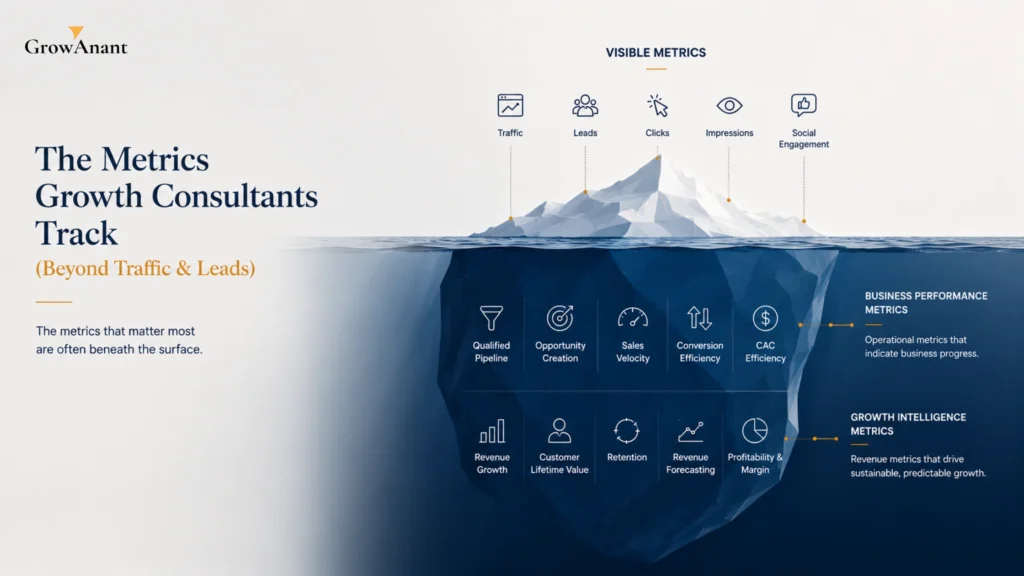
The most valuable metrics are not always the most visible.
Traffic, impressions, and lead volume can provide useful signals. However, sustainable growth requires a deeper understanding of pipeline performance, revenue efficiency, customer behavior, and business scalability.
For founders, CEOs, revenue leaders, and growth teams, understanding the difference between vanity metrics and growth metrics is critical.
Vanity Metrics vs Growth Metrics
A vanity metric is a measurement that looks impressive but provides limited insight into business performance.
A growth metric directly influences decision-making and helps predict future revenue outcomes.
The distinction matters because organizations often optimize what they measure.
If teams are rewarded for traffic, they will focus on traffic.
If they are rewarded for qualified pipeline and revenue efficiency, behaviors change significantly.
Common vanity metrics
Examples include:
- Website sessions
- Social media followers
- Post engagement
- Email subscribers
- Ad impressions
- Total leads generated
These metrics are not useless.
The problem arises when they become the primary indicators of success.
For example, a company may double website traffic while experiencing no improvement in pipeline creation or customer acquisition.
From a growth perspective, little has changed.
Characteristics of growth metrics
Effective business growth metrics generally share three characteristics:
- They connect directly to revenue.
- They support decision-making.
- They predict future performance.
This is why organizations pursuing growth strategy consulting, growth roadmap consulting, and business strategy consulting USA often restructure their reporting systems.
Instead of asking:
“How many visitors did we get?”
They begin asking:
- How much qualified pipeline was created?
- How efficiently are we acquiring customers?
- Which channels produce the highest-value opportunities?
- Where does revenue leakage occur?
Example: SaaS company
A SaaS business may generate:
- 100,000 monthly website visits
- 2,500 free trial signups
These numbers appear impressive.
However, if activation rates remain low and customer retention is poor, growth remains constrained.
The metrics that matter are:
- Activation rate
- Customer acquisition cost
- Trial-to-paid conversion rate
- Customer lifetime value
This is one reason SaaS growth consulting engagements focus heavily on revenue economics rather than traffic alone.
Example: Professional services firm
A consulting firm may generate hundreds of leads through content marketing.
However, if only a small percentage match the ideal customer profile, revenue impact remains limited.
In this scenario, growth depends more on lead quality than lead volume.
Organizations investing in marketing strategy for service businesses, B2B marketing strategy consulting, or lead generation for B2B services often discover that refining qualification criteria produces greater results than increasing lead generation efforts.
Quick comparison
| Vanity Metrics | Growth Metrics |
| Website Traffic | Pipeline Value |
| Social Followers | Opportunity Creation Rate |
| Email Subscribers | Customer Acquisition Cost |
| Ad Impressions | Sales Velocity |
| Total Leads | Qualified Pipeline |
| Click-Through Rate | Revenue Contribution |
The goal is not to eliminate vanity metrics.
The goal is to place them in the proper context.
They are indicators, not outcomes.
Revenue-Aligned KPI Table
Growth consultants typically organize metrics according to the customer journey and revenue process.
This helps leadership identify where growth slows and where investment should be prioritized.
Revenue-aligned KPI framework
| Growth Area | KPI | Why It Matters |
| Acquisition | Customer Acquisition Cost (CAC) | Measures efficiency of growth investments |
| Demand Generation | Marketing Qualified Leads (MQLs) | Indicates market interest |
| Sales Pipeline | Sales Qualified Leads (SQLs) | Measures lead quality |
| Opportunity Management | Opportunity-to-Customer Rate | Evaluates sales effectiveness |
| Revenue Growth | Monthly Recurring Revenue (MRR) | Tracks business expansion |
| Retention | Customer Retention Rate | Measures sustainability |
| Customer Value | Customer Lifetime Value (LTV) | Indicates long-term profitability |
| Velocity | Sales Cycle Length | Tracks conversion efficiency |
| Pipeline Health | Pipeline Coverage Ratio | Supports forecasting accuracy |
| Expansion | Revenue per Customer | Identifies growth opportunities |
Which metrics matter most?
The answer depends on business stage.
Early-stage startups
Organizations seeking startup growth strategy consulting or startup consulting services USA often prioritize:
- Customer acquisition cost
- Product adoption
- Lead quality
- Conversion rates
- Early retention
Growth-stage SaaS companies
Businesses pursuing go to market strategy consulting frequently focus on:
- MRR growth
- Pipeline creation
- Sales velocity
- Expansion revenue
- Customer retention
Professional services firms
Companies investing in business growth consulting often emphasize:
- Qualified opportunities
- Proposal conversion rates
- Average deal size
- Client retention
- Revenue forecasting
KPI hierarchy
An effective KPI system typically follows this structure:
| Level | Focus |
| Strategic Metrics | Revenue, Profitability, Retention |
| Operational Metrics | Pipeline, Opportunities, Conversion Rates |
| Tactical Metrics | Traffic, Engagement, Campaign Performance |
Many businesses reverse this hierarchy.
As a result, teams spend excessive time discussing activity while overlooking revenue outcomes.
This is a common challenge addressed by digital marketing consulting services, growth marketing services, and revenue growth consulting engagements.
How Consultants Prioritize Metrics
One of the most valuable contributions a growth consultant provides is metric prioritization.
Businesses today have access to enormous amounts of data.
The challenge is determining which data deserves attention.
The prioritization framework
Most growth consultants start with three questions:
- Does the metric influence revenue?
- Can the metric drive action?
- Does the metric predict future performance?
If the answer is no, the metric receives lower priority.
The growth systems approach
Organizations working with a B2B growth marketing agency, growth marketing agency USA, or demand generation agency often discover that metrics should be evaluated as part of a larger system.
For example:
Traffic alone means little.
Traffic plus conversion rates provides context.
Conversion rates plus pipeline value provides insight.
Pipeline value plus closed revenue supports decision-making.
This layered approach creates a clearer picture of business performance.
Metric prioritization checklist
Growth consultants frequently recommend tracking:
✓ Revenue growth rate
✓ Customer acquisition cost
✓ Customer lifetime value
✓ Pipeline value
✓ Opportunity conversion rate
✓ Sales cycle length
✓ Customer retention
✓ Revenue per customer
These metrics typically provide stronger guidance than channel-specific vanity indicators.
Real-world example
A B2B software company reports:
- 60% traffic growth
- 40% increase in leads
Leadership initially views performance positively.
However, deeper analysis reveals:
- Opportunity creation is flat
- CAC increased significantly
- Retention declined
- Pipeline growth slowed
Without revenue-aligned metrics, leadership might have continued investing in ineffective acquisition efforts.
The correct decision becomes visible only when growth metrics are prioritized.
Why growth consultants focus on fewer metrics
More data does not necessarily improve decision-making.
In many cases, it creates confusion.
The strongest growth organizations monitor a focused set of metrics that align directly with:
- Revenue
- Pipeline
- Customer value
- Retention
- Efficiency
This is why firms like GrowAnant often build reporting frameworks around business outcomes rather than marketing outputs. Growth becomes easier to manage when leadership teams share a common understanding of what success actually looks like.
Whether a company is evaluating growth consulting, partnering with a digital growth agency, investing in performance marketing services USA, or improving B2B lead generation services, the most effective metrics are the ones that connect activity to revenue.
References
Source: Harvard Business Review
FAQs
There is no single KPI that applies to every business. However, revenue growth, customer acquisition cost, customer lifetime value, pipeline creation, and retention are among the most important metrics because they directly influence long-term business performance.
Strategic metrics should typically be reviewed monthly and quarterly, while operational metrics may require weekly monitoring. The appropriate cadence depends on business stage, sales cycle length, and growth objectives.