
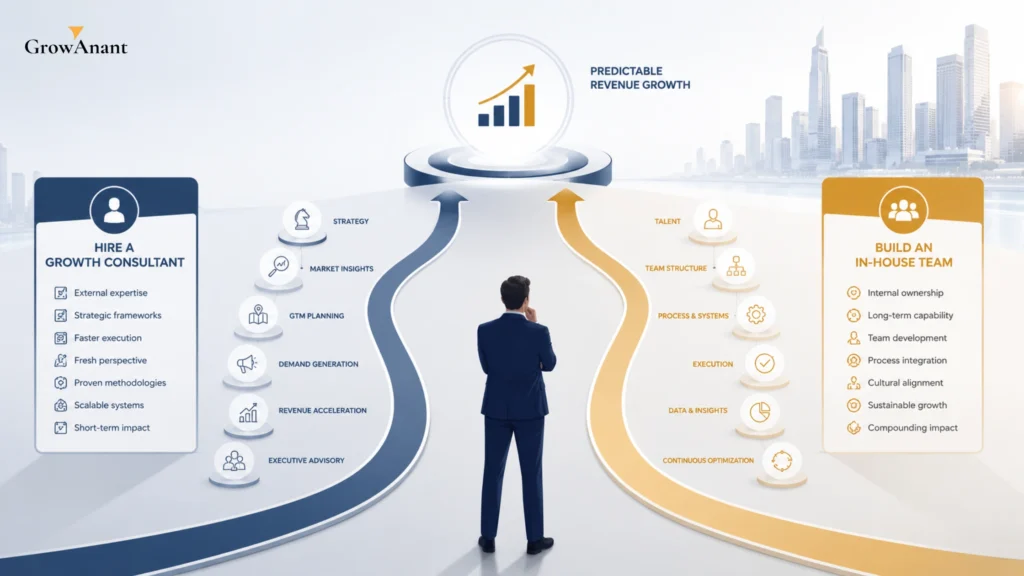
Growth challenges rarely appear because businesses lack effort.
More often, growth slows because leadership lacks the expertise, systems, alignment, or strategic direction required to scale efficiently.
Founders frequently face an important decision:
Should they invest in business growth consulting or build an internal growth team?
The answer depends on growth stage, business complexity, hiring capacity, revenue goals, and speed requirements.
Both approaches can work. However, each creates different advantages, risks, costs, and operational realities.
Companies evaluating growth consulting services, revenue growth consulting, growth consulting services USA, and internal hiring options should focus on business outcomes rather than organizational preferences.
The goal is not choosing the cheapest option.
The goal is creating predictable growth, stronger execution, and scalable revenue systems.
Cost comparison table
One of the most common assumptions is that hiring internally is always more cost-effective.
In practice, the total investment often extends far beyond salary.
Recruitment, onboarding, management overhead, benefits, technology, training, and ramp-up time all contribute to actual costs.
Consultant vs In-House Cost Framework
| Factor | Growth Consultant | Full-Time Hire |
| Recruitment Cost | Minimal | High |
| Onboarding Time | Fast | Moderate to High |
| Specialized Expertise | Immediate | Limited Initially |
| Benefits & Overhead | None | Significant |
| Flexibility | High | Low |
| Long-Term Commitment | Optional | Required |
| Speed to Impact | Faster | Slower |
Hidden Costs of Internal Hiring
Businesses often underestimate:
- Recruiting costs
- Training investments
- Ramp-up periods
- Management requirements
- Turnover risks
For example, a SaaS company hiring a Head of Growth may spend months recruiting before seeing meaningful execution begin.
Meanwhile, experienced consultants can often begin contributing immediately.
When In-House Makes More Sense
Internal hiring is often appropriate when:
✓ Growth processes are established
✓ Long-term execution volume is high
✓ Budget supports senior leadership roles
✓ Specialized expertise is needed daily
✓ Growth priorities are stable
When Consulting Makes More Sense
Consulting often delivers more value when:
✓ Growth challenges require immediate expertise
✓ Revenue goals are urgent
✓ Teams need strategic direction
✓ New markets are being explored
✓ Internal leadership gaps exist
This is particularly common for businesses investing in growth strategy consulting, go to market strategy consulting, startup growth strategy consulting, and market entry strategy USA initiatives.
Speed vs control trade-offs
Every growth decision involves balancing speed and control.
Hiring internally typically increases organizational control.
Consulting often increases speed.
The challenge is understanding which factor matters most at a given stage.
Speed vs Control Comparison
| Priority | Consultant Advantage | In-House Advantage |
| Speed | High | Moderate |
| Flexibility | High | Moderate |
| Specialized Knowledge | High | Variable |
| Organizational Control | Moderate | High |
| Long-Term Ownership | Moderate | High |
| Scalability | High | Moderate |
Why Speed Matters
Many businesses experience:
- Revenue plateaus
- Lead generation issues
- Weak positioning
- Market expansion challenges
Waiting six months to hire and onboard a new leader may delay critical growth initiatives.
Consultants frequently accelerate:
- Market assessments
- Funnel optimization
- Demand generation planning
- Revenue operations improvements
This is why many organizations leverage digital growth agency, business strategy consulting USA, and growth roadmap consulting support during key growth transitions.
Why Control Matters
Internal teams provide:
- Organizational continuity
- Cultural alignment
- Long-term ownership
- Day-to-day execution consistency
For mature businesses with predictable growth engines, this can create significant advantages.
Decision Framework
Choose consulting first when:
- Growth problems need immediate solutions
- Strategic clarity is missing
- Specialized expertise is unavailable internally
- Revenue pressure is high
Choose hiring first when:
- Growth systems already exist
- Long-term execution demand is consistent
- Leadership bandwidth is available
Example
A professional services company entering the U.S. market may benefit from short-term consulting expertise in:
- Positioning
- Messaging
- Market validation
- Demand generation
Building a full internal team before validating the strategy can increase risk and delay learning.
Hybrid growth models
The most successful organizations often avoid choosing between consulting and internal hiring.
Instead, they combine both.
This creates a hybrid model that balances strategic expertise with operational execution.
What a Hybrid Model Looks Like
| Function | Consultant Role | Internal Team Role |
| Growth Strategy | Lead | Support |
| Demand Generation | Guide | Execute |
| Revenue Planning | Lead | Support |
| Campaign Management | Advise | Execute |
| Reporting | Shared | Shared |
Why Hybrid Models Work
Consultants bring:
- Strategic expertise
- External perspective
- Proven frameworks
- Cross-industry insights
Internal teams provide:
- Business knowledge
- Customer familiarity
- Daily execution
- Organizational continuity
Together, the combination often produces stronger outcomes than either model alone.
Example: B2B SaaS Company
A SaaS company may engage consultants for:
- SaaS growth consulting
- B2B marketing strategy consulting
- Revenue modeling
- Market expansion planning
While internal teams handle:
- Content creation
- Campaign execution
- Sales development
- Customer success
Example: Professional Services Firm
A consulting, legal, accounting, or technology services business may use external support for:
- professional services marketing agency strategy
- growth marketing services
- demand generation agency planning
- lead generation for B2B services
Internal teams remain responsible for:
- Relationship management
- Proposal development
- Service delivery
Hybrid Growth Checklist
✓ Internal execution team exists
✓ Leadership seeks strategic guidance
✓ Revenue growth targets are increasing
✓ New markets or services are launching
✓ Specialized expertise is required
✓ Hiring timelines are too slow
Many growth-stage organizations discover that they do not need to choose between consultants and internal teams. Growth partners such as GrowAnant often operate as strategic growth leadership resources that strengthen existing teams while helping companies build scalable growth systems, stronger demand generation capabilities, and more predictable revenue outcomes.
References
Source: Harvard Business Review
FAQs
Not always. However, consultants often reduce recruiting costs, onboarding time, and leadership gaps while providing immediate access to specialized expertise. The overall value depends on business needs, growth stage, and the complexity of the challenges being addressed.
Yes. In fact, the most effective consulting engagements are collaborative. Consultants provide strategic guidance, frameworks, and expertise while internal teams maintain ownership of execution, operations, and ongoing business activities.