
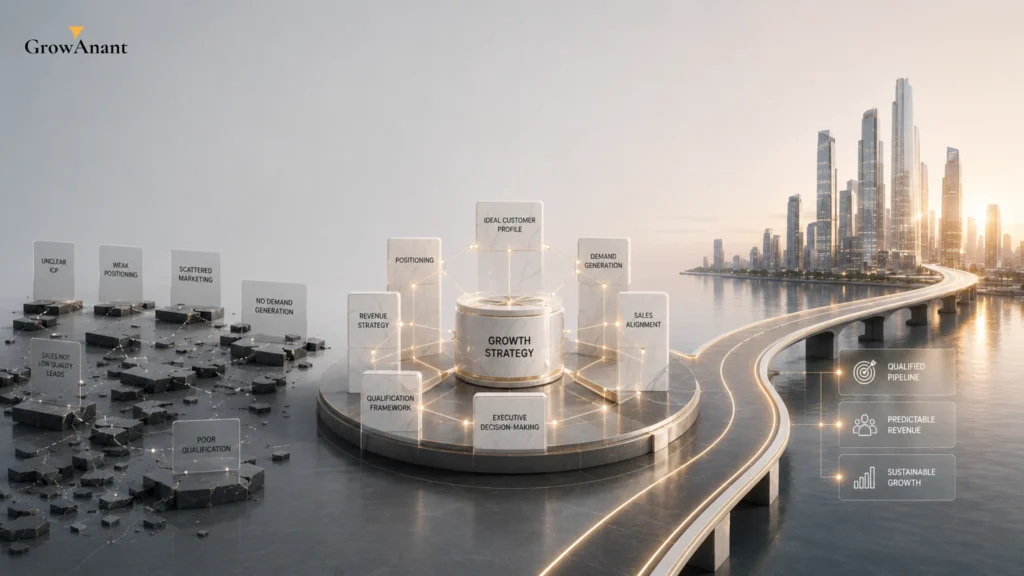
Many founders assume that generating more leads automatically results in more revenue. In reality, many B2B Lead Generation Services campaigns underperform because they optimize for lead quantity instead of revenue quality. Organizations often invest heavily in advertising, outbound outreach, or gated content without first establishing a clear demand generation strategy, a well-defined Ideal Customer Profile (ICP), or a repeatable qualification process.
Successful B2B growth requires more than isolated campaigns. It depends on aligning growth marketing services, lead generation for B2B services, sales execution, positioning, and customer acquisition around measurable business outcomes. Whether you are a SaaS company, professional services firm, or founder expanding into the U.S. market, sustainable growth comes from building systems that consistently convert market demand into qualified pipeline and revenue.
Many businesses working with growth consulting services or a strategic growth partner such as GrowAnant discover that predictable growth begins long before a prospect submits a form. It starts with understanding buyers, creating demand, and connecting every marketing activity to revenue.
Why lead generation fails
The biggest misconception in B2B marketing is that lead generation alone drives growth. In reality, weak results are usually symptoms of deeper strategic issues.
Common reasons campaigns fail
| Business Challenge | Revenue Impact | Strategic Solution |
| Poor targeting | Low-quality opportunities | Clearly define your ICP and buying committee |
| Generic messaging | Low engagement and conversions | Create differentiated value propositions for each audience |
| Weak offers | Few qualified inquiries | Offer resources or consultations that solve real business problems |
| No demand generation | Limited market awareness | Invest in education, thought leadership, and brand credibility |
| Sales and marketing misalignment | Pipeline leakage | Establish shared goals, qualification criteria, and reporting |
| No measurement framework | Budget inefficiency | Track pipeline contribution instead of only lead volume |
The lead volume trap
Many companies celebrate generating hundreds of marketing leads while overlooking a more important question:
How many became qualified opportunities that contributed to revenue?
A campaign producing 50 highly qualified buyers often delivers greater business value than one generating 500 unqualified contacts.
For example, a U.S.-focused SaaS startup may spend heavily on paid advertising and generate a large number of ebook downloads. However, if those contacts are students, consultants, or businesses outside its target market, sales teams waste time pursuing opportunities that were never likely to convert.
This is why modern B2B marketing emphasizes revenue contribution rather than marketing activity alone.
Characteristics of effective lead generation
Successful organizations build campaigns around:
- Clearly defined buyer personas
- Accurate Ideal Customer Profiles
- Strong positioning
- Consistent messaging
- Multi-channel nurturing
- Marketing and sales alignment
- Continuous optimization based on revenue data
These elements transform B2B Lead Generation Services from isolated campaigns into predictable growth systems.
Executive checklist
Before increasing marketing spend, ask:
- Have we clearly defined our ICP?
- Do we understand our buyers’ decision-making process?
- Is our messaging differentiated from competitors?
- Are marketing and sales using the same qualification criteria?
- Can we measure pipeline contribution and revenue impact?
If several answers are “no,” scaling campaigns will likely increase costs without improving outcomes.
Poor ICP definition
An Ideal Customer Profile (ICP) defines the organizations most likely to become successful long-term customers. Without a precise ICP, even the best growth marketing agency USA or B2B growth marketing agency will struggle to produce consistent results.
Why ICP matters
A strong ICP helps organizations:
- Improve campaign targeting
- Increase lead quality
- Reduce acquisition costs
- Improve sales efficiency
- Increase conversion rates
- Create more relevant messaging
Without this clarity, businesses often market to audiences that lack urgency, budget, authority, or strategic fit.
Example
Consider two cybersecurity providers.
Company A targets “all businesses.”
Company B targets U.S. manufacturing companies with 100 to 1,000 employees, internal IT teams, compliance requirements, and aging infrastructure.
Although Company B addresses a smaller audience, its campaigns are significantly more relevant, enabling higher engagement and stronger pipeline quality.
ICP development framework
| Component | Questions to Answer |
| Industry | Which industries receive the greatest value? |
| Company Size | What employee or revenue range is ideal? |
| Geography | Which markets offer the best opportunities? |
| Decision Makers | Who approves purchasing decisions? |
| Business Challenges | What strategic problems need solving? |
| Growth Stage | Startup, SMB, mid-market, or enterprise? |
| Buying Triggers | What events create urgency to purchase? |
Strategic implementation
Organizations investing in digital marketing consulting services, business growth consulting, or growth strategy consulting should review and refine their ICP regularly as products evolve, markets shift, and customer needs change.
Rather than pursuing every possible opportunity, successful growth organizations prioritize customer fit over lead volume. This approach supports stronger revenue growth, improves sales productivity, and creates a more predictable pipeline for long-term business growth.
Wrong messaging
Many organizations assume poor campaign performance is caused by weak advertising or insufficient traffic. In reality, the problem often begins with messaging that fails to resonate with decision-makers.
Executives rarely purchase products because of features alone. They invest in solutions that reduce risk, improve efficiency, accelerate growth, or solve pressing business challenges. When messaging focuses only on capabilities instead of outcomes, engagement declines regardless of channel.
For companies investing in B2B Lead Generation Services, effective messaging should answer three questions immediately:
- Why should buyers care?
- Why should they trust you?
- Why should they act now?
Signs your messaging needs improvement
| Warning Sign | Business Impact | Recommended Action |
| Generic value proposition | Low engagement | Differentiate based on measurable business outcomes |
| Feature-heavy content | Poor conversion rates | Focus on customer problems and expected business impact |
| Same message for every audience | Low relevance | Personalize messaging by industry, role, and buying stage |
| No competitive positioning | Difficult differentiation | Clearly communicate why your approach is different |
| Weak calls-to-action | Fewer qualified inquiries | Offer meaningful next steps such as assessments or strategic consultations |
Business example
A professional services firm advertises:
“We provide marketing solutions for businesses.”
A stronger message would be:
“We help growth-stage B2B companies build predictable revenue systems by aligning positioning, demand generation, sales enablement, and measurable pipeline growth.”
The second statement addresses business outcomes rather than generic services, making it significantly more compelling for founders and revenue leaders.
Messaging framework
Build messaging around:
- Target audience
- Primary business challenge
- Desired business outcome
- Competitive differentiation
- Evidence or credibility
- Clear next action
Organizations working with growth strategy consulting, business growth consulting, or a digital growth agency often discover that refining positioning improves campaign performance without increasing advertising budgets.
Weak offer
Even when targeting and messaging are strong, campaigns frequently underperform because the offer provides little value to potential buyers.
An offer should reduce friction while helping prospects solve an immediate business problem. Asking executives to schedule a sales meeting without first demonstrating expertise often creates unnecessary resistance.
Examples of high-value B2B offers
- Industry benchmark reports
- GTM readiness assessments
- Pipeline health audits
- Growth opportunity assessments
- Revenue strategy workshops
- Executive webinars
- Practical implementation guides
These resources establish credibility before asking prospects to engage with sales.
Offer comparison
| Weak Offer | Strong Offer |
| Contact us | Free GTM assessment |
| Schedule a demo | Personalized revenue growth roadmap |
| Download brochure | Executive playbook solving a business challenge |
| Generic consultation | Industry-specific strategic workshop |
Offer evaluation checklist
Before launching a campaign, ask:
- Does the offer solve a meaningful business challenge?
- Is it relevant to the target decision-maker?
- Does it build trust before requesting a sales conversation?
- Does it differentiate us from competitors?
- Does it naturally move prospects toward the next buying stage?
The strongest growth marketing services focus on helping buyers make better decisions, not simply collecting contact information.
No demand generation
Many businesses attempt to generate leads before creating market demand.
This is one of the most common reasons lead generation for B2B services produces inconsistent results.
Demand generation creates awareness, credibility, and buyer confidence before prospects enter the sales process. Lead generation then captures that existing interest.
Without demand generation:
- Buyers may not recognize the problem.
- They may not know your company.
- They may not trust your expertise.
- Competitors often become the default choice.
Demand generation vs lead generation
| Demand Generation | Lead Generation |
| Creates market awareness | Captures existing demand |
| Builds authority | Collects qualified inquiries |
| Educates buyers | Converts interested prospects |
| Supports long-term pipeline growth | Supports short-term opportunity creation |
| Improves brand preference | Improves sales pipeline volume |
The highest-performing organizations invest in both rather than treating them as competing strategies.
Components of an effective demand generation program
A comprehensive demand generation agency approach typically includes:
- Educational content
- Thought leadership
- SEO
- Industry research
- Executive webinars
- Customer success stories
- Organic social presence
- Strategic email nurturing
- Retargeting campaigns
These initiatives help buyers become familiar with your expertise long before they request a conversation.
Practical framework
An effective B2B revenue engine follows this sequence:
- Build awareness.
- Educate the market.
- Establish credibility.
- Capture qualified demand.
- Nurture opportunities.
- Enable sales.
- Measure pipeline contribution.
- Optimize continuously.
Businesses partnering with growth consulting services, B2B growth marketing agency teams, or strategic advisors such as GrowAnant often prioritize demand generation before aggressively scaling paid acquisition. This approach strengthens brand authority, improves lead quality, and creates a more predictable pipeline instead of relying solely on short-term campaign performance.
Sales alignment
Even the most effective B2B Lead Generation Services campaigns struggle when marketing and sales operate independently. Marketing may celebrate lead volume while sales focuses on revenue, creating different definitions of success and resulting in pipeline leakage.
High-performing organizations treat marketing and sales as a unified revenue team with shared objectives, common metrics, and a consistent qualification process.
Signs of poor alignment
| Challenge | Business Impact | Improvement Strategy |
| Different definitions of a qualified lead | Low conversion rates | Establish shared MQL and SQL criteria |
| Limited campaign feedback | Repeated targeting mistakes | Schedule regular marketing and sales reviews |
| Slow lead follow-up | Reduced conversion opportunities | Define response time SLAs |
| Separate reporting dashboards | Poor revenue visibility | Build unified pipeline reporting |
| Marketing focused on lead volume | Misaligned business priorities | Measure pipeline and revenue contribution |
Revenue alignment framework
For sustainable revenue growth, both teams should agree on:
- Ideal Customer Profile (ICP)
- Buyer personas and buying committee
- Lead qualification criteria
- Pipeline stage definitions
- Attribution model
- Revenue-focused KPIs
- Closed-loop reporting
- Regular optimization meetings
Business example
A B2B SaaS company generated over 800 leads each month through paid campaigns. Despite the high volume, sales struggled to achieve quota because many prospects lacked purchasing authority or immediate business need.
After refining qualification criteria, improving messaging, and aligning marketing with sales, lead volume declined but sales-qualified opportunities increased significantly. The result was a healthier pipeline and more efficient use of marketing budget.
Organizations working with growth consulting services, business growth consulting, or a strategic partner such as GrowAnant often prioritize sales and marketing alignment before increasing campaign investment.
Building predictable lead generation
Predictable growth is not created by continuously increasing advertising budgets. It is built through repeatable systems that consistently attract, qualify, nurture, and convert the right buyers.
The strongest B2B growth marketing agency strategies combine demand generation, growth marketing services, B2B marketing, sales enablement, and measurement into one integrated growth engine.
Predictable pipeline framework
| Stage | Primary Objective | Example Activities |
| Attract | Build awareness | SEO, educational content, webinars, thought leadership |
| Engage | Generate interest | Industry reports, case studies, newsletters |
| Convert | Capture qualified opportunities | Assessments, demos, consultations |
| Nurture | Build buying confidence | Email sequences, remarketing, sales enablement |
| Close | Support revenue generation | Sales process optimization and executive alignment |
| Expand | Increase customer value | Upselling, cross-selling, customer advocacy |
Predictable lead generation checklist
Before scaling campaigns, ensure your business has:
- Clearly defined ICP
- Differentiated positioning
- Revenue-focused messaging
- High-value offers
- A structured demand generation program
- Sales and marketing alignment
- Consistent lead nurturing
- Revenue attribution reporting
- Continuous campaign optimization
- Executive ownership of growth strategy
When these elements work together, lead generation for B2B services becomes part of a scalable revenue system instead of a series of disconnected campaigns.
References
- HubSpot
- Gartner
https://www.gartner.com/en/marketing
FAQs
Poor conversion rates are often caused by weak ICP definition, ineffective messaging, low-value offers, inadequate lead nurturing, or poor alignment between marketing and sales. Improving these areas typically has a greater impact than simply generating more leads.
Poor lead quality usually results from targeting the wrong audience, broad campaign criteria, generic messaging, or generating leads before creating sufficient market demand. Strong demand generation and clearly defined qualification criteria help improve lead quality.
Start by refining your Ideal Customer Profile, strengthening your value proposition, creating educational content, aligning marketing with sales, and measuring pipeline contribution rather than focusing only on lead volume. Combining growth marketing services with a long-term demand generation strategy creates more sustainable results.
Predictable lead generation is a repeatable process that consistently produces qualified opportunities through aligned targeting, B2B marketing, demand generation, sales collaboration, ongoing optimization, and revenue-focused measurement. Instead of relying on one-off campaigns, it builds a scalable system that supports long-term business growth.