
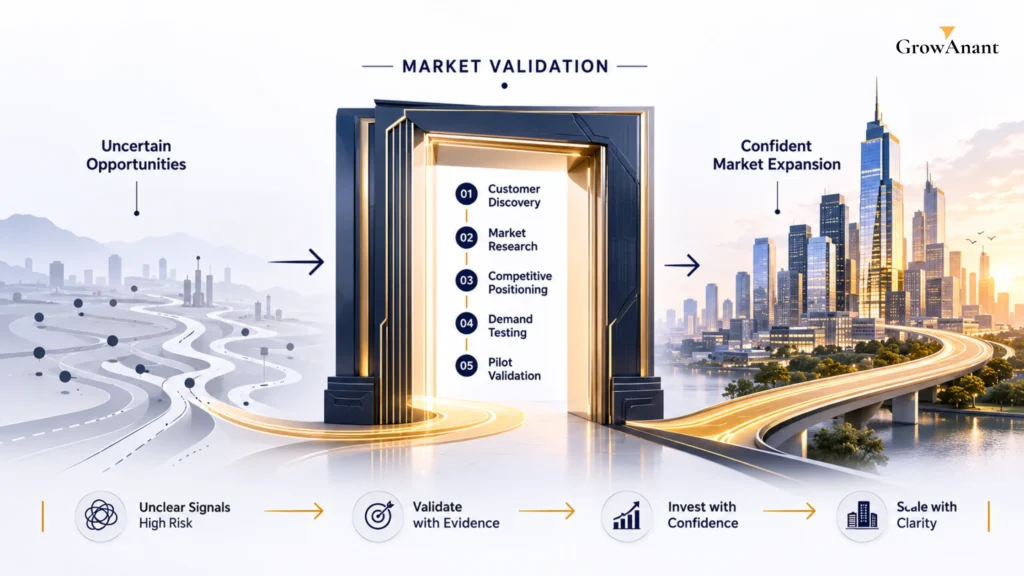
Entering a new market can unlock significant opportunities, but expansion without validation often leads to wasted budgets, delayed growth, and missed revenue targets. Effective Business Strategy Consulting USA emphasizes validating assumptions before making major investments. Whether a company is planning a market entry strategy USA, launching a new SaaS product, or expanding professional services into a different region, understanding real customer demand is essential.
Many organizations invest heavily in marketing, sales hiring, or localization before confirming that their solution truly fits the market. Successful businesses instead combine growth strategy consulting, structured customer research, and measurable experiments to reduce risk. Rather than relying on assumptions, they build evidence that supports confident decision-making and long-term business growth.
Why validation matters
Market validation is the process of confirming that a specific audience has a genuine need, is willing to pay for a solution, and can be reached through a scalable go-to-market approach. It forms the foundation of successful go to market strategy consulting and helps organizations avoid expensive strategic mistakes.
Without validation, businesses often experience:
- Low customer adoption
- Poor conversion rates
- Inefficient marketing spend
- Long sales cycles
- Weak product-market alignment
- Difficulty achieving predictable revenue
For founders and executives, validation is not simply a marketing exercise. It is a strategic decision-making process that influences pricing, positioning, messaging, sales strategy, and future investments.
Market Expansion Without Validation vs With Validation
| Without Validation | With Validation |
| Decisions based on assumptions | Decisions based on customer evidence |
| Broad targeting | Clearly defined ideal customer profile |
| High acquisition costs | More efficient customer acquisition |
| Weak positioning | Strong market differentiation |
| Increased expansion risk | Reduced strategic risk |
For example, a B2B SaaS company expanding from Europe into the United States may assume that the same messaging will resonate with American buyers. However, interviews may reveal that U.S. prospects prioritize integration capabilities and measurable ROI over technical features. Those insights can reshape positioning before significant marketing investments are made.
Many businesses engaging growth consulting services or business growth consulting begin with market validation because it creates a stronger foundation for every future growth initiative.
Customer interviews
Customer interviews remain one of the most valuable methods for validating a new market. Unlike surveys that often capture surface-level opinions, structured interviews uncover buying motivations, operational challenges, decision-making processes, and objections that influence purchasing behavior.
The objective is not to sell a product. The goal is to understand how potential customers think and whether your solution addresses a meaningful business problem.
Questions to Explore During Customer Interviews
| Objective | Example Questions |
| Identify pain points | What business challenge are you trying to solve? |
| Understand current solutions | How do you solve this problem today? |
| Measure urgency | How important is solving this issue this year? |
| Evaluate purchasing behavior | Who participates in buying decisions? |
| Assess willingness to pay | What business impact would justify investment? |
For example:
- A startup exploring SaaS growth consulting opportunities can interview founders to understand why existing software fails to meet operational needs.
- A consulting firm planning a market entry strategy USA can speak with U.S.-based executives to learn how vendor selection differs from other regions.
- A professional services company can validate whether compliance expertise, industry specialization, or faster implementation is the strongest differentiator.
Best Practices for Effective Customer Interviews
✔ Speak with decision-makers rather than general users.
✔ Include prospects from different company sizes and industries.
✔ Focus on understanding existing workflows before discussing your solution.
✔ Look for recurring themes instead of isolated opinions.
✔ Document insights that influence positioning, pricing, and B2B marketing strategy consulting decisions.
Validation interviews also help identify the language customers naturally use when describing their challenges. Those insights improve website messaging, sales conversations, and future demand generation campaigns while strengthening overall growth strategy.
When performed consistently, customer interviews reduce uncertainty and provide the evidence needed to move into competitive analysis and demand testing with greater confidence.
Competitor analysis
Understanding competitors goes beyond identifying companies that offer similar products or services. Effective competitor analysis reveals how the market is positioned, where customer expectations are evolving, and which opportunities remain underserved. As part of Business Strategy Consulting USA, this step helps businesses refine positioning before investing in sales, marketing, or expansion.
Rather than copying competitors, focus on identifying gaps where your business can create a stronger value proposition.
Competitor Analysis Framework
| Area | Questions to Evaluate |
| Positioning | What problems do competitors emphasize? |
| Pricing | How do they structure pricing and packaging? |
| Target audience | Which industries or buyer personas are they targeting? |
| Messaging | What outcomes do they promise customers? |
| GTM channels | Which acquisition channels generate visibility? |
| Customer feedback | What do reviews highlight as strengths and weaknesses? |
For example, a company offering startup consulting services USA may discover that competitors focus heavily on fundraising support while offering limited guidance on execution. Positioning around implementation, measurable growth systems, and ongoing strategic leadership creates a clearer competitive advantage.
Combining competitor insights with business growth consulting helps organizations differentiate instead of competing solely on price.
Demand testing
After validating customer problems and evaluating competitors, the next step is testing whether the market is willing to engage before making major investments.
Demand testing measures actual customer behavior instead of relying on assumptions. This stage is central to growth strategy consulting because real actions provide stronger evidence than opinions.
Common demand validation methods include:
- Landing pages with clear value propositions
- Search advertising targeting specific buyer intent
- LinkedIn campaigns for executive audiences
- Webinar registrations
- Early-access or waitlist programs
- Industry newsletters
- Product demo requests
Demand Testing Checklist
✔ Define one target audience.
✔ Test one core value proposition.
✔ Measure qualified inquiries instead of website traffic alone.
✔ Compare messaging variations.
✔ Evaluate cost per qualified opportunity rather than lead volume.
A B2B SaaS company entering the U.S. market may run two campaigns targeting operations leaders and IT executives separately. Even if both campaigns generate similar traffic, one audience may produce significantly more qualified meetings. Those insights improve future go to market strategy consulting decisions while reducing acquisition risk.
Many organizations working with a digital growth agency or growth consulting services USA use short validation campaigns before committing larger marketing budgets.
Pilot launches
A pilot launch is a controlled market introduction designed to validate sales processes, customer adoption, pricing, and operational readiness before full-scale expansion.
Instead of launching nationwide, successful companies often begin with a focused segment, industry, or geographic region.
Pilot Launch Roadmap
- Select a clearly defined customer segment.
- Launch with a limited offering.
- Measure customer engagement and conversion.
- Collect structured customer feedback.
- Refine messaging, pricing, onboarding, and sales processes.
- Expand after consistent validation.
For example:
- A cybersecurity provider entering the U.S. market may initially target healthcare organizations before expanding into manufacturing and financial services.
- A founder-led SaaS business may begin with 20 pilot customers to validate onboarding, retention, and pricing before investing in broader B2B marketing initiatives.
- A professional services company may launch within one metropolitan area to confirm demand before pursuing national expansion.
Growth partners such as GrowAnant often recommend phased pilot launches because they reduce uncertainty while creating measurable learning opportunities. Rather than accelerating every activity at once, businesses refine their growth roadmap consulting strategy through real customer feedback and performance data.
A successful pilot should answer one critical question:
Can this market consistently generate qualified customers through a repeatable and scalable growth system?
Measuring traction
Market validation is only valuable if businesses measure outcomes against clear success criteria. Traction demonstrates whether customer interest can evolve into sustainable revenue and whether expansion should continue, pause, or be refined.
Instead of focusing only on website visits or impressions, leadership teams should monitor indicators that reflect commercial viability.
Key Metrics for Measuring Traction
| Metric | Why It Matters |
| Qualified pipeline | Indicates whether the target market contains high-fit opportunities |
| Customer acquisition cost (CAC) | Measures the efficiency of expansion efforts |
| Conversion rate | Shows how effectively prospects move through the buying journey |
| Sales cycle length | Reveals whether the buying process is realistic and scalable |
| Customer retention | Confirms that customers continue finding value after purchase |
| Revenue per customer | Evaluates long-term commercial potential |
Market Validation Decision Framework
| Result | Recommended Action |
| Strong demand + efficient acquisition | Scale investment confidently |
| Strong demand + weak conversion | Improve positioning, pricing, or sales process |
| Low demand + positive customer feedback | Refine ICP and messaging before expanding |
| Low demand + poor engagement | Reassess market selection before additional investment |
Founders should avoid expanding simply because early marketing campaigns generate traffic. Sustainable growth comes from evidence that customers buy, remain engaged, and generate profitable revenue over time.
Businesses that adopt a structured validation process make stronger investment decisions and reduce the likelihood of costly market-entry mistakes. Strategic partners such as GrowAnant help organizations combine research, testing, and growth consulting services into repeatable growth systems that support long-term expansion rather than one-time launches.
References
- Harvard Business Review
https://hbr.org - U.S. Small Business Administration
https://www.sba.gov
FAQs
Validate a new market by combining customer interviews, competitor analysis, demand testing, and pilot launches. The goal is to confirm that customers have a genuine problem, are willing to pay for a solution, and can be reached through a scalable go-to-market strategy before making significant investments.
Yes. Testing before expanding reduces financial risk and provides evidence that your positioning, pricing, and customer acquisition strategy work in the target market. Pilot campaigns and limited launches often reveal valuable insights that improve future expansion decisions.
MVP (Minimum Viable Product) validation is the process of launching the simplest version of a product or service to determine whether customers find it valuable enough to engage, purchase, and provide meaningful feedback before full-scale development or expansion.
Research is sufficient when you have consistent evidence from multiple sources, including customer interviews, competitor analysis, demand testing, and early sales results. Rather than aiming for perfect certainty, businesses should gather enough validated insights to make informed, lower-risk growth decisions.