
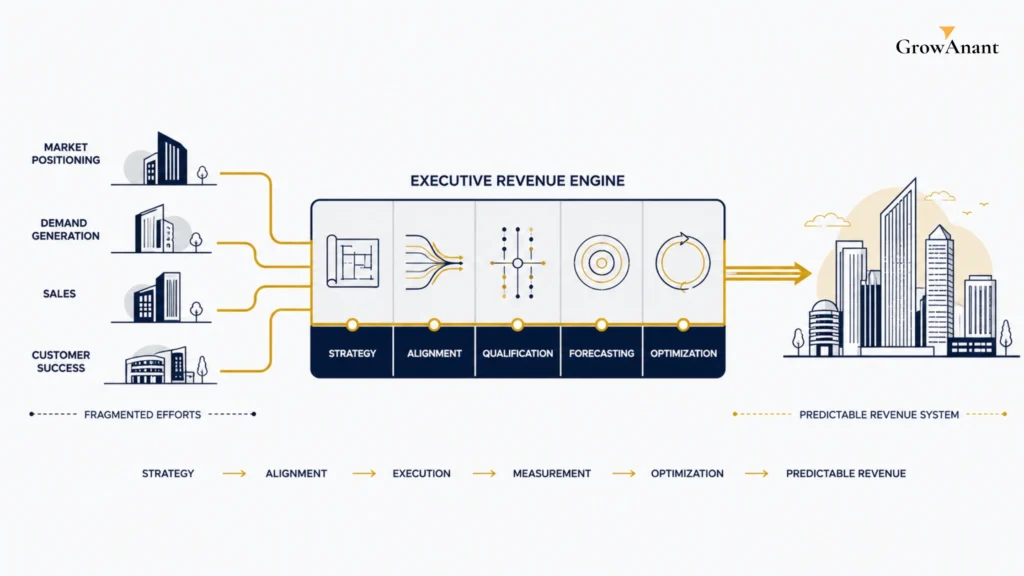
Predictable revenue is rarely the result of isolated marketing campaigns or short-term sales initiatives. Sustainable growth comes from building repeatable systems that consistently generate demand, qualify opportunities, and convert customers. Fractional growth leadership enables growing businesses to establish these systems without immediately hiring a full-time executive.
Whether a company is scaling a SaaS platform, expanding professional services, or entering new markets, experienced leaders help align growth systems, marketing, sales, and revenue strategy around measurable business outcomes. Through revenue growth consulting, structured planning, and cross-functional leadership, organizations reduce uncertainty and create a more consistent path toward business growth.
Revenue Systems Explained
A revenue growth system is a structured framework that connects demand generation, sales execution, customer experience, and performance measurement into one coordinated process. Instead of treating departments as separate functions, a revenue system ensures that every activity contributes toward predictable business outcomes.
Unlike traditional approaches where marketing focuses only on lead volume and sales focuses only on closing deals, modern fractional growth leadership aligns every stage of the customer journey with shared revenue objectives.
Characteristics of a Predictable Revenue System
| Traditional Approach | Revenue System Approach |
| Marketing and sales operate independently | Cross-functional revenue alignment |
| Success measured by lead volume | Success measured by qualified pipeline and revenue |
| Reactive planning | Strategic forecasting and continuous optimization |
| Individual departmental goals | Shared business growth objectives |
| Limited visibility into performance | Data-driven decision-making across teams |
For example, a B2B SaaS company may generate thousands of website visitors every month but struggle to convert them into qualified opportunities. Instead of increasing advertising spend, a fractional chief growth officer evaluates the complete customer journey, identifying gaps in messaging, lead qualification, sales handoffs, and conversion processes before recommending additional investment.
Businesses engaging growth consulting services often discover that predictable revenue depends more on system efficiency than on marketing activity alone.
Growth System Components
Effective revenue systems combine strategy, execution, measurement, and continuous improvement. Every component should support long-term scalability rather than isolated campaign success.
Core Components of Growth Systems
| Component | Business Purpose |
| Market positioning | Differentiate the business within target markets |
| Demand generation | Create consistent qualified opportunities |
| Sales process | Improve conversion efficiency |
| Customer success | Increase retention and expansion opportunities |
| Revenue reporting | Measure performance and guide decisions |
A fractional growth consultant helps leadership evaluate how these components work together instead of optimizing them individually. For example, increasing marketing investment may produce more leads, but without effective qualification and sales alignment, customer acquisition costs continue rising while revenue remains inconsistent.
Growth System Checklist
✔ Define a clear ideal customer profile.
✔ Align marketing, sales, and customer success around shared revenue goals.
✔ Build repeatable demand generation processes.
✔ Establish standardized reporting and forecasting.
✔ Continuously optimize based on customer data and pipeline performance.
Growing businesses often reach a stage where founder intuition is no longer sufficient to guide expansion. Strategic partners such as GrowAnant help organizations strengthen growth strategy consulting, improve growth leadership, and build scalable revenue systems that support predictable execution across every stage of the customer journey.
Sales & Marketing Alignment
One of the biggest obstacles to predictable revenue is misalignment between marketing and sales. Marketing may focus on generating leads, while sales prioritizes opportunities that are ready to buy. Without shared objectives, businesses experience inconsistent pipeline quality, higher customer acquisition costs, and unpredictable revenue.
Fractional growth leadership creates alignment by establishing common goals, standardized processes, and measurable performance indicators across both functions. Rather than optimizing individual departments, leadership focuses on the entire revenue journey from first engagement to customer retention.
Sales and Marketing Alignment Framework
| Area | Marketing Responsibility | Sales Responsibility |
| Ideal Customer Profile | Target qualified audiences | Validate customer fit |
| Lead Qualification | Generate marketing-qualified leads | Convert sales-qualified opportunities |
| Messaging | Communicate value proposition | Address buying objections |
| Performance | Measure pipeline contribution | Measure revenue conversion |
| Feedback | Improve campaign quality | Share customer insights |
For example, a professional services firm may generate strong website traffic through content marketing, yet sales struggles to close new business because prospects do not match the ideal customer profile. A fractional head of growth can align targeting, qualification criteria, and sales enablement so both teams contribute toward the same revenue objectives.
Many organizations working with business growth consulting find that improving alignment produces greater long-term results than simply increasing marketing budgets.
Growth Metrics
Predictable growth requires measuring the metrics that influence revenue rather than focusing only on activity-based indicators. Website traffic, impressions, and social engagement provide useful context, but leadership decisions should prioritize metrics directly connected to business performance.
A fractional growth executive establishes reporting systems that help founders and executives evaluate whether growth investments generate qualified pipeline and sustainable revenue.
Revenue Metrics That Matter
| KPI | Why It Matters |
| Qualified pipeline | Measures future revenue opportunities |
| Customer Acquisition Cost (CAC) | Evaluates acquisition efficiency |
| Conversion rate | Indicates sales and marketing effectiveness |
| Customer Lifetime Value (LTV) | Measures long-term customer value |
| Sales cycle length | Tracks buying efficiency |
| Revenue forecast accuracy | Improves planning and resource allocation |
Executive Growth Dashboard Checklist
✔ Monitor qualified pipeline instead of lead volume alone.
✔ Review CAC alongside customer lifetime value.
✔ Measure conversion rates at every funnel stage.
✔ Track forecast accuracy regularly.
✔ Use customer feedback to refine growth systems and revenue strategy.
For instance, a SaaS company may discover that enterprise customers have a longer sales cycle but significantly higher lifetime value than smaller accounts. Rather than optimizing for lead volume, leadership can refine targeting and resource allocation to improve long-term business growth.
Strategic advisors such as GrowAnant often implement reporting frameworks that connect revenue growth consulting, growth consulting services, and demand generation into a single measurement system. This enables leadership teams to make informed decisions based on business outcomes instead of isolated marketing metrics.
Implementation Framework
Building a predictable revenue system requires a structured implementation process rather than isolated improvements. Businesses should introduce repeatable frameworks that align leadership, operations, marketing, and sales around common revenue objectives.
Predictable Revenue Implementation Framework
| Phase | Key Activities | Business Outcome |
| Assess | Evaluate current funnel, customer journey, and operational gaps | Clear understanding of growth constraints |
| Design | Define growth systems, revenue processes, and ownership | Unified growth strategy |
| Align | Connect marketing, sales, and customer success through shared KPIs | Better cross-functional collaboration |
| Execute | Launch standardized campaigns, reporting, and optimization processes | Consistent pipeline generation |
| Optimize | Review performance data and refine execution continuously | Sustainable business growth |
Implementation Checklist
✔ Define measurable revenue goals before launching new initiatives.
✔ Document customer acquisition and qualification processes.
✔ Establish shared KPIs across marketing, sales, and customer success.
✔ Build reporting dashboards for pipeline, conversion, and revenue performance.
✔ Review performance regularly and optimize based on customer behavior and business outcomes.
For example, a founder-led SaaS company preparing for rapid expansion may first introduce standardized demand generation processes, sales qualification criteria, and revenue reporting before increasing hiring or advertising spend. This structured approach allows growth to scale through repeatable systems instead of founder availability alone.
Organizations seeking long-term scalability often engage strategic partners such as GrowAnant to strengthen fractional growth leadership, improve growth strategy consulting, and develop integrated revenue systems that connect planning, execution, and measurable business outcomes.
References
- Harvard Business Review
FAQs
A revenue growth system is a structured framework that aligns marketing, sales, customer success, and leadership around shared revenue objectives. It creates repeatable processes for generating demand, qualifying opportunities, converting customers, and measuring business performance.
Fractional growth leadership improves predictability by aligning cross-functional teams, implementing standardized growth processes, defining measurable KPIs, and using data-driven decision-making to optimize the complete customer journey rather than isolated marketing activities.
Key KPIs include qualified pipeline, customer acquisition cost (CAC), conversion rate, customer lifetime value (LTV), sales cycle length, forecast accuracy, and customer retention. These metrics provide a comprehensive view of revenue performance and scalability.
Growth systems improve marketing ROI by ensuring campaigns generate qualified opportunities, aligning marketing with sales objectives, reducing funnel leakage, and continuously optimizing investments based on measurable revenue outcomes rather than activity metrics.
The timeline depends on business size, existing processes, and organizational maturity. Most companies begin seeing operational improvements within a few months, while fully optimized revenue systems require continuous refinement as markets, customers, and business goals evolve.
Yes. Small businesses can implement scalable growth systems by defining clear customer profiles, aligning marketing and sales activities, tracking meaningful KPIs, and documenting repeatable processes. Starting with simple frameworks creates a strong foundation for future growth.