
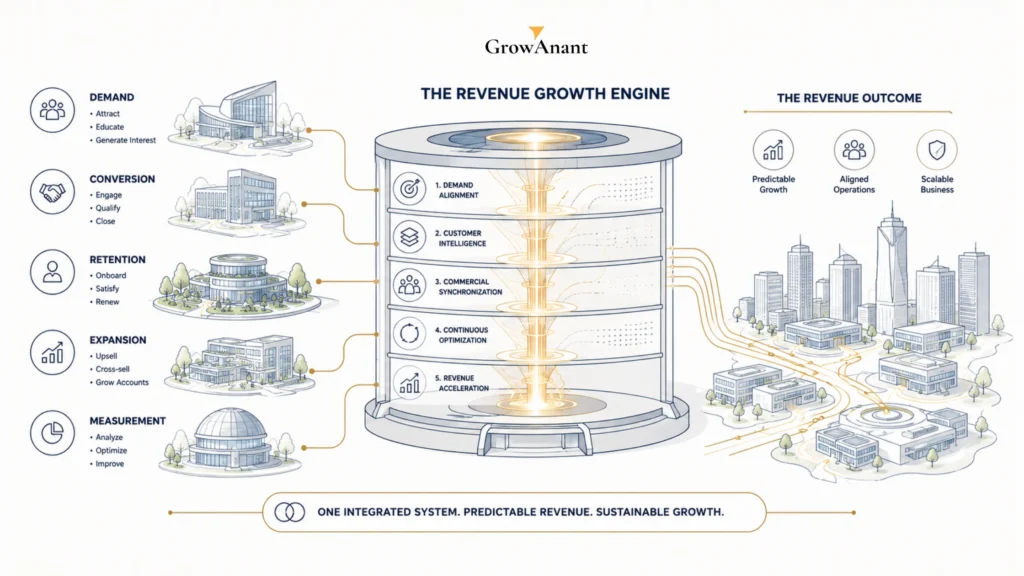
Many businesses invest heavily in marketing but still struggle to achieve consistent revenue growth. Campaigns generate traffic, advertising produces leads, and sales teams stay busy, yet revenue remains unpredictable. The challenge often lies in the absence of a structured growth system rather than a lack of marketing activity. A Growth Marketing Agency USA helps organizations build connected systems that align customer acquisition, sales execution, and long-term revenue objectives.
Whether you are a SaaS company scaling operations, a professional services firm expanding into new markets, or a founder-led business preparing for growth, sustainable success depends on integrating growth marketing services, demand generation, and measurable business growth into one coordinated framework. Instead of optimizing individual campaigns, successful businesses optimize the complete revenue journey.
What is a growth system?
A growth system is a structured framework that connects marketing, sales, customer success, technology, and performance measurement into a repeatable process for generating revenue. Unlike isolated campaigns, a growth system ensures every customer interaction contributes to pipeline development, customer retention, and long-term business performance.
Organizations that implement growth systems make decisions based on customer data, measurable KPIs, and continuous optimization rather than short-term marketing activity.
Campaigns vs Growth Systems
| Marketing Campaigns | Revenue-Focused Growth Systems |
| Short-term initiatives | Long-term revenue strategy |
| Channel-specific execution | Cross-functional alignment |
| Activity-based reporting | Revenue-focused measurement |
| Independent optimization | Continuous business improvement |
| Marketing ownership | Shared commercial ownership |
For example, a B2B software company may achieve strong website traffic through paid advertising but experience weak conversion rates because sales qualification, onboarding, and customer nurturing are disconnected. A structured growth system identifies these gaps and improves the entire revenue process.
Businesses investing in B2B growth marketing agency, growth consulting services, growth strategy consulting, and revenue growth consulting often prioritize system development before increasing advertising budgets, resulting in stronger operational alignment and more sustainable growth.
Demand
Demand is the starting point of every revenue-focused growth system. Without a consistent flow of qualified prospects, businesses struggle to build pipeline, forecast revenue, and scale efficiently. Effective demand generation is not about maximizing lead volume. It is about attracting organizations that closely match the ideal customer profile and demonstrate genuine buying intent.
Demand Generation Framework
| Activity | Business Objective |
| Content Marketing | Educate and attract qualified buyers |
| Organic Search | Capture high-intent demand |
| Paid Search | Generate qualified opportunities |
| LinkedIn Marketing | Reach B2B decision-makers |
| Webinars & Events | Build trust and engagement |
Demand Generation Checklist
✔ Clearly define the Ideal Customer Profile before launching campaigns.
✔ Align messaging with customer challenges and business outcomes.
✔ Prioritize B2B lead generation services that focus on lead quality rather than quantity.
✔ Measure pipeline contribution instead of traffic alone.
✔ Continuously refine lead generation for B2B services using customer insights and conversion data.
For instance, a cybersecurity SaaS company targeting U.S. manufacturers may achieve stronger results by combining educational SEO content, LinkedIn thought leadership, and intent-based search advertising rather than relying on broad awareness campaigns. This approach improves pipeline quality while supporting more predictable revenue performance.
Strategic partners such as GrowAnant help businesses integrate Growth Marketing Agency USA, demand generation agency, and digital marketing consulting services into scalable growth frameworks that connect marketing investment directly to measurable commercial outcomes.
Conversion
Generating demand creates opportunities, but revenue is realized only when qualified prospects become customers. Conversion is the stage where marketing, sales, and customer experience work together to move buyers through the decision-making process. Weak positioning, inconsistent follow-up, or poor sales alignment can reduce conversion rates even when demand generation performs well.
Conversion Framework
| Focus Area | Business Objective |
| Lead Qualification | Prioritize high-fit opportunities |
| Sales Enablement | Equip teams with consistent messaging |
| Landing Pages | Improve visitor-to-lead conversion |
| Nurture Campaigns | Build trust during longer buying cycles |
| Sales Follow-up | Increase opportunity progression |
Conversion Checklist
✔ Define qualification criteria before handing leads to sales.
✔ Align marketing and sales around shared pipeline goals.
✔ Optimize landing pages and calls to action using customer insights.
✔ Measure conversion at every funnel stage.
✔ Review lost opportunities to identify recurring barriers.
For example, a B2B technology company may generate qualified demo requests but lose opportunities because follow-up is inconsistent. Improving qualification, response times, and sales messaging can significantly strengthen pipeline performance. Businesses working with a B2B growth marketing agency, growth marketing services, and business strategy consulting USA often improve revenue by optimizing conversion before increasing acquisition spend.
Retention
A sustainable growth system extends beyond customer acquisition. Retaining existing customers reduces acquisition pressure, improves profitability, and creates opportunities for referrals and expansion. Businesses focused only on acquiring new customers often experience unpredictable revenue despite high marketing investment.
Customer Retention Framework
| Strategy | Business Impact |
| Structured Onboarding | Faster customer success |
| Regular Customer Reviews | Stronger client relationships |
| Educational Content | Higher product or service adoption |
| Proactive Support | Reduced churn |
| Feedback Programs | Continuous service improvement |
Retention Checklist
✔ Create a structured onboarding process.
✔ Monitor customer satisfaction regularly.
✔ Identify at-risk accounts early.
✔ Use customer feedback to improve products or services.
✔ Align customer success metrics with long-term revenue objectives.
For example, a SaaS company may reduce churn by improving onboarding and product education, while a professional services firm can increase retention through regular business reviews and strategic advisory sessions. Companies investing in SaaS growth consulting, business growth consulting, and growth roadmap consulting often view customer retention as an essential driver of long-term revenue growth.
Expansion
Expansion enables businesses to increase revenue from existing customers while strengthening long-term relationships. It is generally more efficient than relying exclusively on new customer acquisition because trust and familiarity already exist.
Expansion opportunities should be built into the overall growth strategy rather than treated as occasional sales initiatives.
Expansion Opportunities
| Opportunity | Strategic Value |
| Cross-selling | Introduce complementary solutions |
| Upselling | Increase customer value |
| Market Expansion | Enter new industries or regions |
| Referral Programs | Generate qualified opportunities |
| Strategic Partnerships | Accelerate commercial growth |
Expansion Checklist
✔ Identify customer segments with expansion potential.
✔ Develop personalized account growth plans.
✔ Align sales and customer success around expansion goals.
✔ Evaluate new market opportunities using a structured market entry strategy USA.
✔ Track expansion revenue alongside new customer acquisition.
Consider a professional services firm that begins serving healthcare clients and later expands into financial services using the same proven delivery model. Similarly, a SaaS platform may increase annual recurring revenue by introducing premium features to existing customers instead of depending solely on new acquisitions.
Growth partners such as GrowAnant help organizations combine growth marketing, growth consulting, and go to market strategy consulting into scalable commercial systems that support acquisition, retention, and expansion throughout the customer lifecycle.
Measurement
A revenue-focused growth system is only effective when performance is measured consistently. Tracking marketing activity alone does not explain whether growth is sustainable. Leadership teams need visibility into how marketing, sales, and customer success contribute to pipeline creation, customer retention, and overall revenue performance.
The most effective organizations review leading and lagging indicators together, allowing them to identify bottlenecks early and optimize investment decisions based on measurable business outcomes rather than assumptions.
Revenue Measurement Framework
| KPI | Why It Matters |
| Qualified Pipeline | Measures future revenue potential |
| Lead-to-Customer Conversion | Evaluates funnel efficiency |
| Customer Acquisition Cost (CAC) | Assesses marketing efficiency |
| Customer Lifetime Value (LTV) | Measures long-term customer value |
| Retention Rate | Indicates customer satisfaction and recurring revenue |
| Revenue Growth | Tracks overall business performance |
Growth Measurement Checklist
✔ Define shared KPIs across marketing, sales, and customer success.
✔ Monitor pipeline quality instead of lead volume alone.
✔ Review acquisition, retention, and expansion metrics together.
✔ Build executive dashboards with real-time reporting.
✔ Continuously refine campaigns and processes using performance data.
For example, a B2B SaaS company may discover that organic search produces fewer leads than paid advertising but delivers significantly higher conversion rates and customer lifetime value. Similarly, a professional services firm may identify that webinar-generated opportunities close at a much higher rate than cold outreach. These insights help leadership prioritize investments that contribute to sustainable revenue growth rather than short-term marketing activity.
Many growth-stage organizations work with GrowAnant to connect growth marketing services, growth consulting services, revenue growth consulting, and business growth consulting into measurable revenue systems that improve strategic decision-making and create predictable commercial performance.
References
FAQs
A revenue system is a structured framework that connects marketing, sales, customer success, technology, and performance measurement to generate predictable and sustainable business growth. It aligns every customer-facing function around shared revenue objectives.
Growth becomes predictable when businesses build repeatable processes for demand generation, conversion, retention, expansion, and performance measurement. Consistent execution, shared KPIs, and continuous optimization reduce uncertainty and improve long-term results.
Strategic growth partners build systems by aligning customer research, positioning, demand generation, sales processes, technology, and reporting into a unified operating model. The focus is on creating repeatable frameworks that support measurable revenue outcomes rather than isolated marketing campaigns.
Marketing generates awareness and demand, but sustainable growth also depends on sales execution, customer retention, operational alignment, and performance measurement. Without an integrated revenue system, marketing activities alone rarely produce consistent, scalable business growth.