
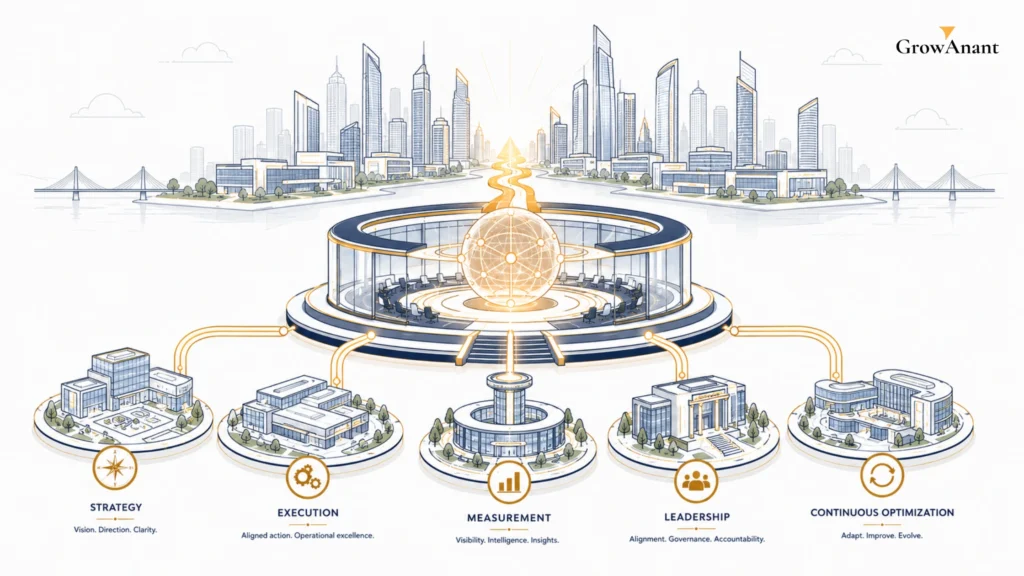
Many growth-stage businesses reach a point where more marketing activity no longer produces better business results. Teams generate leads, launch campaigns, and invest in sales, yet revenue remains unpredictable because every function operates independently. Business Growth Consulting helps organizations replace disconnected initiatives with an integrated operating system that aligns strategy, execution, measurement, and leadership around sustainable business growth.
Whether a SaaS company is preparing for expansion, a founder-led business is entering a new market, or a professional services firm is improving operational efficiency, combining growth strategy consulting, growth consulting services, and fractional growth consultant expertise creates the structure required for consistent execution and measurable revenue outcomes.
What is a Growth Operating System?
A Growth Operating System is a structured framework that connects business strategy, go-to-market execution, marketing, sales, customer success, and performance measurement into one coordinated growth model. Rather than treating growth as a series of isolated campaigns, it creates repeatable processes that improve decision-making and support long-term scalability.
An effective operating system enables leadership teams to prioritize the initiatives that have the greatest impact on revenue while maintaining alignment across every department.
Growth Operating System Framework
| Component | Strategic Purpose |
| Business Strategy | Define long-term growth priorities |
| Go-to-Market Execution | Coordinate customer acquisition |
| Revenue Measurement | Track commercial performance |
| Leadership Alignment | Improve organizational decisions |
| Continuous Improvement | Support sustainable scaling |
Growth Operating System Checklist
✔ Align every growth initiative with business objectives.
✔ Create shared KPIs across marketing, sales, and leadership.
✔ Standardize decision-making processes.
✔ Review performance using measurable business outcomes.
✔ Build systems that remain effective as the company grows.
For example, a B2B SaaS company preparing for U.S. expansion may use business strategy consulting USA, go to market strategy consulting, SaaS growth consulting, and startup growth strategy consulting to establish a unified operating framework before increasing marketing investment. This reduces execution gaps while improving revenue visibility.
Strategy
Strategy establishes the direction of the Growth Operating System. Without a documented roadmap, organizations often pursue disconnected initiatives that consume resources without contributing to long-term objectives. A strong strategy identifies target markets, customer segments, competitive positioning, and measurable business priorities before execution begins.
Instead of reacting to short-term opportunities, leadership should build a roadmap that aligns every marketing, sales, and operational initiative with sustainable growth goals.
Strategic Planning Framework
| Strategic Area | Executive Focus |
| Market Positioning | Improve competitive differentiation |
| Customer Segmentation | Prioritize high-value opportunities |
| Revenue Objectives | Define measurable outcomes |
| Resource Allocation | Maximize investment efficiency |
| Growth Roadmap | Coordinate long-term execution |
Strategy Checklist
✔ Establish measurable growth objectives.
✔ Prioritize markets with the strongest commercial opportunity.
✔ Align marketing, sales, and operations around shared goals.
✔ Review strategy against changing market conditions.
✔ Update the roadmap using performance insights.
For instance, a professional services firm expanding into multiple U.S. regions may first define its ideal customer profile, competitive positioning, and expansion priorities before investing in demand generation. Growth partners such as GrowAnant combine Business Growth Consulting, growth roadmap consulting, revenue growth consulting, fractional chief growth office, and fractional head of growth capabilities to help organizations develop strategy-led growth systems that connect business planning with long-term execution.
Execution
Execution transforms strategic plans into measurable business outcomes. Even the strongest growth strategy fails if marketing, sales, and customer success teams operate independently. A Growth Operating System creates repeatable workflows, shared accountability, and clear ownership so every initiative contributes to revenue objectives rather than isolated activity.
Successful execution depends on prioritization, cross-functional collaboration, and disciplined implementation rather than launching more campaigns.
Execution Framework
| Execution Area | Strategic Purpose |
| Go-to-Market Alignment | Coordinate commercial teams |
| Demand Generation | Build qualified pipeline |
| Sales Enablement | Improve opportunity conversion |
| Customer Success | Increase retention and expansion |
| Operational Processes | Standardize execution |
Execution Checklist
✔ Define ownership for every growth initiative.
✔ Align marketing and sales around shared pipeline goals.
✔ Document repeatable execution processes.
✔ Prioritize high-impact initiatives over low-value activities.
✔ Review execution progress using business KPIs.
For example, a funded startup introducing a new SaaS solution can synchronize product marketing, sales outreach, and onboarding instead of allowing each department to execute independently. Businesses leveraging growth consulting services, growth marketing consultant, B2B marketing strategy consulting, and demand generation agency capabilities often achieve stronger execution because every team works toward common commercial objectives.
Measurement
Without reliable measurement, leadership cannot determine whether growth initiatives are creating sustainable business value. A Growth Operating System relies on consistent reporting that connects marketing activity to pipeline, customer acquisition, profitability, and revenue growth. Executive dashboards should focus on meaningful KPIs instead of isolated marketing metrics.
Growth Measurement Framework
| KPI | Executive Insight |
| Qualified Pipeline | Future revenue potential |
| Customer Acquisition Cost | Acquisition efficiency |
| Customer Lifetime Value | Long-term profitability |
| Revenue Growth | Commercial performance |
| Customer Retention | Sustainable expansion |
Measurement Checklist
✔ Track metrics that influence revenue decisions.
✔ Build dashboards shared across departments.
✔ Review performance consistently with leadership.
✔ Eliminate vanity metrics from executive reporting.
✔ Refine KPIs as business priorities evolve.
For instance, a founder-led technology company may identify rising acquisition costs before they significantly affect profitability by monitoring a unified dashboard. Organizations investing in revenue growth consulting, growth consulting services USA, business growth agency USA, and growth marketing services gain greater visibility into commercial performance by measuring outcomes rather than activity.
Leadership
Leadership is the foundation of every successful Growth Operating System. Growth frequently slows because organizations lack strategic ownership rather than marketing capability. A dedicated growth leader ensures priorities remain aligned, departments collaborate effectively, and decisions support long-term objectives.
Many scaling businesses address this challenge by introducing a fractional growth executive or fractional head of growth who provides senior strategic direction without building a full executive team. Growth partners such as GrowAnant complement internal teams by combining Business Growth Consulting, growth strategy consulting, digital growth agency, and fractional growth consultant expertise to establish scalable growth systems while maintaining executive alignment.
Growth Leadership Framework
| Leadership Focus | Business Outcome |
| Strategic Direction | Clear organizational priorities |
| Cross-Functional Alignment | Better execution consistency |
| Decision-Making | Faster strategic responses |
| Accountability | Improved operational ownership |
| Growth Governance | Sustainable scaling |
Leadership Checklist
✔ Assign executive ownership for growth initiatives.
✔ Align departments around shared business objectives.
✔ Review strategic priorities regularly.
✔ Build accountability into every growth process.
✔ Invest in leadership before increasing operational complexity.
Continuous optimization
A Growth Operating System should evolve as the business grows. Continuous optimization ensures that strategies, processes, and performance metrics remain aligned with changing customer needs, market conditions, and revenue objectives. Rather than making occasional improvements, successful organizations establish a routine of reviewing data, testing ideas, and refining execution.
Continuous Optimization Framework
| Optimization Area | Strategic Purpose |
| Performance Reviews | Identify improvement opportunities |
| Customer Feedback | Strengthen market alignment |
| Process Optimization | Improve operational efficiency |
| KPI Analysis | Support better decisions |
| Growth Experiments | Validate strategic initiatives |
Continuous Optimization Checklist
✔ Review growth KPIs consistently.
✔ Test improvements before scaling investments.
✔ Use customer insights to refine strategy.
✔ Optimize processes across departments.
✔ Document successful practices for repeatability.
For example, a professional services firm may discover that refining its proposal process increases conversion rates more effectively than expanding advertising budgets. Businesses supported by growth consulting, small business growth consulting, marketing strategy for service businesses, and professional services marketing agency expertise often improve revenue by continuously optimizing existing systems instead of adding unnecessary complexity.
Long-term scaling
Long-term scaling is achieved when strategy, execution, measurement, leadership, and optimization operate as one integrated system. Instead of relying on individual campaigns or short-term initiatives, businesses develop repeatable processes that support sustainable business growth while maintaining operational efficiency.
An effective Growth Operating System enables leadership to expand into new markets, launch new offerings, and increase revenue without losing organizational alignment. Whether a SaaS company is pursuing a market entry strategy USA or a founder-led business is strengthening B2B marketing, scalable systems create a stronger foundation for future growth. Growth partners such as GrowAnant help organizations integrate Business Growth Consulting, growth consulting services, growth strategy consulting, and revenue growth consulting into structured operating models that connect strategic planning with measurable commercial outcomes.
Long-Term Scaling Framework
| Scaling Priority | Executive Outcome |
| Strategic Alignment | Consistent decision-making |
| Scalable Processes | Efficient execution |
| Revenue Visibility | Better forecasting |
| Leadership Accountability | Stronger governance |
| Continuous Improvement | Sustainable growth |
Long-Term Scaling Checklist
✔ Standardize growth processes before expanding.
✔ Align every department with shared revenue goals.
✔ Invest in scalable systems instead of isolated tactics.
✔ Review strategic priorities as markets evolve.
✔ Measure long-term performance using business outcomes.
References
FAQs
A Growth Operating System is a structured framework that aligns strategy, execution, leadership, measurement, and continuous improvement to support sustainable business growth. It connects every growth function to shared business objectives and measurable revenue outcomes.
Businesses need a Growth Operating System to eliminate disconnected initiatives, improve cross-functional alignment, increase visibility into performance, and create repeatable processes that support scalable growth.
It improves scaling by standardizing decision-making, aligning departments around shared KPIs, strengthening operational consistency, and providing leadership with reliable performance insights that guide strategic investment.
Implementation timelines vary depending on business size, operational complexity, and existing processes. Most organizations begin establishing core frameworks within a few months, with ongoing optimization supporting long-term scalability.