
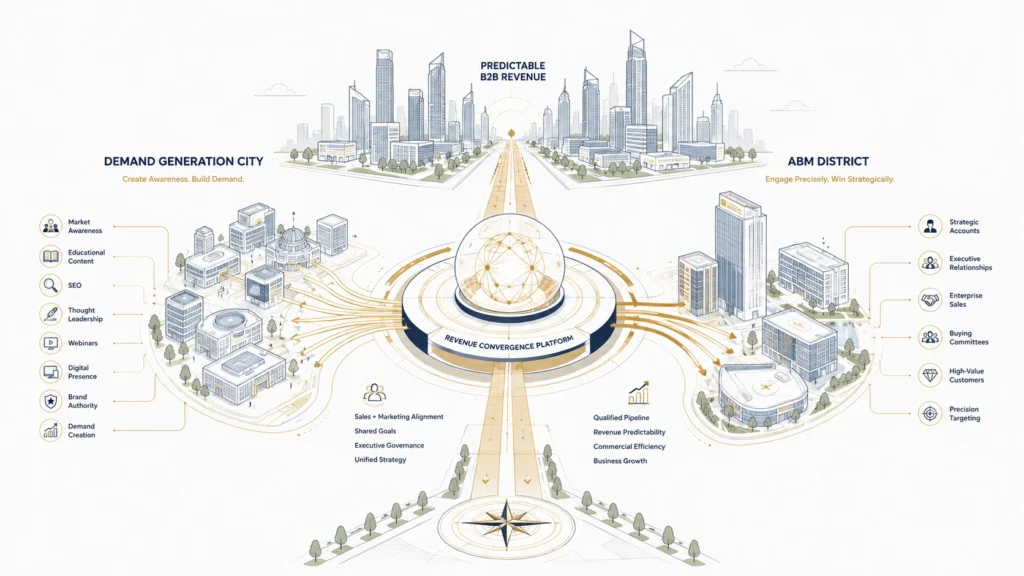
Many B2B organizations struggle with a common question: should they invest in account based marketing vs demand generation? The answer depends on business goals, sales complexity, target audience, and revenue strategy. While both approaches aim to generate pipeline and accelerate growth, they serve different purposes within a modern B2B growth framework.
Businesses investing in growth marketing services, demand generation agency expertise, and ABM for B2B strategies often achieve stronger commercial outcomes when they understand where each approach fits within the customer journey. Rather than viewing them as competing strategies, founders should evaluate how each contributes to predictable business growth and long-term revenue performance.
What Is ABM?
Account-Based Marketing (ABM) is a focused growth strategy that targets a carefully selected group of high-value accounts instead of marketing to a broad audience. Marketing and sales teams work together to create personalized campaigns designed for specific companies, buying committees, and decision-makers.
ABM is particularly effective for organizations selling enterprise solutions, high-value professional services, or complex SaaS products with long buying cycles. Success depends on close collaboration between marketing and sales, personalized engagement, and measurable account progression.
ABM Framework
| Component | Strategic Purpose |
| Target Account Selection | Prioritize high-value prospects |
| Personalized Messaging | Improve buyer engagement |
| Sales & Marketing Alignment | Coordinate outreach efforts |
| Multi-Channel Engagement | Reach multiple stakeholders |
| Revenue Measurement | Track account progression |
ABM Checklist
✔ Build a list of high-value target accounts.
✔ Align marketing and sales teams around shared objectives.
✔ Personalize messaging for each buying committee.
✔ Measure account engagement instead of lead volume.
✔ Review pipeline contribution at the account level.
For example, an enterprise SaaS company selling cybersecurity software may target 100 Fortune 1000 companies using personalized campaigns, executive outreach, and tailored content. Businesses adopting B2B growth marketing agency, B2B marketing strategy consulting, lead scoring model b2b, and growth consulting services frequently improve sales efficiency because resources are concentrated on high-potential opportunities.
What Is Demand Generation?
Demand generation is a broader marketing strategy designed to create awareness, educate potential buyers, and generate qualified demand across a larger audience. Rather than focusing on specific companies, demand generation attracts prospects through valuable content, digital campaigns, webinars, search visibility, and nurturing programs that gradually move buyers through the purchasing journey.
Demand generation is particularly valuable for organizations seeking to expand market awareness, increase pipeline volume, or support product launches in competitive markets.
Demand Generation Framework
| Component | Strategic Purpose |
| Educational Content | Build market awareness |
| Multi-Channel Campaigns | Reach broader audiences |
| Lead Nurturing | Increase buying readiness |
| Marketing Automation | Improve scalability |
| Performance Analytics | Optimize campaign results |
Demand Generation Checklist
✔ Create educational content aligned with buyer challenges.
✔ Build nurturing workflows for different customer segments.
✔ Measure pipeline quality alongside lead volume.
✔ Optimize campaigns using demand generation analytics.
✔ Align marketing performance with revenue objectives.
For instance, a founder-led professional services firm entering the U.S. market may use webinars, SEO, and LinkedIn thought leadership to generate awareness before introducing targeted outreach. Growth partners such as GrowAnant combine growth marketing agency USA, B2B lead generation services, digital marketing consulting services, and growth strategy consulting to help businesses build demand generation systems that create qualified pipeline while supporting long-term revenue growth.
Key Differences
Although both strategies contribute to revenue growth, account based marketing vs demand generation differs in audience focus, campaign execution, measurement, and business objectives. Demand generation creates awareness and fills the top of the funnel, while ABM concentrates resources on converting carefully selected high-value accounts.
ABM vs Demand Generation Comparison
| Category | ABM for B2B | Demand Generation |
| Audience | Selected target accounts | Broad target market |
| Personalization | Highly customized | Segment-based messaging |
| Primary Goal | Win strategic accounts | Generate qualified demand |
| Sales Alignment | Very high | Moderate to high |
| Success Metrics | Account engagement, pipeline | Leads, MQLs, pipeline growth |
Decision Checklist
✔ Evaluate average deal size before selecting an approach.
✔ Consider sales cycle complexity.
✔ Align marketing strategy with revenue objectives.
✔ Review available sales and marketing resources.
✔ Measure success using business outcomes rather than campaign activity.
For example, a cybersecurity SaaS provider selling enterprise contracts may achieve better results through personalized ABM campaigns, while a startup launching a new software platform may first invest in broader growth marketing services and demand generation agency initiatives to build market awareness.
When to Use ABM
ABM is most effective when the business targets a relatively small number of high-value customers where each successful deal has a significant revenue impact. It works particularly well in enterprise sales environments involving multiple stakeholders, long buying cycles, and complex purchasing decisions.
Best Situations for ABM
| Business Scenario | Why ABM Fits |
| Enterprise SaaS | Multiple decision-makers |
| Healthcare Technology | Long evaluation cycles |
| Financial Technology | High-value accounts |
| Professional Services | Relationship-driven sales |
| Strategic Partnerships | Personalized engagement |
ABM Checklist
✔ Identify high-value target accounts.
✔ Align sales and marketing before campaign launch.
✔ Develop account-specific messaging.
✔ Track engagement across buying committees.
✔ Measure pipeline progression at the account level.
For instance, a fintech company pursuing Fortune 500 clients can personalize executive outreach, webinars, and industry-specific case studies for each account. Organizations supported by growth consulting services USA, SaaS growth consulting, linkedin growth marketing b2b, and go to market strategy consulting often improve sales efficiency because marketing investments focus on accounts with the highest commercial potential.
When to Use Broad Demand Generation
Broad demand generation is appropriate when businesses need to increase brand awareness, educate buyers, launch new offerings, or build a larger pipeline of qualified prospects. It supports companies with shorter sales cycles or those expanding into new industries and geographic markets.
Demand Generation Use Cases
| Business Need | Strategic Benefit |
| Product Launch | Increase market awareness |
| Market Expansion | Reach new audiences |
| Brand Building | Establish industry authority |
| Pipeline Growth | Generate qualified opportunities |
| Customer Education | Improve buying readiness |
Demand Generation Checklist
✔ Invest in educational content and SEO.
✔ Build nurturing campaigns across multiple channels.
✔ Measure attribution using a b2b marketing attribution model.
✔ Optimize campaigns through continuous testing.
✔ Connect marketing KPIs with pipeline and revenue.
For example, a professional services company entering the U.S. market may use search optimization, webinars, and thought leadership to establish credibility before launching account-focused outreach. Growth partners such as GrowAnant help businesses combine B2B growth marketing agency, performance marketing services USA, business strategy consulting USA, and growth roadmap consulting to build scalable demand generation systems that strengthen long-term commercial growth.
Combining Both Approaches
The strongest B2B growth strategies rarely rely on a single methodology. Instead of choosing between account based marketing vs demand generation, many successful organizations integrate both approaches to create a balanced revenue engine. Demand generation builds awareness and generates qualified interest, while ABM converts strategically important accounts through personalized engagement.
A common approach is to begin with broad demand generation to educate the market and identify buying signals. High-intent accounts can then transition into targeted ABM campaigns supported by sales outreach and customized content. This enables marketing and sales teams to prioritize resources where commercial impact is greatest.
Integrated Growth Framework
| Stage | Primary Strategy | Business Outcome |
| Market Awareness | Demand Generation | Build brand visibility |
| Lead Qualification | Marketing Automation | Identify buying intent |
| High-Value Accounts | ABM for B2B | Improve strategic conversions |
| Sales Engagement | Personalized Outreach | Accelerate pipeline |
| Revenue Optimization | Combined Measurement | Increase commercial efficiency |
Combined Strategy Checklist
✔ Use demand generation to build a consistent pipeline.
✔ Identify high-intent accounts using engagement data.
✔ Transition qualified accounts into personalized ABM programs.
✔ Measure campaign performance using demand generation analytics and account-level KPIs.
✔ Continuously optimize marketing investments based on revenue contribution.
For example, a B2B SaaS company launching in the U.S. may first generate awareness through educational content, webinars, SEO, and LinkedIn campaigns before moving enterprise prospects into personalized ABM initiatives. Likewise, a professional services firm can combine broad visibility campaigns with executive outreach for strategic clients. Growth partners such as GrowAnant help organizations integrate growth consulting services, growth strategy consulting, growth marketing agency USA, and revenue growth consulting into scalable GTM systems that align marketing investments with pipeline creation and long-term business growth.
References
Frequently Asked Questions
Neither strategy is universally better. ABM for B2B is typically more effective for high-value accounts with complex buying processes, while demand generation is better suited for building market awareness and generating a larger volume of qualified opportunities. The best approach depends on business goals, sales complexity, and target audience.
ABM is well suited for enterprise SaaS companies, B2B technology providers, professional services firms, and organizations selling high-value solutions with long sales cycles and multiple decision-makers.
Yes. Many high-performing organizations combine demand generation to attract and educate prospects with ABM to engage and convert high-value accounts. This integrated strategy creates a stronger and more predictable revenue pipeline.
ABM focuses on account-level metrics such as engagement, buying committee activity, pipeline progression, opportunity creation, and revenue from target accounts. Demand generation typically emphasizes broader marketing metrics such as lead volume, marketing-qualified leads, conversion rates, and overall pipeline growth.