
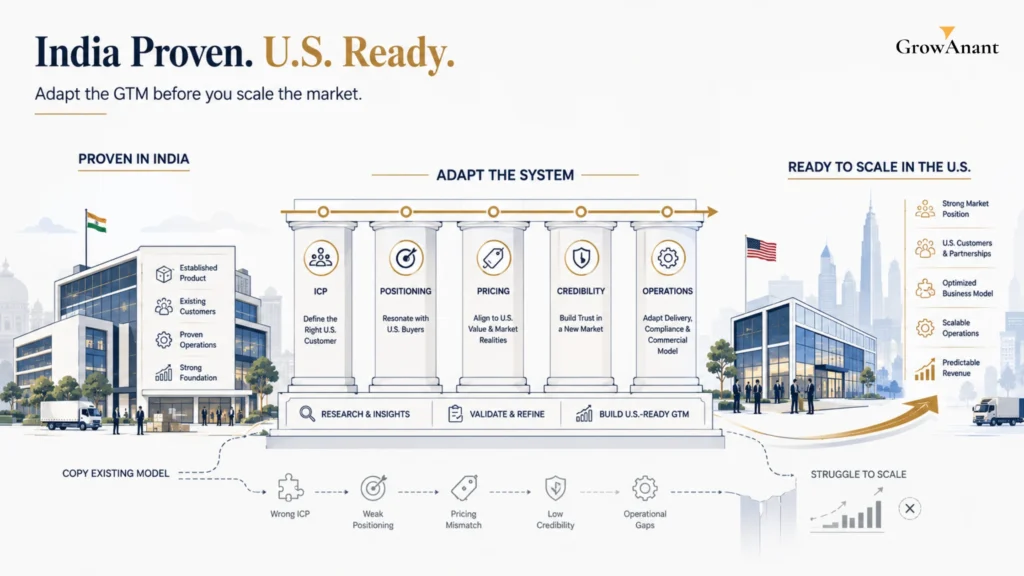
For Indian companies, entering the U.S. is not simply an international sales exercise. It requires a deliberate us market entry consulting for indian companies approach that connects positioning, pricing, customer acquisition, operations, and credibility.
A company may have strong products, technical expertise, or an established customer base in India and still struggle to gain traction in the United States. The reason is often not product quality. It is a mismatch between the existing business model and U.S. buyer expectations.
A practical market entry strategy USA framework should answer five questions:
- Who is the ideal U.S. customer?
- Why should that customer choose the company?
- What pricing and commercial model makes sense?
- How will the company establish credibility?
- What operational and legal infrastructure is required?
The objective is not to launch everywhere at once. It is to create a focused entry strategy that reduces uncertainty and establishes a foundation for sustainable growth.
Common Challenges for Indian Companies Entering the U.S.
Indian companies entering the U.S. commonly face challenges across positioning, customer acquisition, pricing, credibility, and operations.
| Challenge | Typical Problem | Strategic Response |
| Positioning | Messaging developed for Indian buyers may not resonate with U.S. customers | Reframe around U.S. customer priorities |
| Pricing | INR-based thinking influences commercial decisions | Build pricing around U.S. value and economics |
| Credibility | Limited U.S. customer references | Develop localized proof and partnerships |
| Demand generation | Existing acquisition channels may not transfer | Test U.S.-specific acquisition channels |
| Operations | Indian and U.S. business requirements differ | Establish appropriate operational infrastructure |
For example, an Indian SaaS company may have strong adoption among cost-conscious businesses in India but position itself primarily around affordability. In the U.S., the stronger message may be productivity, integration, risk reduction, or measurable business value.
Similarly, an Indian IT services company may have excellent delivery capabilities but struggle because its website and sales messaging emphasize technical services instead of the business outcomes U.S. decision-makers expect.
A focused go to market strategy consulting process should identify these gaps before significant marketing investment begins.
Positioning & Cultural Localization
Localization is not simply changing Indian spelling or adding U.S. currency to a website. It means adapting the value proposition to the expectations, priorities, language, proof points, and buying behavior of the target market.
An effective positioning framework is:
Customer → Problem → Business Impact → Differentiation → Proof
For example, an Indian cybersecurity company targeting U.S. mid-market businesses should avoid generic claims such as “high-quality cybersecurity services.” Instead, its positioning could focus on a specific business problem, such as reducing security risk for organizations without large internal security teams.
The same principle applies to SaaS, professional services, manufacturing, healthcare technology, and other categories.
Companies should review:
- Website messaging
- Value propositions
- Case studies
- Customer terminology
- Sales presentations
- Social proof
- Calls to action
- Industry-specific messaging
A strong growth strategy consulting process should also identify whether the U.S. market requires a narrower ICP than the company’s existing international strategy.
For founders, this can be uncomfortable. A company may have succeeded by serving many customer segments in India. U.S. expansion often requires greater focus rather than broader targeting.
Pricing in USD
Moving from INR pricing to USD pricing requires more than currency conversion.
The commercial model should reflect:
- Customer value
- Competitive alternatives
- Delivery economics
- Sales cycle
- Support requirements
- Customer expectations
- Desired positioning
For example, converting an Indian service package from ₹10 lakh directly into an equivalent USD amount may not produce an appropriate U.S. price. The underlying value proposition, scope, proof, and competitive context need to be evaluated first.
Pricing Decision Framework
| Question | Consideration |
| What problem does the offer solve? | Quantify business relevance where possible |
| Who is the buyer? | Founder, executive, department head, procurement |
| What alternatives exist? | Competitors, internal hiring, existing vendors |
| What level of trust is required? | Higher-risk purchases usually require stronger proof |
| How is the offer packaged? | Project, subscription, retainer, usage, or outcome-based |
Pricing should also account for U.S. taxes, payment processing, contracts, fulfillment, support, and other operating costs. The final commercial structure should be reviewed with appropriate legal and financial professionals.
Building U.S. Credibility
One of the biggest barriers for an Indian company entering the U.S. is the credibility gap.
A founder may think:
“We have years of experience and hundreds of customers.”
A U.S. buyer may still ask:
“Have you solved this problem for companies like mine?”
The solution is not to hide the company’s Indian track record. Instead, connect existing expertise with U.S.-relevant proof.
Credibility Framework
Existing Expertise + Relevant Proof + Local Understanding + Visible Leadership
Useful credibility assets include:
- Relevant case studies
- Customer testimonials
- Industry expertise
- U.S.-focused website messaging
- Executive thought leadership
- Industry partnerships
- U.S. customer references
- Relevant certifications
- Clear business address and contact information where appropriate
For an Indian B2B technology company, the first U.S. customers can be strategically valuable beyond their immediate revenue. They can create references, market insight, testimonials, and stronger understanding of U.S. buyer expectations.
A business growth consulting approach should therefore treat early customers as market-learning assets, not simply sales targets.
Legal & Operational Setup
Legal and operational requirements vary significantly depending on whether the company is selling software, services, physical products, or regulated offerings.
Before expansion, founders should assess:
- Appropriate U.S. business structure
- State registration requirements
- Contracts
- Tax obligations
- Intellectual property protection
- Employment requirements
- Data and privacy obligations
- Import or export requirements where applicable
- Payment and banking infrastructure
The U.S. Small Business Administration notes that registration requirements depend on the business structure and state, and companies operating across states may have additional foreign qualification requirements.
This means there is no universal “U.S. company setup” checklist. The appropriate structure depends on the company’s activities and operating model.
SBA also recommends identifying applicable laws, regulations, taxes, duties, and trade requirements when conducting international business.
For this reason, founders should use qualified U.S. legal and tax professionals for decisions involving incorporation, taxation, employment, immigration, contracts, or regulatory compliance.
A practical growth roadmap consulting process should place these requirements alongside commercial milestones rather than treating legal setup as a completely separate project.
Common Mistakes
Indian companies often make predictable mistakes when entering the U.S. market.
1. Treating the U.S. as One Large Market
The U.S. contains different industries, regions, customer segments, and competitive environments. Start with a clearly defined ICP and market segment.
2. Reusing Indian Messaging
Existing messaging may communicate capabilities but fail to explain why the offering matters to U.S. buyers.
3. Competing Primarily on Price
Lower pricing can create attention, but it may also weaken positioning and create doubts about quality or capability.
4. Launching Too Broadly
Trying to target every U.S. industry and state increases acquisition costs and makes learning difficult.
5. Hiring Before Validating Demand
Building a large U.S. team before validating customer demand can increase fixed costs before the business model is proven.
6. Treating Marketing as the Entire GTM Strategy
Marketing cannot compensate for unclear positioning, weak sales processes, poor customer fit, or inadequate operational readiness.
U.S. Entry Readiness Checklist
Before scaling, confirm:
- Defined U.S. ICP
- Localized positioning
- USD pricing model
- U.S.-relevant proof
- Clear acquisition strategy
- Sales process
- Operational readiness
- Legal and tax review
- Measurable GTM milestones
Many Indian companies benefit from treating U.S. expansion as a staged learning process rather than a single launch. Strategic partners such as GrowAnant can support that process by connecting market entry strategy USA, demand generation, positioning, and revenue execution into one growth roadmap.
The goal is not simply to enter the U.S. market. It is to build a repeatable commercial system that can eventually scale with confidence.
References
- U.S. Small Business Administration: Register Your Business
SBA: Register Your Business - U.S. Small Business Administration: Know the Import and Export Laws and Regulations
SBA: Import and Export Laws and Regulations
Frequently Asked Questions
The biggest mistake is treating the U.S. as an extension of the Indian market. Companies often reuse positioning, pricing, targeting, and sales approaches without validating whether they match U.S. customer expectations.
Pricing should be based on customer value, competitive alternatives, delivery economics, positioning, and the buying model rather than simply converting INR into USD. Financial and tax implications should also be reviewed before finalizing pricing.
Use relevant existing case studies, customer outcomes, industry expertise, leadership visibility, partnerships, certifications, and early U.S. customer references. The objective is to demonstrate relevance and reduce perceived buyer risk.
There is no single setup that applies to every company. Requirements depend on business structure, state, activities, taxation, employees, contracts, and whether the company imports or exports goods. Founders should obtain advice from qualified U.S. legal and tax professionals before making structural decisions.