
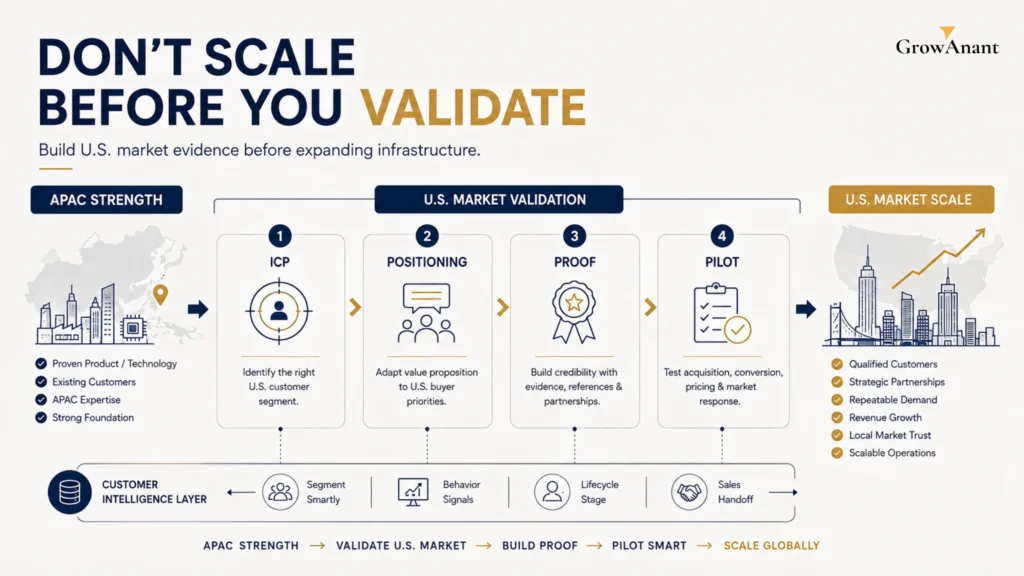
For Taiwanese and APAC companies, entering the United States is rarely just a geographic expansion. It is a shift in positioning, buyer expectations, sales processes, pricing, partnerships, and growth infrastructure. A strong taiwan go to market strategy gtm consulting approach should therefore connect market entry strategy USA, customer validation, localization, and revenue execution rather than treating U.S. expansion as simply another marketing campaign.
The challenge is particularly important for B2B SaaS companies, technology startups, manufacturers, professional service firms, and founder-led businesses. A company may already have product-market fit in Taiwan, Singapore, Japan, or another APAC market, but that does not automatically translate into U.S. demand.
The objective should be simple: build enough U.S. market evidence to justify larger investment before scaling the entire operation.
Why APAC Companies Struggle With U.S. GTM
The biggest mistake is assuming that a successful APAC strategy can simply be translated into English.
U.S. buyers may evaluate the same product differently. They may expect different proof points, buying processes, contract structures, support models, and competitive differentiation.
For example, a Taiwanese technology company selling an enterprise software platform may have strong technical credibility in Asia. In the U.S., however, the buyer may want customer references, security documentation, implementation expectations, ROI evidence, and a clear reason to choose the company over established American competitors.
A practical U.S. GTM assessment should evaluate:
| Area | APAC Approach | U.S. Question |
| Positioning | Product capabilities | What business problem does it solve? |
| Proof | Existing customers | Which U.S. buyers can validate it? |
| Pricing | Local benchmarks | Does pricing reflect U.S. value perception? |
| Sales | Relationship-led | How will pipeline be generated predictably? |
| Channels | Existing partners | Which U.S. partners already reach the ICP? |
| Support | Regional operations | What does the U.S. buyer expect? |
This is where go to market strategy consulting, growth strategy consulting, and business strategy consulting USA can help leadership identify gaps before significant expansion spending.
The U.S. entry decision should answer three questions:
- Is there a sufficiently attractive customer segment?
- Can the company differentiate against local alternatives?
- Can the business acquire and serve customers economically?
Language & Positioning Adjustments
Localization is not simply translation.
For APAC companies, effective localization means adapting the way value is communicated to U.S. decision-makers while preserving the company’s underlying strengths.
A useful positioning framework is:
APAC Strength → U.S. Business Value → Evidence → Buyer Outcome
For example:
Advanced manufacturing capability → lower operational complexity → customer evidence → improved production efficiency.
The website, sales deck, case studies, outbound messaging, and content should communicate this value consistently.
Companies should also avoid positioning themselves primarily around their country of origin unless that origin creates a meaningful competitive advantage. A U.S. buyer usually wants to understand the business value first.
This does not mean eliminating APAC credibility. Instead, use it strategically. A semiconductor, manufacturing, robotics, or enterprise technology company may have deep technical expertise that strengthens its positioning when connected directly to customer outcomes.
For startup growth strategy consulting, the priority should be identifying the smallest viable positioning change that improves U.S. buyer understanding without rebuilding the entire brand.
Choosing the Right Entry Model
There is no single correct U.S. entry model. The appropriate structure depends on product complexity, sales cycle, customer expectations, capital availability, and the level of local support required.
| Entry Model | Best For | Main Advantage | Main Risk |
| Direct sales | B2B SaaS, technology | Customer control | Higher acquisition workload |
| U.S. distributor | Products, hardware | Faster channel access | Lower control |
| Local partner | Specialized B2B | Existing relationships | Partner dependency |
| E-commerce | Consumer products | Fast market testing | Competitive acquisition costs |
| U.S. subsidiary | Larger expansion | Local operating presence | Higher fixed costs |
A founder should avoid establishing a large U.S. operation before validating demand.
A better sequence is:
Market research → ICP validation → Positioning → Pilot acquisition → Customer evidence → Channel expansion → Operational scale
The U.S. Small Business Administration recommends developing an export plan, researching target markets, identifying customers and partners, and considering operational and financial requirements before expanding internationally.
For APAC companies, market entry strategy USA should therefore be treated as a staged investment decision rather than a single launch.
Building Local Trust
Trust becomes a growth asset when a company enters a market where buyers have limited familiarity with the brand.
A company without a U.S. track record can build credibility through several forms of evidence:
- Relevant customer case studies
- Industry certifications and memberships
- U.S. customer references
- Local partnerships
- Founder or executive visibility
- Industry events
- Independent reviews
- U.S.-relevant thought leadership
- Clear service and support commitments
The key is relevance.
A case study from another country can still be valuable if it demonstrates a problem that a U.S. buyer recognizes. But the company should explain the business context rather than simply presenting a logo.
For example, a Taiwanese B2B SaaS company entering the U.S. could combine APAC customer proof with a U.S.-specific pilot program, local industry partnerships, and executive-led educational content.
This creates a credibility bridge rather than pretending the company already has deep U.S. market presence.
Companies using growth consulting services or startup consulting services USA should also evaluate credibility as part of the GTM system, not as a separate branding exercise.
Channel & Partnership Options
Partnerships can reduce the distance between an APAC company and U.S. buyers, but the wrong partner can create another layer of complexity.
Potential partners include:
- Distributors
- Resellers
- Industry consultants
- Technology partners
- Implementation firms
- Associations
- Regional specialists
- Complementary software providers
The right partner should provide more than introductions. Ideally, it contributes market access, customer understanding, implementation capability, or credibility.
A simple partner scorecard can evaluate:
| Criterion | Question |
| ICP overlap | Does the partner already serve your target buyers? |
| Market access | Can it create qualified opportunities? |
| Expertise | Does it understand the category? |
| Incentives | Does your commercial model benefit both sides? |
| Capability | Can it support implementation or service? |
| Commitment | Will the partnership receive active attention? |
The U.S. SBA also identifies foreign distributors and wholesalers as potential routes to market and points businesses toward market research and partner-identification resources.
For technology companies, SaaS growth consulting, B2B growth marketing agency, and demand generation agency capabilities should complement partnerships rather than replace them.
Common Mistakes
APAC companies often create avoidable problems when they scale before validating the U.S. growth system.
1. Treating the U.S. as one homogeneous market
The U.S. contains different industries, buyer segments, regions, and competitive environments. Start with a defined ICP and use focused market testing.
2. Translating instead of localizing
English-language content is not automatically U.S.-market positioning. Adapt the value proposition, examples, proof points, pricing communication, and sales narrative.
3. Scaling paid acquisition too early
Advertising can generate traffic without creating sustainable demand. Validate positioning and conversion economics before aggressively increasing acquisition spending.
4. Depending entirely on one distributor
A channel partner can accelerate access, but excessive dependency reduces learning and creates concentration risk.
5. Building infrastructure before demand
A large U.S. office, team, or operational structure may create fixed costs before the company has demonstrated repeatable demand.
6. Ignoring revenue alignment
Marketing, sales, partnerships, and leadership should share a common growth strategy and measurable pipeline objectives. Otherwise, activity can increase while revenue remains unpredictable.
A strategy-first growth partner such as GrowAnant can help APAC leadership connect go to market strategy consulting, demand generation, positioning, and revenue execution into one operating framework rather than managing each activity separately.
U.S. market entry checklist:
- Define the highest-priority U.S. ICP
- Validate the market problem
- Localize positioning
- Benchmark competitive alternatives
- Establish U.S. pricing logic
- Select the appropriate entry model
- Build credibility assets
- Identify strategic partners
- Run a focused market pilot
- Measure qualified pipeline and conversion
- Scale only after evidence supports expansion
References
- U.S. Small Business Administration, International Sales and Market Identification: SBA Market Identification
- U.S. Small Business Administration, Developing an Export Plan: SBA Develop Your Export Plan
Frequently Asked Questions
APAC companies often face challenges involving localization, unfamiliar U.S. buying processes, limited local references, different competitive expectations, pricing, channel selection, and establishing credibility. Strong technical or operational capabilities do not automatically create U.S. market demand.
Yes, but localization should focus on buyer relevance rather than simple translation. The core product and brand can remain consistent while positioning, examples, proof points, terminology, pricing communication, and customer outcomes are adapted for U.S. buyers.
There is no universal model. Direct sales can provide greater customer control, while distributors, resellers, and strategic partners can provide faster market access. The best model depends on the product, ICP, sales cycle, support requirements, and available resources.
Use relevant customer evidence, partnerships, executive thought leadership, industry participation, certifications, references, and clear support commitments. A focused U.S. pilot can also generate the local customer evidence needed to support broader expansion.