
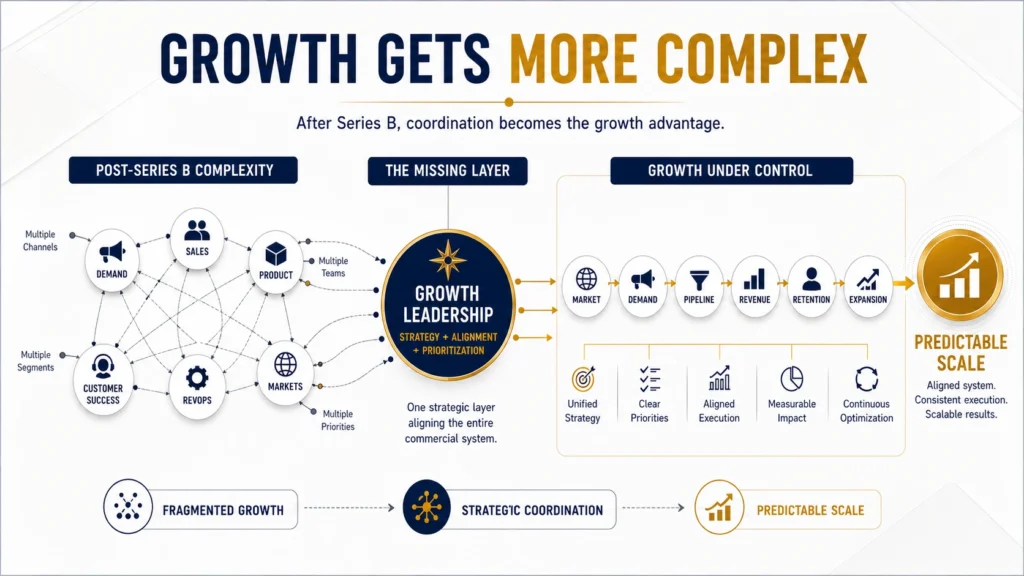
For companies beyond Series B, growth becomes less about finding one successful acquisition channel and more about managing a complex commercial system. fractional growth leadership series b can provide senior strategic direction when a company has significant execution capacity but needs stronger coordination across marketing, sales, product, customer success, and revenue operations.
At this stage, fractional growth leadership is not simply about adding another marketer. A fractional growth consultant or fractional chief growth officer can help leadership identify growth constraints, prioritize investments, establish operating rhythms, and connect activity to revenue. The question is whether fractional leadership still provides enough leverage as the organization becomes more complex.
Scaling Complexity After Series B
After Series B, a company typically has more customers, channels, employees, markets, and revenue targets. The growth challenge therefore changes.
An earlier-stage company may ask:
“How do we find a repeatable acquisition channel?”
A post-Series B company is more likely to ask:
“How do we scale multiple growth motions without creating inefficiency, fragmentation, or declining performance?”
This creates several interconnected challenges:
- Multiple acquisition channels compete for resources.
- Regional expansion introduces market-specific requirements.
- Sales and marketing teams become increasingly specialized.
- Product-led and sales-led motions may coexist.
- Customer retention becomes more important to the growth model.
- Attribution becomes harder across longer buying journeys.
- Leadership needs clearer visibility into growth economics.
For example, a U.S. SaaS company expanding into Europe may have separate demand generation, sales, partnerships, and customer success initiatives. Without centralized growth leadership, every function can optimize its own objectives while the overall commercial system becomes less efficient.
This is where revenue growth consulting can provide strategic value. The objective is not to create more activity. It is to determine where additional investment is justified and where the company should simplify.
Post-Series B Growth Complexity
| Area | Earlier Stage | Post-Series B |
| Acquisition | Find repeatable channels | Optimize channel portfolio |
| GTM | Establish initial motion | Scale multiple motions |
| Marketing | Build demand | Improve efficiency and coordination |
| Sales | Validate process | Scale teams and territories |
| Data | Basic reporting | Cross-functional attribution |
| Leadership | Founder-led | Distributed ownership |
| Markets | Primary market | Multiple segments or geographies |
| Growth challenge | Repeatability | Predictable scaling |
Multi-Channel Growth Systems
At scale, individual channels cannot be evaluated independently.
Paid acquisition may create demand. SEO may capture existing demand. Partnerships may create high-value opportunities. Events may influence enterprise buyers. Product-led activity may accelerate adoption.
The leadership challenge is understanding how these channels work together.
A fractional head of growth can help establish a channel portfolio based on strategic roles rather than simply channel popularity.
| Channel | Primary Role | Executive Question |
| SEO | Capture existing demand | Are priority buyers discovering us organically? |
| Paid media | Create and capture demand | Is incremental spend producing quality pipeline? |
| Content | Build authority | Does content influence buying decisions? |
| Partnerships | Extend reach | Are partners producing strategic opportunities? |
| Events | Build relationships | Are events influencing target accounts? |
| Sales development | Create conversations | Are outreach efforts producing qualified opportunities? |
| Customer marketing | Expansion and retention | Are existing customers creating additional value? |
The objective is a connected system.
A company may use growth marketing services, demand generation agency support, or B2B lead generation services for specialized execution. But executive growth leadership should determine how those activities fit into the broader commercial model.
A practical operating framework is:
Market → ICP → Positioning → Demand → Pipeline → Conversion → Retention → Expansion
If one stage consistently underperforms, adding budget to another stage may simply increase leakage.
Cross-Functional Alignment at Scale
Post-Series B growth problems often become organizational problems.
Marketing may optimize qualified leads. Sales may optimize bookings. Product may prioritize adoption. Customer success may focus on retention. Finance may prioritize efficiency.
All of these objectives are reasonable, but they can conflict.
A fractional growth executive can provide a cross-functional layer that connects these priorities to a shared growth agenda.
Growth Leadership Operating Model
| Function | Shared Growth Responsibility |
| Marketing | Demand and pipeline contribution |
| Sales | Conversion and revenue |
| Product | Adoption and product value |
| Customer Success | Retention and expansion |
| RevOps | Data, process, attribution |
| Finance | Economics and investment discipline |
| Leadership | Strategic priorities and tradeoffs |
The critical question is ownership.
If everyone contributes to growth but nobody owns the system, problems can persist between departments.
A fractional growth leadership contract can establish explicit responsibilities, decision rights, reporting cadence, and strategic priorities without immediately creating another permanent executive position.
For example, a post-Series B SaaS company might establish a quarterly growth council. Marketing, sales, product, customer success, RevOps, and finance review the same commercial scorecard and agree on three to five strategic priorities.
That creates a shared operating system rather than isolated departmental reporting.
When to Move From Fractional to Full-Time
Fractional leadership can remain effective while the company needs senior growth direction but does not yet require a permanent executive operating role.
The decision should be based on complexity, not simply company age or funding stage.
Fractional Leadership May Fit When
- Growth priorities are changing rapidly.
- The company needs senior expertise without immediate permanent hiring.
- Existing teams can execute against a clear strategy.
- Leadership needs cross-functional coordination.
- The organization is entering a new market.
- Growth leadership capability is temporarily missing.
- The company needs to define the future executive role before hiring.
Full-Time Leadership May Become More Appropriate When
- Growth leadership requires daily executive involvement.
- Multiple business units need continuous coordination.
- The growth function has become a large permanent organization.
- Strategic decisions require constant internal ownership.
- The company has enough complexity to justify dedicated executive capacity.
- The leadership role requires extensive internal stakeholder management.
A useful decision framework is:
Need for strategic leadership + organizational complexity + required operating involvement = leadership model
Do not choose a full-time executive simply because the company has reached a particular funding milestone. Conversely, do not retain a fractional model indefinitely if the organization clearly needs permanent executive ownership.
Transition Checklist
Before moving from fractional to full-time leadership, assess:
- Growth strategy is documented.
- Core growth metrics are established.
- Functional ownership is clear.
- Growth roadmap is active.
- Channel economics are understood.
- Cross-functional operating cadence exists.
- Leadership responsibilities are defined.
- Internal teams understand decision rights.
- The permanent role has a clearly defined mandate.
This makes the transition more deliberate and reduces the risk of hiring a senior executive into an undefined role.
Metrics That Matter at This Stage
Post-Series B companies need metrics that explain both growth and the efficiency of growth.
A dashboard focused only on leads or revenue can hide important problems.
A stronger executive scorecard connects acquisition, conversion, retention, expansion, and economics.
| Metric Category | Examples | Strategic Question |
| Acquisition | Qualified pipeline, new opportunities | Are we creating enough demand? |
| Conversion | Opportunity-to-customer rate | Where is the funnel leaking? |
| Economics | CAC, acquisition efficiency | Are investments becoming less efficient? |
| Revenue | New revenue, recurring revenue | Is growth translating into commercial value? |
| Retention | Customer retention, churn | Are acquired customers staying? |
| Expansion | Expansion revenue, account growth | Can existing customers grow with us? |
| Forecasting | Pipeline coverage, forecast accuracy | Can leadership plan with confidence? |
| Productivity | Revenue per sales or marketing resource | Is the organization scaling efficiently? |
A growth strategy consulting approach should connect these metrics to decisions.
For example, if pipeline is increasing but conversion is declining, the answer may not be more demand generation. The company may have an ICP problem, qualification problem, positioning issue, sales capacity constraint, or product-market mismatch within a particular segment.
This is why growth consulting services at this stage should emphasize diagnosis and prioritization alongside execution.
For GrowAnant, the relevant role is that of a strategic growth partner that helps connect growth strategy, demand generation, GTM execution, measurement, and leadership alignment. The value of a fractional model is strongest when it creates clarity and operating discipline while helping the organization determine what permanent growth leadership should eventually look like.
Frequently Asked Questions
After Series B, growth leadership typically becomes more complex because the company may have multiple acquisition channels, larger teams, broader markets, and higher revenue expectations. The focus shifts from validating growth channels to coordinating and scaling a repeatable growth system across marketing, sales, product, customer success, and revenue operations.
Yes, when the company needs senior strategic leadership but does not yet require a permanent full-time executive. A fractional growth consultant, fractional head of growth, or fractional chief growth officer can help establish priorities, align teams, improve growth systems, and prepare the organization for a future full-time leadership role.
Post-Series B companies should track metrics across acquisition, conversion, revenue, retention, expansion, and efficiency. Important measures can include qualified pipeline, conversion rates, customer acquisition cost, recurring revenue, retention, expansion revenue, pipeline coverage, forecast accuracy, and revenue productivity.
A company should consider a full-time leader when growth requires continuous executive involvement, multiple teams or business units need ongoing coordination, and strategic decisions increasingly depend on permanent internal ownership. The decision should be based on organizational complexity and leadership requirements rather than funding stage alone.