
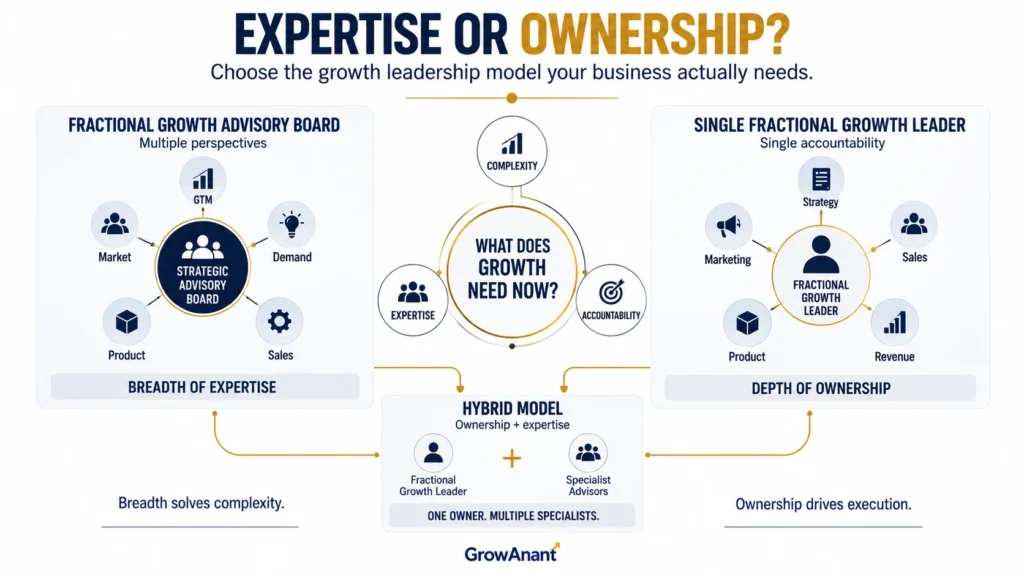
A fractional growth advisory board gives a company access to multiple experienced perspectives across strategy, marketing, sales, product, GTM, and revenue. A single fractional growth leadership model, by contrast, gives the company one accountable senior leader who can coordinate growth decisions and execution.
The distinction matters because companies do not always have the same growth leadership problem.
A founder preparing for U.S. expansion may need several specialized perspectives. A SaaS company with a capable marketing team but no senior growth owner may benefit more from a fractional growth consultant or fractional chief growth officer.
The right decision depends on the company’s stage, complexity, internal capabilities, and need for accountability.
What Is a Growth Advisory Board?
A growth advisory board is a group of experienced advisors brought together to provide strategic perspective, specialized expertise, networks, and challenge around important business decisions.
It is different from a formal board of directors. A growth advisory board generally does not carry the same governance responsibilities or legal authority.
Harvard Business Review has highlighted advisory boards as a way for entrepreneurs to access perspectives, experience, competencies, and networks that complement the founder’s capabilities.
A fractional growth advisory board applies this concept specifically to growth.
The group might include expertise across:
- Go-to-market strategy
- Demand generation
- Sales
- Product
- Pricing
- Customer acquisition
- Revenue operations
- U.S. market expansion
- Industry-specific growth
For example, a healthtech startup entering the U.S. could benefit from advisors with healthcare commercialization, product, demand generation, and market-entry experience.
A fintech company may need a different combination.
This makes the advisory model particularly useful when the growth challenge is broad and specialized knowledge is required.
What an Advisory Board Should Actually Do
A productive advisory board should not become a monthly meeting where executives receive disconnected opinions.
Its role should be structured around specific strategic questions:
Where should we compete?
How should we position the business?
Which growth opportunities deserve investment?
What risks could prevent scaling?
What capabilities are missing?
McKinsey’s research on scaling startups emphasizes the importance of deliberately choosing board capabilities and ensuring that board expertise complements the company’s strategic needs.
That principle also applies to a growth-focused advisory structure.
The Single Leader Model
A single fractional growth executive takes a different approach.
Instead of assembling several specialists, the company gives one senior leader responsibility for coordinating the growth system.
That person may operate as a:
- fractional growth consultant
- fractional chief growth officer
- fractional head of growth
- strategic growth advisor
- interim growth leader
The key advantage is accountability.
A single leader can connect:
Strategy → Positioning → Demand → Acquisition → Conversion → Pipeline → Revenue
This is especially useful when a company already has execution resources but lacks strategic ownership.
For example, imagine a Series A SaaS company with:
- a content marketer
- paid media support
- SDRs
- a sales leader
- product marketing resources
The company may not need five more specialists.
It may need one senior person who can determine which initiatives matter, align the teams, establish KPIs, and hold the growth system together.
That is where fractional growth leadership can be more effective than an advisory group.
Pros and Cons of Each
The two models solve different problems.
| Factor | Fractional Growth Advisory Board | Single Fractional Growth Leader |
| Strategic perspectives | Multiple | One integrated perspective |
| Specialized expertise | High | Depends on leader |
| Accountability | Shared | Clearer |
| Execution leadership | Limited unless explicitly structured | Stronger |
| Cross-functional coordination | More difficult | Easier |
| Founder access | Typically periodic | More continuous |
| Decision speed | Can require alignment | Usually faster |
| Best use | Complex strategic questions | Ongoing growth ownership |
| Internal team integration | Moderate | High potential |
| Scaling leadership | Advisory | Operating |
Advisory Board Advantages
Breadth: Multiple perspectives can expose blind spots.
Specialization: The company can access expertise it does not have internally.
Network access: Advisors may bring relationships and market knowledge.
Strategic challenge: A group can challenge founder assumptions from different angles.
Advisory Board Limitations
The same breadth can create fragmentation.
If five advisors recommend five different growth priorities, the CEO still has to decide what to do.
Other limitations can include:
- unclear accountability
- slower decisions
- conflicting recommendations
- limited execution involvement
- meeting-heavy structures
Single Leader Advantages
A single fractional head of growth can:
- establish priorities
- coordinate teams
- manage the growth roadmap
- connect marketing to pipeline
- establish accountability
- run growth reviews
- translate strategy into execution
- adapt priorities as evidence changes
Single Leader Limitations
One person may not possess deep expertise across every required discipline.
There is also key-person dependency if the organization relies too heavily on one external leader.
The solution is not necessarily to replace the leader with a board. It may be to give the leader access to specialist advisors when needed.
Cost Comparison
Cost should be evaluated against the business problem being solved, not simply the number of people involved.
A board can look attractive because the company gets multiple experts without hiring multiple full-time executives. However, if those experts provide advice without execution ownership, the company may still have the same leadership gap.
A single fractional leader may cost more than one individual advisor but can create greater operating leverage when that person owns the growth agenda.
Cost and Value Framework
| Question | Advisory Board | Single Leader |
| Need specialized expertise? | Strong fit | Moderate fit |
| Need daily or weekly ownership? | Weak to moderate | Strong fit |
| Need strategic challenge? | Strong fit | Strong fit |
| Need team coordination? | Moderate | Strong |
| Need one accountable owner? | Weak | Strong |
| Need multiple market perspectives? | Strong | Moderate |
| Need execution oversight? | Moderate | Strong |
The relevant calculation is therefore:
Required expertise × required involvement × decision complexity
A company should pay for the leadership model that matches those three variables.
For a growth-stage business, growth consulting services, revenue growth consulting, and growth strategy consulting should be evaluated based on the level of strategic ownership required rather than simply the number of services offered.
Which Fits Different Company Stages
Company stage is one of the strongest indicators of which model makes sense.
Early-Stage Startup
An early startup may benefit from a small advisory group when the founder needs external perspective on product-market fit, positioning, pricing, fundraising, or initial GTM decisions.
The objective is learning and strategic validation.
Early Growth
As the company begins generating consistent demand, a single fractional growth leader can become more valuable.
The organization now needs someone to coordinate marketing, sales, product, and customer insights around a defined growth roadmap.
Growth-Stage SaaS
A SaaS company with multiple channels, a growing team, and increasing pipeline complexity may benefit from a fractional leader supported by specialist advisors.
This creates both accountability and access to expertise.
U.S. Market Expansion
Companies entering the U.S. may benefit from a hybrid structure.
For example:
Fractional Growth Leader
→ owns GTM roadmap and execution
U.S. Market Advisor
→ provides market-specific insight
Demand Generation Specialist
→ supports acquisition strategy
Industry Advisor
→ provides vertical expertise
This is particularly relevant to market entry strategy USA, B2B marketing strategy consulting, and SaaS growth consulting situations.
McKinsey’s research on scaling startups emphasizes that leadership structures and capabilities need to evolve as companies move through different growth stages.
Stage-Based Decision Matrix
| Company Situation | Better Starting Model |
| Founder needs external perspective | Advisory board |
| Several strategic unknowns | Advisory board |
| Clear strategy but weak execution leadership | Fractional leader |
| Existing team lacks senior growth ownership | Fractional leader |
| Complex U.S. market entry | Hybrid |
| Multiple specialized growth problems | Hybrid |
| Rapidly scaling organization | Fractional leader + advisors |
Combining Both Models
The strongest solution is sometimes not either/or.
A company can use a fractional growth leadership model as the operating layer and a fractional growth advisory board as the strategic specialist layer.
Think of the structure as:
CEO / Founder
↓
Fractional Growth Leader
↓
Marketing + Sales + Product + Revenue Teams
↙ ↓ ↘
Specialist Advisors
The leader owns the roadmap.
The advisors provide targeted expertise.
The internal team executes.
The CEO retains strategic oversight.
This creates a growth leadership team structure without immediately building a large executive organization.
Example
Consider a U.S. B2B SaaS company entering a new vertical.
The fractional head of growth owns:
- ICP
- positioning
- GTM roadmap
- demand generation
- pipeline KPIs
- experimentation
- cross-functional coordination
Specialist advisors might support:
- industry positioning
- enterprise sales
- product strategy
- channel partnerships
The model works because each person has a distinct role.
Hybrid Model Checklist
Before combining the models, define:
- Who owns the growth roadmap?
- Who makes final growth decisions?
- Which advisors have specific expertise?
- What decisions require advisory input?
- What does the internal team own?
- Which KPIs determine progress?
- How frequently are advisors engaged?
- How are conflicting recommendations resolved?
- When should the company transition to full-time leadership?
The biggest mistake is creating an advisory structure without ownership.
More expertise does not automatically create better growth.
The company needs a clear operating model that turns expertise into decisions and decisions into execution.
For GrowAnant, this distinction is central to a strategy-first growth partnership. The appropriate model may involve fractional growth leadership, targeted advisory expertise, or a combination depending on the company’s growth constraints, internal capabilities, and stage.
The objective is to create enough strategic leadership and specialized expertise to connect business growth, demand generation, GTM execution, and revenue outcomes without creating unnecessary organizational complexity.
References
- Harvard Business Review: Who Advises the Entrepreneur?
- McKinsey & Company: Leadership lessons on scaling start-ups
Frequently Asked Questions
A fractional growth advisory board is a group of external advisors who provide specialized strategic expertise to help a company address growth, GTM, market, marketing, product, sales, or revenue challenges. Unlike a formal board of directors, an advisory board generally provides guidance rather than governance authority.
Neither is universally more effective. An advisory board is stronger when the company needs multiple specialized perspectives. A single fractional leader is usually more effective when the company needs one accountable person to coordinate strategy, teams, execution, and growth measurement.
There is no universal cost because advisory structures vary based on the number of advisors, expertise required, meeting frequency, scope, and level of involvement. Companies should evaluate the model based on the strategic problem being solved and the value of the expertise required rather than simply comparing advisor fees.
Yes. A company can use a fractional growth leader as the accountable owner of the growth roadmap while engaging specialist advisors for specific strategic questions. This hybrid model can provide both operating accountability and access to specialized expertise when roles, decision rights, and responsibilities are clearly defined.