
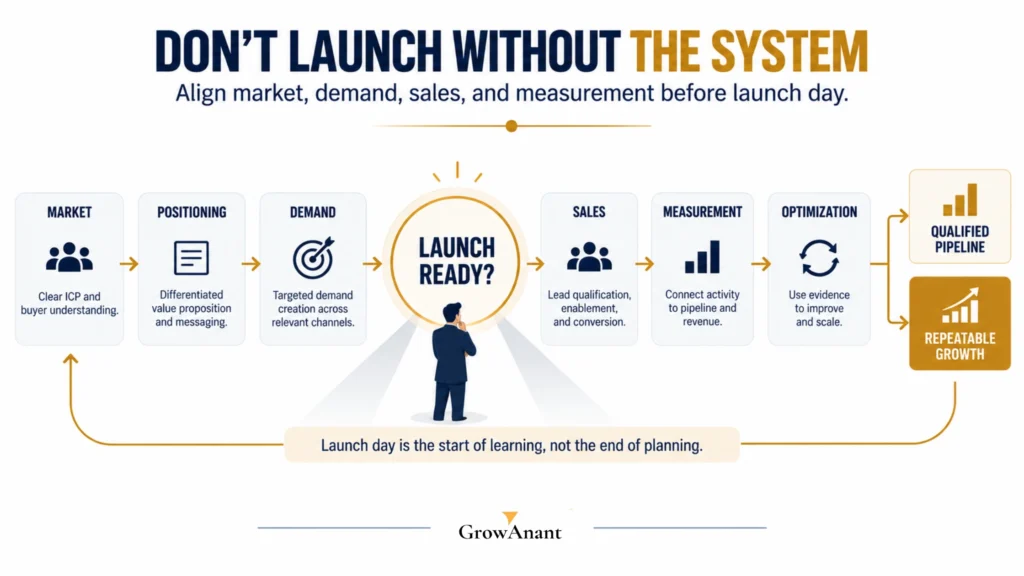
Launching a new SaaS product requires more than creating campaigns and announcing a release date. A demand gen b2b saas go to market checklist helps marketing, sales, product, and leadership teams coordinate the decisions that influence pipeline before launch day. The right growth marketing services approach connects positioning, audience targeting, channel readiness, sales enablement, and measurement into one operating system.
For a growth-stage SaaS company, the objective is not simply to generate attention. It is to create qualified demand that can move through the buying journey and contribute to measurable pipeline and revenue.
A useful launch model is:
Market insight → Positioning → Demand creation → Lead capture → Sales conversion → Measurement → Optimization
HubSpot’s product launch guidance similarly emphasizes customer research, positioning, go-to-market planning, measurable goals, promotion, testing, team preparation, and post-launch evaluation as interconnected launch activities.
Pre-Launch Foundations
The first stage of a b2b saas go to market checklist is making sure the commercial foundation is ready before traffic is generated.
A common mistake is starting with channels. A SaaS company may immediately plan LinkedIn campaigns, paid search, webinars, or email sequences without first establishing who the product is for, which problem it solves, and why the market should care.
Pre-launch foundation checklist
| Area | Questions to validate | Launch-ready signal |
| ICP | Which companies and roles are highest priority? | Clear ICP and buyer roles |
| Problem | What urgent business problem does the product solve? | Documented pain points |
| Use case | What situation triggers purchase consideration? | Prioritized use cases |
| Differentiation | Why choose this product over alternatives? | Clear competitive narrative |
| Buying process | Who influences, evaluates, approves, and uses it? | Buying committee mapped |
| Offer | What is the next logical step for prospects? | Clear conversion path |
| Sales alignment | What qualifies a marketing-generated opportunity? | Agreed qualification criteria |
| Data | Can engagement be connected to accounts and pipeline? | Tracking architecture tested |
This foundation matters particularly for SaaS companies entering competitive categories. SaaS growth consulting should therefore begin with commercial clarity rather than immediately increasing media spend.
For example, a U.S. HR technology startup launching an employee analytics platform may have very different demand-generation requirements depending on whether its primary buyer is a 50-person startup, a 500-person mid-market company, or an enterprise HR organization.
The launch plan should be built around the highest-value segment first.
Messaging & Positioning Checklist
Demand generation cannot compensate for unclear positioning.
Before launching growth marketing services, confirm that the product narrative answers four questions quickly:
- Who is this for?
- What problem does it solve?
- Why does the problem matter now?
- Why is this solution meaningfully different?
A strong message should translate product capabilities into business consequences.
For example:
Feature: Automated revenue forecasting
Weak message: AI-powered forecasting for modern sales teams
Stronger message: Help revenue leaders identify forecast risk earlier and improve pipeline visibility across the sales organization.
The second version connects the product to an executive concern.
Messaging checklist
- ICP-specific value proposition
- Primary pain point clearly stated
- Business outcome explained
- Competitive differentiation documented
- Industry-specific variations prepared
- Website headline aligned with campaign messaging
- Landing-page copy aligned with sales messaging
- Objections documented
- Proof points and customer evidence available
- Messaging reviewed by sales and product teams
This is also where B2B marketing strategy consulting can create leverage. Instead of producing more content around a weak narrative, the team can identify the positioning gap first.
For a U.S. SaaS launch, messaging should also account for market-specific terminology, competitive expectations, pricing context, and buyer priorities. Companies entering the U.S. market may need a dedicated market entry strategy USA approach rather than simply translating messaging developed for another region.
Channel Readiness Checklist
Once positioning is established, determine where demand should be created and captured.
The goal is not to appear everywhere. It is to identify the channels most aligned with the ICP, buying journey, and available resources.
| Channel | Best use | Launch readiness question |
| Awareness, thought leadership, targeted B2B reach | Is the ICP active and identifiable? | |
| Paid search | Capturing existing intent | Are high-intent searches commercially relevant? |
| Nurturing known audiences | Are segments and sequences ready? | |
| Content | Education and organic demand | Does content address real buying questions? |
| ABM | Strategic account engagement | Are target accounts clearly defined? |
| Webinars | Education and trust | Is the topic valuable before the product pitch? |
| Partnerships | Borrowed credibility and reach | Are relevant partners available? |
| Retargeting | Re-engagement | Are audiences and conversion paths configured? |
Understanding account based marketing vs demand generation is important here. ABM can focus resources on defined high-value accounts, while broader demand generation builds awareness and interest across a larger market. They can operate together rather than being treated as mutually exclusive.
Similarly, linkedin growth marketing b2b should not mean posting frequently without a strategic objective. LinkedIn activity should support awareness, education, executive credibility, account engagement, or conversion.
A specialized demand generation agency or internal demand team should be judged by how effectively channels work together, not simply by the number of campaigns launched.
Sales Enablement Checklist
Marketing creates demand, but sales determines whether much of that demand becomes pipeline.
Before launch, sales should have the information required to respond consistently to prospects.
Sales enablement checklist
- Product positioning document
- ICP and qualification criteria
- Buyer persona summaries
- Discovery questions
- Competitive objection handling
- Product demo narrative
- Follow-up sequences
- Launch-specific email templates
- Case studies or proof points
- FAQ document
- Lead routing rules
- Sales and marketing SLA
A lead scoring model b2b should also distinguish between activity and commercial relevance. A prospect downloading one article is not automatically more valuable than an ICP account showing repeated engagement with a high-intent product page.
The most useful scoring systems combine factors such as:
Fit + Intent + Engagement + Buying Stage
For example, a VP Marketing from a target SaaS company visiting pricing and implementation pages may warrant more sales attention than a large volume of anonymous traffic.
This is where B2B lead generation services should connect directly to sales qualification rather than optimizing only for form fills.
Measurement Setup Checklist
Launch measurement should be designed before launch, not after the first campaign produces confusing data.
A practical measurement framework should connect:
Channel → Engagement → Qualified Lead → Opportunity → Pipeline → Revenue
Measurement checklist
| Measurement layer | Example metrics |
| Awareness | Reach, branded search, relevant engagement |
| Demand | Content engagement, returning visitors, account engagement |
| Lead | Qualified leads, conversion rate, lead quality |
| Pipeline | Opportunities, pipeline sourced, pipeline influenced |
| Efficiency | CAC, CPL, cost per opportunity |
| Revenue | Closed revenue, customer acquisition payback |
| Retention | Activation, expansion, retention indicators |
A b2b marketing attribution model should be selected based on the company’s sales cycle and data maturity. Avoid pretending that every touchpoint can be assigned perfectly to one source.
The more important question is whether leadership can identify which audiences, channels, messages, and campaigns are contributing to commercial outcomes.
Demand generation analytics should therefore support decisions such as:
- Which audience is responding?
- Which channel is producing qualified opportunities?
- Where is funnel leakage occurring?
- Which message generates stronger engagement?
- Which campaigns should receive more or less investment?
- Is marketing-generated pipeline progressing?
McKinsey’s research on B2B growth similarly emphasizes tracking performance against the market and managing growth initiatives as measurable bets rather than relying on isolated activities.
Post-Launch Review
The launch is not the finish line. It is the beginning of the learning cycle.
A SaaS company should avoid judging the entire launch from first-day traffic or lead volume. Early indicators can reveal attention and engagement, but commercial performance takes longer to develop.
Post-launch review framework
Within 24-48 hours
- Confirm tracking
- Check campaign delivery
- Review technical issues
- Monitor early engagement
- Identify obvious messaging problems
Within 1-2 weeks
- Review lead quality
- Compare channel performance
- Analyze conversion points
- Review sales feedback
- Identify audience patterns
Within 30 days
- Review qualified pipeline
- Compare CAC efficiency
- Evaluate sales progression
- Identify winning messages
- Reallocate budget
- Update ICP assumptions
The key principle is to separate signal from noise.
For example, if a launch generates 1,000 leads but only a small proportion match the ICP, increasing spend may worsen the underlying problem. Conversely, a smaller campaign generating highly qualified opportunities may deserve greater investment.
A strong growth strategy consulting process therefore treats the launch as a controlled learning system.
Executive launch review
At the leadership level, ask five questions:
- Did we reach the right market?
- Did the market understand the value proposition?
- Did engagement translate into qualified demand?
- Did qualified demand convert into pipeline?
- What should we change before scaling?
This approach helps founders and marketing leaders avoid the common trap of optimizing for activity while revenue remains unpredictable.
For growth-stage SaaS companies, the broader objective is to create a repeatable demand engine. That may involve growth consulting services, business growth consulting, or a fractional growth leadership model when internal teams can execute but lack the senior ownership required to connect strategy, demand generation, sales, and revenue.
GrowAnant approaches this problem as a growth partner rather than a tactical vendor, helping businesses connect growth strategy, demand generation, go-to-market planning, and revenue execution into scalable systems.
Get the Launch Checklist: Use this framework as a pre-launch operating document and assign an owner, deadline, and completion status to every item before launch day.
References
Frequently Asked Questions
Before launch, the ICP, positioning, messaging, offer, channels, landing pages, sales enablement, lead-routing process, tracking, attribution approach, and reporting structure should be ready. The most important requirement is alignment between marketing and sales on what constitutes qualified demand.
For a meaningful B2B SaaS launch, planning should begin several weeks ahead, with larger or strategically important launches requiring substantially more preparation. HubSpot recommends working backward from the launch date and building time for research, positioning, content, testing, promotion, and team preparation.
The biggest mistake is treating launch day as the strategy rather than the execution point of a broader go-to-market system. Teams often focus heavily on traffic and announcements while overlooking positioning, sales readiness, lead quality, follow-up, and measurement.
Technical and campaign issues should be reviewed immediately. Lead quality and engagement can be assessed within the first one to two weeks, while pipeline and revenue impact generally require a longer evaluation window. The objective is to review early signals quickly without making premature decisions based on incomplete data.