
For a growth-stage company, international expansion can look like the natural next step after establishing a strong U.S. position. But how do companies successfully navigate global market entry without spreading resources too thin or assuming that what worked in the U.S. will work everywhere?
The answer is not simply entering the largest available market. Successful expansion requires a clear go to market strategy consulting approach, disciplined market selection, local understanding, and a repeatable operating model.
Whether the company is a SaaS startup, professional services firm, or established B2B business, global expansion should be treated as a business transformation rather than a marketing campaign. The objective is to identify where the company can create a genuine competitive advantage, determine how that advantage must adapt, and build a system for learning before scaling.
Why Global Expansion Differs by Region
A product that performs well in the U.S. does not automatically have product-market fit elsewhere.
Markets differ in:
- Customer expectations
- Pricing sensitivity
- Buying processes
- Regulations
- Competitive intensity
- Distribution channels
- Language and communication
- Cultural norms
- Procurement requirements
- Partner ecosystems
For example, a U.S. B2B SaaS company entering Germany may face different procurement expectations from those it encounters in the United States. An Indian technology company expanding into the U.S. may need to adjust positioning, sales processes, proof points, and customer acquisition models rather than simply reproduce its domestic playbook.
This is why market entry support needs to combine commercial analysis with operational readiness.
A useful executive question is not:
“Which country has the biggest market?”
It is:
“Where can we realistically win, and what must change for us to win there?”
McKinsey’s research similarly emphasizes that international expansion works best when companies have an advantage that can transfer into a new market while still understanding and responding to local conditions.
Standardization vs. Localization
| Area | Standardize | Localize |
| Core product | Often | Selectively |
| Brand principles | Usually | Messaging may change |
| Pricing | Framework | Market-specific |
| Sales process | Core methodology | Buying process |
| Content | Brand standards | Language and examples |
| Partnerships | Strategic criteria | Local relationships |
| Customer support | Service principles | Local expectations |
The goal is not complete standardization or complete localization. It is finding the right balance.
A Repeatable Market Entry Framework
A disciplined market entry strategy USA or international expansion plan should begin with evidence rather than enthusiasm.
A practical five-step framework is:
1. Define the transferable advantage
Identify what actually makes the company competitive.
It could be:
- Proprietary technology
- Cost efficiency
- Strong brand credibility
- Specialized expertise
- Distribution capability
- Customer experience
- A differentiated business model
If the advantage depends entirely on U.S.-specific conditions, expansion may require significant redesign.
2. Score potential markets
Build a simple market attractiveness scorecard.
| Factor | Key Question |
| Demand | Is there a meaningful customer problem? |
| Competition | Can we differentiate? |
| Economics | Can customers support profitable pricing? |
| Accessibility | Can we reach buyers efficiently? |
| Regulation | What barriers exist? |
| Capability | Can we support customers locally? |
| Strategic fit | Does the market strengthen our broader business? |
This approach is consistent with the principle behind structured market-selection frameworks such as HubSpot’s MARACA approach, which considers market availability, real-time analytics, and customer addressability.
3. Define the entry model
Different markets may require different approaches:
- Direct sales
- Local distributor
- Strategic partnership
- Reseller model
- Joint venture
- Acquisition
- Local subsidiary
A B2B SaaS company may begin with direct sales and remote customer success, while a professional services company might benefit from a local strategic partner.
4. Build a localized go-to-market plan
This is where growth strategy consulting becomes particularly valuable.
The plan should connect:
Market → ICP → Positioning → Offer → Channel → Sales Motion → Customer Success → Economics
The important point is that localization should happen at the level of the customer journey, not just website translation.
5. Establish measurable entry criteria
Before investing heavily, define what would prove that the market deserves additional resources.
Examples include:
- Qualified pipeline generated
- Sales cycle length
- Win rate
- Customer acquisition cost
- Average contract value
- Retention
- Expansion revenue
- Partner contribution
- Time to first meaningful revenue
This turns expansion into a controlled business experiment rather than an irreversible bet.
Localization Considerations
Localization is often misunderstood as translating content.
True localization asks whether the business feels relevant and credible to customers in the target market.
Consider four layers.
Product localization
Does the product meet local requirements, integrations, workflows, and expectations?
Commercial localization
Does the pricing model fit local purchasing behavior? Are contracts, payment methods, and procurement processes appropriate?
Messaging localization
Does the value proposition address the market’s actual pain points?
For instance, a SaaS company selling workflow automation might emphasize productivity in one market and compliance or cost control in another.
Trust localization
Can prospects see evidence that the company understands their environment?
This may require:
- Local customer stories
- Regional experts
- Local partners
- Relevant certifications
- Market-specific case studies
- Local sales or customer success support
For an Indian company entering the U.S., us market entry consulting for indian companies may therefore involve much more than generating American leads. It may require repositioning the company for U.S. buyers, refining its ICP, strengthening credibility, and building a sales process suited to the market.
A useful principle is:
Keep the strategic core consistent. Adapt the customer-facing experience where the market demands it.
Common Global Expansion Mistakes
Global expansion tends to fail when companies treat geography as the primary growth lever instead of evaluating whether the underlying business model is ready.
Mistake 1: Choosing markets based only on size
A large TAM does not guarantee accessible demand.
A smaller market where the company has strong differentiation can be more attractive than a huge market dominated by established competitors.
Mistake 2: Copying the U.S. playbook
A sales process that works in America may not work in Europe, Asia, or the Middle East.
Customer expectations, decision-making structures, pricing, and trust-building can differ significantly.
Mistake 3: Localizing too late
Waiting until after launch to understand local customers can create expensive rework.
Market interviews, competitor research, and buyer validation should happen before major investment.
Mistake 4: Expanding without ownership
International expansion often becomes everyone’s responsibility and therefore nobody’s responsibility.
A market needs a clear owner, commercial targets, operating assumptions, and decision rights.
Mistake 5: Measuring activity instead of economics
Website traffic, meetings, campaigns, and partnerships can create the appearance of progress without producing a viable business.
Executives should continually ask:
Are we learning enough to justify the next investment?
Mistake 6: Expanding before the core business is ready
International expansion cannot compensate indefinitely for weak positioning, poor retention, or an inefficient acquisition model.
A strong domestic foundation provides a better platform for exporting the company’s competitive advantage.
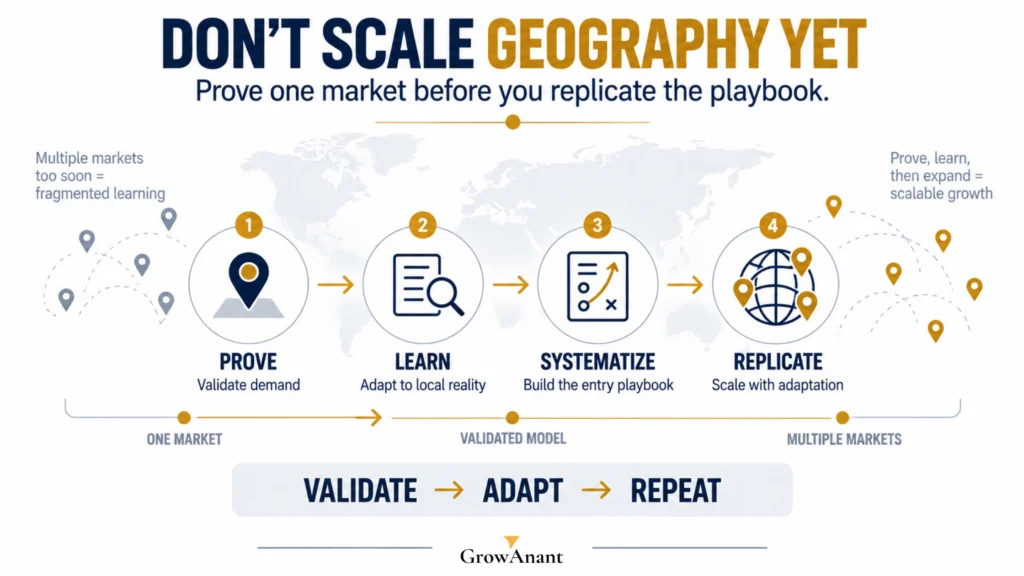
Sequencing Multi-Market Expansion
The temptation is understandable: if three markets appear attractive, why not enter all three?
Because each market creates operational complexity.
A better approach is often:
Prove → Learn → Systematize → Replicate
Phase 1: Prove
Select one priority market and establish whether the business can generate meaningful demand.
Phase 2: Learn
Document:
- Buyer objections
- Competitive differences
- Pricing response
- Sales cycle
- Channel performance
- Product gaps
- Customer expectations
Phase 3: Systematize
Convert those lessons into repeatable processes.
Build a market-entry playbook covering positioning, sales, marketing, onboarding, customer success, partnerships, and reporting.
Phase 4: Replicate
Use the playbook to evaluate the next market while remaining willing to adapt where local conditions differ.
| Expansion Approach | Advantage | Risk |
| One market at a time | Strong learning | Slower geographic coverage |
| Multiple similar markets | Potential efficiency | Resource dilution |
| Aggressive global launch | Fast visibility | High complexity |
| Pilot-led expansion | Controlled investment | Requires patience |
For most growth-stage companies, a focused sequence is easier to manage than simultaneous expansion across unrelated markets.
This is particularly important for startups. startup growth strategy consulting should not simply ask how to generate demand faster. It should determine whether the organization has the leadership capacity, customer success infrastructure, capital discipline, and operating model required to support additional markets.
References
- Harvard Business Review: How to Develop a Targeted Market Expansion Strategy
Harvard Business Review
Frequently Asked Questions
There is no single framework that works identically for every company or market.
However, a repeatable process can still guide decisions:
Assess the market → Validate demand → Define the entry model → Localize the customer experience → Launch → Measure → Learn → Scale.
The framework creates discipline while allowing market-specific decisions.
Enough to remove meaningful barriers to adoption without unnecessarily rebuilding the entire business.
Product functionality, pricing, messaging, sales processes, customer support, regulatory requirements, and partnerships may require localization. Core brand principles and strategic capabilities can often remain consistent.
The right question is not “How much should we localize?”
It is:
Which parts of our customer experience must change for customers to choose us confidently?
The most common mistake is assuming that existing success will transfer automatically.
A company may have strong revenue, brand recognition, or customer traction in its home market and still struggle internationally because its positioning, channels, competitive advantage, or operating model does not translate.
Global expansion should therefore begin with validation, not assumption.
Usually, expansion should be sequenced unless there is a strong operational reason to enter several highly related markets simultaneously.
Entering multiple markets can make sense when customer needs, regulations, language, channels, and economics are sufficiently similar. Otherwise, the organization risks dividing leadership attention and learning too slowly in every market.
The stronger approach is to establish a successful market-entry model first, then replicate and adapt it.
GrowAnant approaches global expansion from this strategy-first perspective, connecting growth consulting services, demand generation, go-to-market planning, and revenue execution so expansion decisions are tied to the broader growth system rather than isolated marketing activity.