
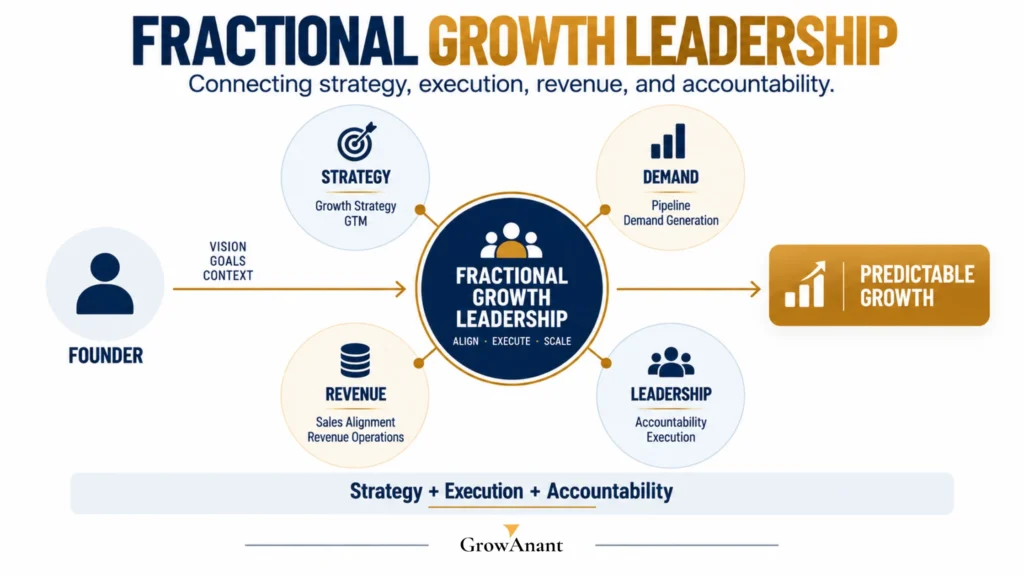
A fractional growth leadership glossary helps founders understand the roles, revenue concepts, operating models, and engagement structures involved in building a scalable growth function. Terms such as fractional growth leadership, fractional growth consultant, fractional chief growth officer, and fractional head of growth describe different approaches to adding senior growth expertise without necessarily building a full executive team immediately.
For growth-stage companies, understanding these growth leadership terms matters because growth is rarely just a marketing problem. It can involve positioning, demand generation, customer acquisition, sales execution, pipeline management, go-to-market decisions, and leadership accountability.
Leadership & Role Terms
Fractional growth leadership refers to senior growth leadership provided on a part-time, interim, or defined-engagement basis. The objective is to provide strategic direction while connecting marketing, sales, customer acquisition, and revenue priorities.
A fractional growth consultant typically works across strategy, growth opportunities, customer acquisition, experimentation, and execution planning. The role can be particularly useful when a founder has an execution team but lacks senior growth ownership.
A fractional chief growth officer generally operates at an executive level. The focus is broader than campaign management and may include growth strategy, revenue priorities, organizational alignment, and resource allocation.
A fractional head of growth is usually closer to day-to-day growth leadership. This role may coordinate marketing, demand generation, analytics, experimentation, and sales alignment.
| Term | Primary focus | Typical business need |
| fractional growth executive | Executive growth direction | Senior leadership without a full-time executive hire |
| fractional growth consultant | Strategy and problem solving | Specific growth challenges |
| fractional chief growth officer | Enterprise-level growth leadership | Cross-functional growth ownership |
| fractional head of growth | Growth execution and optimization | Building a structured growth function |
The appropriate role depends on the company’s stage, internal capabilities, growth challenges, and leadership structure.
For example, a SaaS founder with strong marketing execution but inconsistent pipeline may need senior growth direction rather than another execution resource. A healthcare startup entering a new market may require strategic leadership across positioning, acquisition, demand generation, and go-to-market planning.
A fractional growth advisory board can provide another layer of strategic perspective, particularly when founders need external expertise across growth decisions without creating a permanent executive structure.
Revenue & Pipeline Terms
Growth leadership becomes meaningful when marketing activity connects to commercial outcomes.
Revenue growth consulting focuses on identifying and improving the systems that influence revenue, including acquisition, conversion, retention, expansion, positioning, and go-to-market execution.
Business growth consulting can address broader growth questions such as which markets to enter, which customer segments to prioritize, how to improve acquisition efficiency, and where execution is constrained.
Growth consulting services may include strategy development, growth diagnostics, demand generation planning, funnel analysis, positioning, experimentation, and growth roadmap development.
A practical revenue framework is:
Market → Positioning → Demand → Pipeline → Conversion → Revenue → Retention
This prevents teams from treating traffic, leads, or campaigns as the final objective.
For example, a B2B software company may generate thousands of website visitors but still experience weak pipeline. The issue may not be traffic volume. It could be poor ICP definition, weak positioning, ineffective qualification, or disconnected sales follow-up.
A strong growth leadership team structure therefore connects the following:
| Area | Leadership question |
| Market | Which customers and markets matter most? |
| Positioning | Why should those customers choose us? |
| Demand | How will qualified demand be created? |
| Pipeline | How does demand become sales opportunity? |
| Revenue | Which activities contribute to commercial outcomes? |
| Retention | Does acquisition create sustainable customer value? |
This approach also supports growth strategy consulting, where strategic priorities are connected to measurable business outcomes rather than isolated marketing activities.
GTM & Channel Terms
Go-to-market terminology describes how a company reaches, acquires, and serves its target market.
Go to market strategy consulting focuses on decisions such as target segments, positioning, routes to market, acquisition channels, sales motions, launch strategy, and market expansion.
A company expanding into the U.S., for example, may need to evaluate positioning, customer expectations, competitive alternatives, pricing, demand channels, and sales processes before increasing acquisition spend.
Startup growth strategy consulting is often focused on prioritization. A founder may have several possible channels but limited capital, people, and time. The strategic question becomes which growth opportunities deserve attention first.
Common channel terms include:
- growth marketing services: marketing activities designed around measurable growth objectives.
- demand generation agency: an external partner focused on creating and developing market demand.
- B2B lead generation services: activities designed to identify and generate potential business buyers.
- growth marketing agency USA: a growth-focused marketing provider serving the U.S. market.
- digital growth agency: a digital partner focused on growth activities across relevant online channels.
- B2B growth marketing agency: a marketing provider focused specifically on business-to-business growth.
- B2B marketing: marketing activities designed for business buyers and organizational purchasing processes.
- demand generation: activities that build awareness, interest, engagement, and qualified demand.
Other relevant terms include account based marketing vs demand generation, linkedin growth marketing b2b, and demand generation analytics. These describe different approaches to reaching and understanding prospective buyers.
A SaaS company targeting enterprise accounts, for example, may use account-focused programs while simultaneously building broader category demand.
For companies expanding into the United States, market entry strategy USA and business strategy consulting USA may become relevant when growth depends on adapting an existing business model to a new market.
Metrics & Reporting Terms
Growth leadership requires a shared measurement system.
Common metrics include:
- Pipeline value
- Qualified opportunities
- Conversion rates
- Customer acquisition cost
- Sales cycle length
- Average deal value
- Customer retention
- Revenue growth
- Channel performance
- Marketing contribution
A b2b marketing attribution model attempts to connect marketing interactions with pipeline and revenue outcomes. Attribution should support decision-making rather than create false precision.
Similarly, lead scoring model b2b frameworks help businesses prioritize prospects based on characteristics and behaviors that indicate potential fit or buying intent.
The objective is not to track every available metric. It is to establish a practical relationship between activity and business outcomes.
For example:
Campaign activity → Qualified engagement → Sales opportunity → Closed revenue
HubSpot describes pipeline management as a way to monitor deals through stages, while its glossary defines deal scoring as an indicator of the likelihood that a deal will close.
Other targeted concepts include performance marketing services USA, digital marketing consulting services, and B2B marketing strategy consulting. These should ultimately be evaluated according to their contribution to business objectives rather than activity volume alone.
Engagement & Contract Terms
The engagement structure determines how external growth leadership works with the internal organization.
A fractional growth leadership contract typically defines scope, responsibilities, decision rights, meeting cadence, priorities, deliverables, and engagement duration.
Common engagement models include:
| Model | Best suited for | Primary characteristic |
| Advisory | Founder seeking strategic perspective | Guidance |
| Fractional leadership | Company lacking senior growth ownership | Leadership |
| Project-based consulting | Defined growth challenge | Specific outcome |
| Retainer | Ongoing strategic and execution support | Continuity |
A growth roadmap consulting engagement may focus on identifying priorities, sequencing initiatives, defining owners, and establishing measurement.
For specialized businesses, terms such as fractional growth leadership fintech and fractional growth leadership healthtech describe the application of fractional leadership within specific industry environments.
Other relevant services can include startup consulting services USA, small business growth consulting, professional services marketing agency, lead generation for B2B services, and marketing strategy for service businesses.
The right engagement depends on the company’s internal capability. If execution already exists but leadership is missing, fractional leadership may be more relevant than adding another tactical provider.
McKinsey’s research on operating models emphasizes that strategy requires an operating model capable of translating strategic objectives into execution, with clear accountability, processes, leadership, and capabilities.
How to Use This Glossary
Founders can use this glossary as a practical decision framework.
Step 1: Identify the business problem
Ask:
- Is the challenge strategy?
- Demand generation?
- Pipeline?
- Positioning?
- Market expansion?
- Execution?
- Leadership capacity?
Step 2: Identify the capability gap
Determine whether the company needs:
Strategy → Leadership → Execution → Measurement
A company should avoid hiring or outsourcing a capability simply because it is popular. The requirement should originate from the actual growth constraint.
Step 3: Map the right terminology
For example:
| Business situation | Relevant concept |
| No senior growth ownership | fractional growth leadership |
| Founder needs strategic support | fractional growth consultant |
| Cross-functional growth accountability | fractional chief growth officer |
| Growth function needs operational leadership | fractional head of growth |
| Pipeline is inconsistent | revenue growth consulting |
| Market expansion is planned | go to market strategy consulting |
| Growth priorities are unclear | growth strategy consulting |
| Execution lacks strategic direction | growth consulting services |
For businesses considering SaaS growth consulting, business growth consulting, or growth roadmap consulting, the same principle applies: first identify the constraint, then select the capability required to address it.
GrowAnant approaches growth as a connected system across strategy, demand generation, go-to-market execution, and revenue rather than treating individual marketing activities as isolated initiatives. This reflects its positioning as a growth partner for scalable, predictable revenue growth.
A useful founder checklist is:
- Do we have clear growth ownership?
- Is our growth strategy documented?
- Are marketing and sales working toward shared outcomes?
- Can we connect demand generation to pipeline?
- Do we know which channels deserve investment?
- Are responsibilities clearly defined?
- Do we have reliable reporting?
- Do we have the internal leadership required for the next stage?
The terminology becomes useful when it helps leadership make better decisions about people, priorities, resources, and accountability.
References
McKinsey & Company: What is an operating model?
HubSpot: Glossary of CRM, Marketing, and Sales Terms
Frequently Asked Questions
“Fractional” means a senior professional provides leadership or expertise without necessarily working as a full-time executive. The engagement can be structured around defined responsibilities, strategic priorities, and an agreed cadence.
A CGO, or Chief Growth Officer, generally focuses on broad growth across functions. A CRO, or Chief Revenue Officer, typically has broader responsibility for revenue generation and may oversee sales and other commercial functions. A Head of Growth generally focuses on growth strategy, acquisition, experimentation, and related execution.
The exact responsibilities vary by company, so founders should evaluate the actual scope rather than relying only on job titles.
A growth operating system is the coordinated structure through which a company manages growth priorities, people, processes, data, experiments, decision-making, and accountability.
It connects strategy to execution so that growth does not depend entirely on isolated campaigns or individual decisions.
Founders can continue studying growth strategy, operating models, revenue management, demand generation, go-to-market planning, and organizational design through established business and marketing resources.
The most useful approach is to connect terminology with the company’s actual growth challenges, priorities, capabilities, and revenue objectives.