
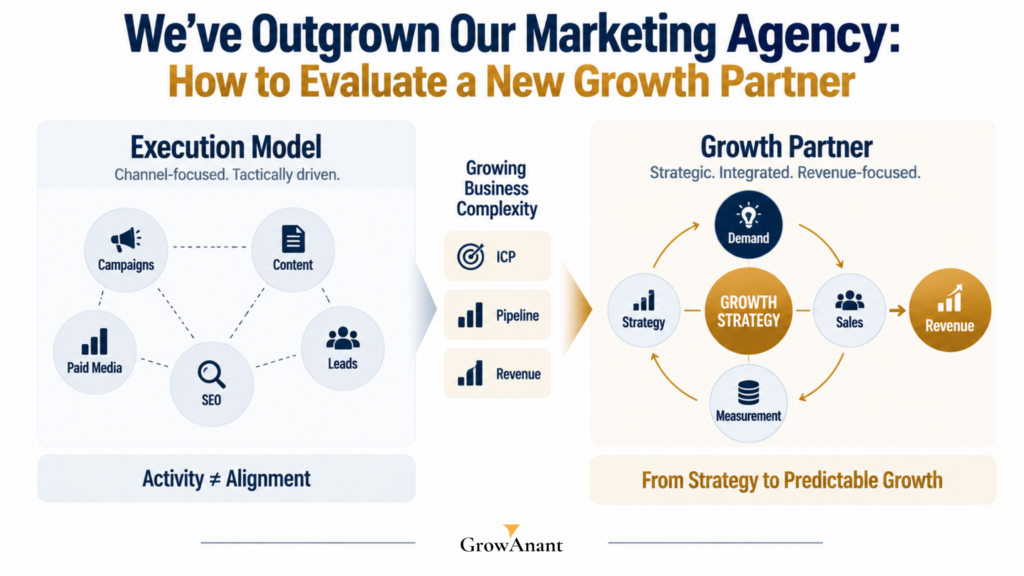
A common question among growth-stage companies is, we’ve outgrown our current agency what should we look for in a new one? The answer is not simply another digital marketing agency with a larger service list. As a company grows, its marketing requirements often shift from campaign execution toward strategy, demand generation, attribution, positioning, and revenue alignment.
An outgrown traditional marketing agency relationship can become visible when marketing activity continues, but strategic clarity, pipeline visibility, and measurable business impact do not keep pace. At that point, the issue may not be that the existing agency is ineffective. The company may simply need a different operating model.
Signs You’ve Outgrown Your Agency
Outgrowing an agency is usually a business-stage issue rather than a single performance problem.
A company may have started with focused growth marketing services, paid campaigns, content, SEO, or B2B lead generation services. Those activities can be appropriate when the immediate objective is establishing acquisition channels.
As the business matures, the questions become broader:
- Which customer segments should receive investment?
- Which channels are producing qualified pipeline?
- Where is the funnel leaking?
- Is positioning strong enough for the next growth stage?
- How should marketing and sales share accountability?
- What should the next 12 months of growth strategy look like?
A useful diagnostic is:
| Signal | What it may indicate |
| More activity but limited pipeline visibility | Execution is ahead of strategy |
| Lead volume is increasing but quality is inconsistent | Acquisition is not aligned with ICP |
| Marketing reports focus mainly on clicks and leads | Revenue accountability is underdeveloped |
| Sales and marketing disagree on lead quality | Revenue processes are disconnected |
| Campaigns operate independently | No integrated growth roadmap |
| Agency recommendations remain channel-specific | Business-level growth questions are not being addressed |
| Leadership frequently changes priorities | Strategic ownership may be missing |
For example, a U.S. SaaS company may have an agency managing paid acquisition successfully at the channel level while still lacking a clear segmentation strategy, sales enablement process, or market expansion plan.
That is often the point at which an B2B growth marketing agency or broader growth partner needs to be evaluated differently.
What to Look for in a New Partner
The most important distinction is between a provider that executes marketing activities and a partner that helps connect strategy, marketing, sales, and revenue.
A new partner should be evaluated across five dimensions.
| Evaluation area | What to look for |
| Strategy | Clear connection between market, ICP, positioning, channels, and revenue |
| Demand generation | A system rather than isolated campaigns |
| Measurement | Pipeline and revenue metrics alongside channel metrics |
| Execution | Ability to turn strategy into coordinated action |
| Leadership | Senior involvement in decisions, prioritization, and problem solving |
For a growth-stage SaaS company, this could include SaaS growth consulting, demand generation, funnel optimization, and sales alignment.
For a professional services business, the requirement may instead involve marketing strategy for service businesses, positioning, lead generation for B2B services, and building a more predictable pipeline beyond referrals.
The right partner should also be able to explain what will remain internal. A mature relationship does not mean outsourcing every growth responsibility.
A useful evaluation framework
Score potential partners against these questions:
- Can they explain the business problem before recommending channels?
- Can they connect marketing activity to pipeline?
- Can they define the target customer clearly?
- Can they identify funnel leakage?
- Can they establish measurable priorities?
- Can they work effectively with internal sales and marketing teams?
- Can they challenge assumptions constructively?
- Can they provide senior strategic involvement?
The objective is not to find the agency with the longest capability list. It is to find the operating model that matches the company’s current growth complexity.
Questions to Ask During Evaluation
A proposal can look impressive while leaving the most important business questions unanswered.
Founders and CEOs should therefore evaluate the thinking behind the proposal, not just its deliverables.
| Question | What a strong answer should clarify |
| What do you believe is our biggest growth constraint? | Whether the partner understands the business |
| How would you prioritize our ICPs? | Strategic segmentation |
| How will marketing connect to pipeline? | Revenue accountability |
| Which activities would you stop? | Ability to prioritize |
| What should remain in-house? | Operating model clarity |
| How will you measure success? | KPI and attribution framework |
| How will sales participate? | Cross-functional alignment |
| What happens in the first 90 days? | Implementation discipline |
For example, a growth consulting services proposal should not simply list content, paid media, SEO, email, and social campaigns. It should explain why those activities matter, how they fit together, and what business problem each one addresses.
The same principle applies to growth consulting, business growth consulting, and revenue growth consulting engagements.
Ask specifically how the partner approaches:
- ICP definition
- Positioning
- Demand generation
- Funnel conversion
- Attribution
- Sales alignment
- Experimentation
- Budget allocation
- Growth roadmap development
A company entering a new market should also test whether the proposed partner understands market entry strategy USA and go to market strategy consulting, rather than simply applying an existing marketing playbook to a new geography.
Red Flags in Proposals
Certain proposal characteristics should trigger deeper questions.
1. Deliverables dominate the strategy
If a proposal contains dozens of deliverables but provides little explanation of business priorities, the relationship may remain execution-led.
2. Guaranteed outcomes
Be cautious of proposals promising specific revenue, lead, or conversion outcomes without establishing the assumptions, baseline, market conditions, budget, sales capacity, and execution dependencies.
3. Channel-first recommendations
A recommendation that begins with “run more ads,” “publish more content,” or “increase social activity” without diagnosing the business can create more activity without solving the underlying constraint.
4. No measurement architecture
A credible growth plan should explain how performance will be measured across the funnel.
This may include:
Traffic → Engagement → Qualified Lead → Sales Opportunity → Pipeline → Revenue
The exact metrics will vary by business model, but the measurement logic should remain connected to commercial outcomes.
5. No senior involvement
If the proposal is strategic but all strategic discussions are delegated to junior account resources, clarify who actually owns the strategic relationship.
6. No transition methodology
Switching partners without a structured handover can create tracking gaps, lost context, campaign disruption, and internal confusion.
McKinsey’s research on marketing operating models emphasizes the importance of connecting organizational structure, ways of working, capabilities, and business outcomes rather than treating marketing capabilities as isolated functions.
Transition Planning
Changing a marketing partner should be treated as an operating-model transition, not simply a vendor replacement.
A practical transition can follow four steps.
| Phase | Priority |
| 1. Audit | Review campaigns, analytics, CRM, content, tracking, pipeline, and existing commitments |
| 2. Document | Capture accounts, audiences, messaging, campaigns, access, reporting, and historical learnings |
| 3. Prioritize | Identify what continues, stops, changes, or requires testing |
| 4. Stabilize | Establish reporting, responsibilities, communication cadence, and initial priorities |
Before ending the current relationship, secure access to all critical business assets, including:
- Analytics platforms
- Advertising accounts
- CRM data
- Search and content assets
- Creative files
- Tracking configurations
- Campaign history
- Audience information
- Reporting dashboards
- Documentation
Then establish a clear responsibility matrix.
| Responsibility | Internal team | New partner |
| Business goals | Own | Support |
| Strategic priorities | Joint | Lead/support |
| Channel execution | Depending on capability | Execute |
| Sales feedback | Own | Integrate |
| Reporting | Joint | Build/manage |
| Budget approval | Own | Recommend |
| Experimentation | Joint | Coordinate |
For a company seeking digital marketing consulting services, B2B marketing strategy consulting, or startup consulting services USA, this distinction is particularly important. The objective is not to create another disconnected vendor relationship.
The partner should become part of a coordinated growth system.
This is also where GrowAnant’s positioning differs from a traditional execution-only agency. As a growth consulting partner, GrowAnant can operate across strategy, demand generation, go-to-market planning, and revenue-focused execution, helping leadership connect marketing decisions to broader growth priorities.
McKinsey similarly notes that successful organizations can use external specialists while building complementary internal capabilities and treating partners as part of a broader operating model rather than isolated vendors.
Transition checklist
Before the new engagement begins, confirm:
- Business objectives are documented
- ICPs are defined
- Current funnel performance is understood
- Existing campaigns have been audited
- Analytics and CRM access is secured
- Historical performance data is transferred
- Ownership is documented
- Reporting expectations are agreed
- Sales and marketing responsibilities are clear
- Initial priorities are approved
The goal is continuity with improvement, not disruption for its own sake.
Frequently Asked Questions
You may have outgrown the agency when your business requires strategic capabilities that the current engagement does not provide. Common signals include inconsistent lead quality, limited pipeline visibility, disconnected marketing activities, weak sales alignment, and increasing difficulty translating marketing activity into revenue outcomes.
An agency may have performed well for an earlier stage while no longer matching the complexity of the business.
A strong proposal should explain the business context, target audience, growth constraints, strategic priorities, measurement approach, execution responsibilities, communication model, and implementation roadmap.
It should make clear how activities connect to pipeline and revenue rather than presenting an isolated list of deliverables.
Ask what the prospective partner believes is currently preventing growth, what they would stop doing, how they would prioritize resources, how marketing performance will connect to pipeline, and which responsibilities should remain internal.
Also ask who will actually provide strategic leadership throughout the engagement.
These questions reveal whether the proposal is based on a business diagnosis or primarily on a predefined service package.
Start with an audit and structured handover. Secure access to accounts and historical data, document active campaigns and responsibilities, preserve valuable institutional knowledge, and establish priorities before making major changes.
A phased transition reduces unnecessary disruption while giving the new partner enough context to improve the growth system.