
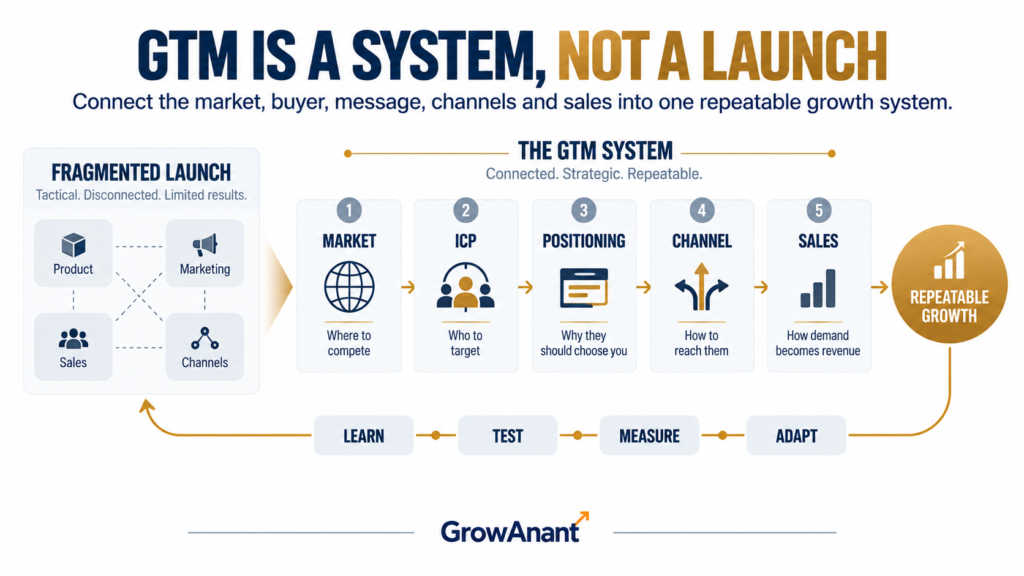
A successful B2B startup launch requires more than a strong product. gtm consulting for b2b startup helps founders connect product-market fit, customer targeting, positioning, channels, sales, and demand generation into one coordinated launch system. Effective b2b gtm consulting focuses on answering a fundamental question: how will the business consistently reach the right customers, communicate relevant value, and convert market interest into revenue?
For an early-stage SaaS company, a founder-led startup, or a business entering the U.S. market, the goal is not to launch everywhere at once. It is to build enough strategic clarity to test the market, learn quickly, and create a repeatable path to customer acquisition.
Pre-Launch Foundations
Before selecting channels or creating campaigns, establish the commercial foundation.
A practical startup GTM framework should answer five questions:
| Question | What to Define |
| Who? | Ideal customer profile and buyer |
| Problem? | High-value problem being solved |
| Why? | Differentiation and value proposition |
| Where? | Market and acquisition channels |
| How? | Sales and conversion process |
The first step is identifying the ideal customer profile, or ICP. An ICP defines the type of company most likely to purchase, succeed with, and generate long-term value from the product. HubSpot
For example, a B2B SaaS startup should avoid defining its market simply as “small businesses.” A stronger ICP could specify industry, company size, operational problem, technology environment, buying authority, and urgency.
This clarity affects every downstream decision, including messaging, pricing, content, outbound prospecting, and demand generation.
A pre-launch checklist should include:
- Clear ICP
- Defined buyer roles
- Validated customer problem
- Competitive understanding
- Core positioning
- Initial pricing logic
- Sales process
- Launch objectives
- Measurement framework
Startups pursuing growth strategy consulting, startup consulting services USA, or business growth consulting should treat these foundations as one connected system rather than isolated exercises.
ICP & Positioning
Once the market is defined, the next challenge is positioning.
Your positioning should make three things clear:
Who is the product for?
What important problem does it solve?
Why should the buyer consider it instead of existing alternatives?
A useful positioning framework is:
For [specific customer], who struggle with [specific problem], our product provides [specific value] because [meaningful differentiation].
Consider a hypothetical U.S. SaaS startup selling workflow software to mid-sized professional service firms. Saying “Our platform helps businesses improve productivity” is broad.
A stronger positioning direction would connect the product to a specific operational problem, buyer, and business outcome.
This matters because go to market strategy consulting is not simply about selecting promotional channels. It connects market definition, positioning, sales, pricing, and distribution into one commercial model.
For startups entering the United States, market entry strategy USA may require additional research into local competitors, buyer expectations, pricing, industry terminology, and purchasing behavior.
For an Indian SaaS company entering the U.S., for example, us market entry consulting for indian companies can help identify where existing positioning may need adaptation without changing the underlying product.
A practical positioning test is:
- Can the target buyer immediately recognize themselves?
- Is the problem commercially important?
- Is the differentiation meaningful?
- Can sales explain the value consistently?
- Can marketing build content around the positioning?
- Can the value be connected to measurable business outcomes?
If these answers are unclear, adding more marketing channels will not solve the underlying GTM problem.
Channel Selection for Startups
Startups often make the mistake of trying to be present everywhere.
A better approach is to select channels based on customer behavior, sales complexity, available resources, and the type of demand being created.
| Channel | Best Used When | Key Consideration |
| Founder-led outbound | ICP is narrow | Requires personalized outreach |
| Buyers are active professionally | Strong for authority and relationship building | |
| SEO | Search demand exists | Requires consistent investment |
| Paid search | High-intent demand exists | Requires careful economics |
| Partnerships | Trusted ecosystems exist | Longer relationship-building cycle |
| Events | Buyers value relationships | Can support high-value accounts |
| Content | Education is important | Requires clear positioning |
The objective is not maximum channel coverage. It is learning which channels can consistently create qualified conversations.
A B2B startup may begin with one primary acquisition channel and one supporting channel. For example, founder-led outbound could create early conversations while strategic content supports credibility and organic discovery.
growth marketing services, B2B lead generation services, and demand generation agency support can become useful when execution capacity becomes a constraint, but channel selection should come from the GTM strategy rather than from vendor availability.
The key metric is not simply traffic or leads. It is whether the channel produces qualified opportunities that can progress through the sales process.
Building the Launch Plan
A launch plan converts strategy into coordinated execution.
A practical 90-day framework can be divided into three phases:
Phase 1: Validate
Focus on:
- ICP validation
- Customer interviews
- Messaging tests
- Competitive research
- Initial outreach
- Early sales conversations
Phase 2: Launch
Focus on:
- Core website messaging
- Sales assets
- Content
- Selected acquisition channels
- Outreach sequences
- Lead capture
- CRM tracking
- Conversion measurement
Phase 3: Learn
Focus on:
- Lead quality
- Conversion rates
- Sales objections
- Channel performance
- Customer feedback
- Pipeline movement
- Messaging effectiveness
HubSpot similarly describes GTM strategy as a coordinated process involving the target audience, positioning, sales and marketing strategies, and alignment among relevant functions. HubSpot Blog
For a founder, the launch dashboard should remain simple.
Track:
Qualified conversations → Opportunities → Pipeline → Customers
Then add diagnostic metrics such as conversion rate, sales cycle, acquisition cost, and channel performance.
This prevents the startup from confusing marketing activity with commercial progress.
Post-Launch Iteration
A GTM strategy should not be treated as a document that becomes irrelevant after launch.
Early-stage startups operate with incomplete information. Customer conversations, objections, conversion data, and sales cycles provide evidence that should continuously improve the strategy.
Use a simple weekly learning loop:
Observe → Diagnose → Prioritize → Test → Measure → Update
For example, suppose a SaaS startup generates website traffic but receives few qualified inquiries.
The response should not automatically be “increase traffic.”
Instead, examine:
- Is the traffic coming from the intended ICP?
- Does the positioning communicate a relevant problem?
- Is the CTA appropriate?
- Does the landing page address buyer concerns?
- Are visitors reaching the right conversion point?
- Are sales follow-ups aligned with the message?
Similarly, if many prospects enter conversations but few progress, the issue may involve positioning, qualification, pricing, product fit, or sales execution.
McKinsey highlights the importance of building repeatable go-to-market and sales capabilities as startups move from product-market fit toward scalable growth. McKinsey & Company
For this reason, growth roadmap consulting should focus not only on launch activity but also on the operating system required to learn from market feedback.
GrowAnant approaches this type of challenge from a strategy-first perspective, connecting GTM planning, demand generation, positioning, and revenue execution rather than treating each activity as a separate marketing project.
Post-Launch Review Checklist
Ask:
- Are we attracting the intended ICP?
- Which messages generate meaningful conversations?
- Which channels generate qualified opportunities?
- Where does the funnel lose prospects?
- What objections appear repeatedly?
- Which customer segments show stronger fit?
- What should we stop doing?
- What should we test next?
- What evidence supports changing the GTM strategy?
This creates a feedback-driven growth strategy rather than a static launch plan.
Common Startup GTM Mistakes
1. Launching before defining the ICP
A broad audience creates diluted messaging and inefficient acquisition.
2. Treating GTM as a marketing campaign
GTM includes positioning, pricing, sales, distribution, customer acquisition, and measurement. It is broader than growth marketing or digital marketing agency execution.
3. Choosing too many channels
More channels create more execution complexity. Early startups benefit from focused experimentation.
4. Confusing activity with demand
More impressions, content, clicks, or followers do not necessarily mean stronger commercial traction.
5. Changing strategy without evidence
Iteration is important, but constant strategic changes can prevent meaningful learning. Distinguish between a weak execution problem and a flawed strategic assumption.
6. Scaling before finding repeatability
A startup should understand which customer segments, messages, channels, and sales motions are producing qualified opportunities before significantly increasing execution complexity.
7. Ignoring the sales process
Marketing can create awareness and demand, but B2B revenue often depends on what happens after a prospect enters the pipeline.
A stronger GTM model connects:
Market → ICP → Positioning → Channel → Lead → Sales → Customer → Feedback
That connection is what turns a launch into a growth system.
References
HubSpot: What is a Go-to-Market Strategy? GTM Plan Template + Examples
McKinsey & Company: Leadership lessons on scaling start-ups
Frequently Asked Questions
A startup should define its ICP, validate the customer problem, establish positioning, understand competitors, determine its initial sales and distribution model, select priority channels, and define how success will be measured. The goal is to create enough strategic clarity to test the market deliberately rather than launch based on assumptions.
There is no universal number. Early-stage B2B startups should generally prioritize a small number of channels where their ICP is reachable and where the team can execute consistently. The priority should be learning which channels generate qualified conversations and pipeline rather than maximizing channel presence.
Iteration should begin as soon as meaningful customer and market feedback becomes available. Startups can review early signals such as prospect responses, sales objections, lead quality, conversion behavior, and customer feedback, then prioritize changes based on evidence rather than changing every element simultaneously.
One common mistake is treating GTM as a launch campaign rather than a complete commercial system. A startup can generate attention without establishing clear ICP targeting, positioning, sales processes, channel economics, and measurement. A stronger approach connects these elements and continuously improves them based on market feedback.