
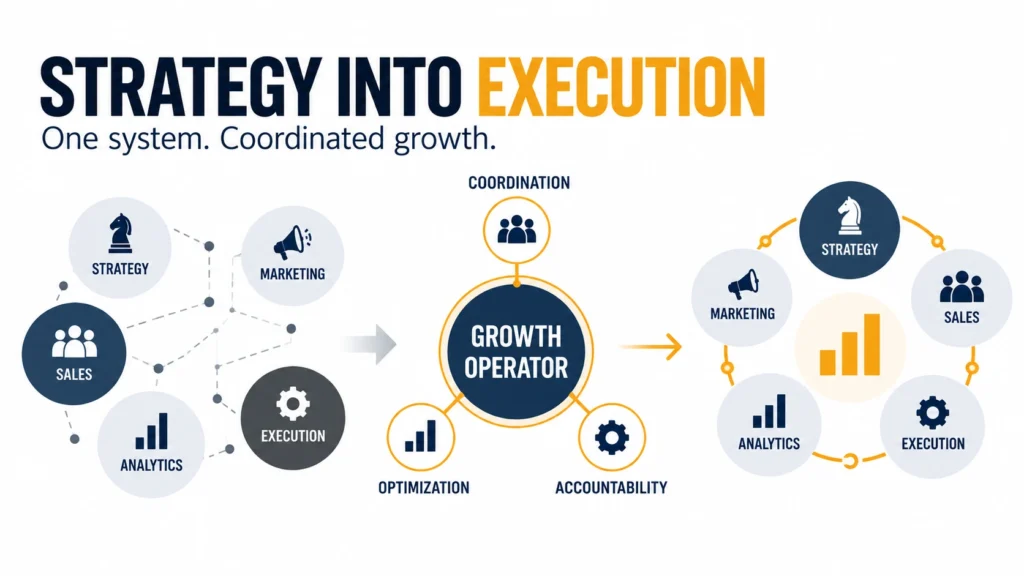
If you are asking what is a growth operator, think of a professional who turns growth strategy into coordinated, measurable execution. A growth operator connects marketing, sales, customer acquisition, analytics, and business priorities so that growth activities contribute to pipeline and revenue outcomes.
For founders hiring their first growth professional, the distinction matters. A startup may already run campaigns, publish content, and generate leads, yet still struggle to identify which activities produce customers. Another business may have a clear strategy but lack someone to coordinate implementation and improve performance.
This is where growth operators for startups can add value. They help translate priorities into action, identify bottlenecks, coordinate resources, and establish a consistent process for measuring progress. Unlike a specialist who owns one channel, a growth operator looks across the customer acquisition system.
The role is especially relevant to growth-stage businesses that need stronger execution without adding unnecessary complexity. However, operators cannot compensate for every strategic problem. Founders must understand when they need execution ownership, when they need senior strategic guidance, and when both capabilities are necessary.
Growth Operator Defined
A growth operator is a professional who coordinates and executes growth initiatives across relevant business functions, using data and structured experimentation to improve customer acquisition, conversion, retention, and revenue performance.
The exact responsibilities vary by company. In an early-stage B2B SaaS business, a growth operator might coordinate demand generation, improve lead qualification, analyze conversion rates, and work with sales to identify why opportunities are not progressing.
Typical responsibilities include:
- Translating agreed growth priorities into an actionable roadmap.
- Coordinating marketing, sales, and customer-facing activities.
- Identifying bottlenecks in acquisition and conversion.
- Managing experiments, timelines, and implementation.
- Monitoring performance indicators and reporting findings.
- Improving processes for lead management and pipeline visibility.
- Recommending adjustments based on evidence.
For example, consider a U.S. SaaS startup generating 100 leads per month but converting very few into qualified sales opportunities. A growth operator would investigate lead sources, qualification criteria, response times, messaging, and conversion data. The goal would be to identify the main constraint before recommending additional spending.
A growth operator is not necessarily responsible for every marketing channel or every revenue decision. The role works best when priorities, decision rights, budget authority, and expected outcomes are clearly defined.
| Area | Typical growth operator responsibility |
| Strategy | Translate agreed priorities into an execution roadmap |
| Marketing | Coordinate campaigns, content, and acquisition initiatives |
| Sales alignment | Improve handoffs, qualification, and feedback loops |
| Analytics | Track performance and identify bottlenecks |
| Experimentation | Prioritize, execute, and evaluate tests |
| Operations | Establish repeatable processes and accountability |
The key distinction is that a growth operator focuses on making the growth system work in practice, rather than simply recommending what the business should do.
How It Differs From a Growth Consultant
A growth consultant primarily diagnoses business challenges, evaluates opportunities, and recommends strategic improvements. A growth operator focuses more heavily on coordinating and implementing the agreed plan.
The two roles can overlap, especially in smaller companies. Some consultants provide hands-on implementation, while experienced operators may contribute to strategic decisions.
| Dimension | Growth consultant | Growth operator |
| Primary focus | Diagnosis, strategy, and recommendations | Implementation, coordination, and optimization |
| Typical deliverable | Growth assessment, roadmap, strategic priorities | Executed initiatives, operating processes, performance reviews |
| Time horizon | May be project-based or ongoing | Often ongoing and execution-oriented |
| Main question | What should the business change, and why? | How do we implement, measure, and improve the change? |
| Success indicators | Clarity, prioritization, validated opportunities | Execution progress, process improvement, commercial performance |
Imagine a professional services firm experiencing inconsistent lead generation.
A consultant might identify that the firm targets too many customer segments, has unclear positioning, and relies heavily on referrals. The consultant could recommend a focused ideal customer profile, clearer messaging, and a repeatable acquisition process.
The growth operator would then coordinate implementation, establish reporting, improve lead qualification, and monitor whether the new approach produces better opportunities.
Founders considering growth strategy consulting should therefore determine whether they need a diagnosis and roadmap, an ongoing execution owner, or both.
A practical rule is:
- Choose a consultant when the problem is unclear and strategic decisions need to be made.
- Choose an operator when priorities are established but implementation is fragmented or inconsistent.
- Consider a combined engagement when strategy and execution both need improvement.
The distinction should be based on responsibilities, not job titles alone.
How It Differs From a Fractional Growth Leader
A fractional growth leader provides senior, part-time leadership across growth strategy, organizational priorities, resource allocation, and performance accountability. A growth operator generally focuses more directly on executing and coordinating the growth plan.
A fractional leader may determine which customer segments to prioritize, how resources should be allocated, and how marketing and sales should work together. An operator may translate those decisions into initiatives, workflows, experiments, and performance reporting.
| Dimension | Growth operator | Fractional growth leader |
| Main responsibility | Execution and operational coordination | Strategic direction and leadership |
| Decision-making | Executes and improves agreed priorities | Sets priorities and guides major decisions |
| Team involvement | Coordinates activities and workflows | Aligns teams and manages strategic accountability |
| Typical need | Execution gaps | Leadership and strategic ownership gaps |
| Best fit | A business with clear priorities but inconsistent implementation | A business that lacks senior growth direction |
For example, a Series A SaaS company may have marketers, sales representatives, and external vendors but no shared growth plan. A fractional leader could establish the strategy, clarify ownership, and align teams around pipeline objectives. A growth operator could then coordinate execution and reporting.
Some organizations need only one of these roles. Others benefit from combining them, particularly when leadership capacity and execution discipline are both limited.
This is also where fractional growth leadership, a fractional growth consultant, or a fractional head of growth may be relevant. The right choice depends on whether the company needs senior decision-making, hands-on implementation, or a combination of both.
When Companies Need an Operator vs a Strategist
The best role depends on the company’s primary growth constraint, not its headcount alone.
A company with a validated offer and a functioning acquisition model may need an operator to improve execution. A company that cannot explain its ideal customer, differentiation, or acquisition economics may need strategic guidance first.
| Business condition | Better starting point | Why |
| Marketing activities lack clear priorities | Growth strategist or consultant | The business needs diagnosis and direction |
| Strategy is clear, but initiatives are delayed | Growth operator | Execution and coordination are the main constraints |
| Leads are plentiful but poorly qualified | Diagnose first, then assign ownership | The issue may involve targeting, positioning, or lead handling |
| Marketing and sales are misaligned | Fractional leader or experienced operator, depending on scope | Cross-functional accountability is required |
| A new U.S. market launch is being planned | Strategist or consultant | Market assumptions and positioning need validation |
| A repeatable acquisition model needs optimization | Growth operator | The company needs ongoing implementation and measurement |
Consider a founder-led U.S. consulting firm that wants to reduce its dependence on referrals. If it has not identified a specific customer segment or developed a differentiated offer, hiring an operator to launch more campaigns may create activity without solving the underlying problem.
If the firm already knows its target customers, has a validated offer, and understands its sales process, an operator could coordinate outreach, content, conversion improvements, and pipeline reporting.
GrowAnant’s strategy-first approach follows this principle: identify the business constraint before deciding which capabilities to add. The goal is to connect strategic decisions, demand generation, and execution to measurable commercial priorities.
Hiring Signals
Founders should consider hiring a growth operator when execution has become a persistent constraint and the business has enough strategic clarity to support focused implementation.
Common hiring signals include:
- Fragmented execution: Marketing, sales, and external vendors work independently without coordinated priorities.
- Inconsistent reporting: The company cannot clearly explain which initiatives generate qualified opportunities.
- Repeated implementation delays: Important growth initiatives remain unfinished because ownership is unclear.
- Weak experimentation discipline: Teams launch activities without documenting hypotheses, results, or lessons.
- Limited operational capacity: Founders spend too much time coordinating routine growth work.
- Poor pipeline visibility: Lead sources, qualification, conversion, and follow-up are not consistently tracked.
Before hiring, use this checklist:
- Define the primary business problem the role must solve.
- Separate strategic decisions from execution responsibilities.
- Identify the data, systems, and internal teams the operator will need.
- Establish a small set of measurable performance indicators.
- Clarify authority over priorities, timelines, and implementation.
- Define how the role will collaborate with sales, marketing, and leadership.
For a B2B startup, suitable measures may include qualified opportunities, conversion between funnel stages, campaign execution, lead response time, and pipeline visibility. The specific measures should reflect the business model and sales cycle.
Avoid defining the role solely around the number of campaigns launched, content pieces published, or leads generated. Those indicators can help measure activity, but they do not establish whether the business is attracting the right customers or improving commercial performance.
Founders should also evaluate whether the company can support the role. An operator needs access to relevant information, timely decisions, and the resources required to implement changes. Without these conditions, the role may become a coordinator of unresolved problems rather than an owner of meaningful progress.
References
- HubSpot, Growth Marketing: A Guide
- Harvard Business Review, Why the Lean Start-Up Changes Everything
Frequently Asked Questions
A growth operator is a professional who turns agreed growth priorities into coordinated execution. The role can include managing experiments, improving acquisition processes, aligning marketing and sales, tracking performance, and identifying bottlenecks. The objective is to make growth initiatives more systematic and measurable, with responsibilities defined around the company’s needs.
No. A growth consultant typically focuses on diagnosing problems, developing strategy, and recommending improvements. A growth operator focuses more on implementing and coordinating those improvements. The roles can overlap, and some professionals provide both services. The right choice depends on whether the business needs strategic clarity, execution capacity, or both.
A startup should consider an operator when its target market, offer, and strategic priorities are sufficiently clear, but execution is inconsistent or delayed. If the company has not validated its positioning, cannot identify its ideal customer, or lacks a coherent growth plan, strategic guidance should generally come first.
A growth operator may review performance dashboards, coordinate marketing and sales initiatives, manage experiments, improve lead workflows, investigate conversion problems, and report progress against agreed priorities. Daily work varies by company, but it should connect execution to measurable business objectives rather than focus only on completing tasks.