
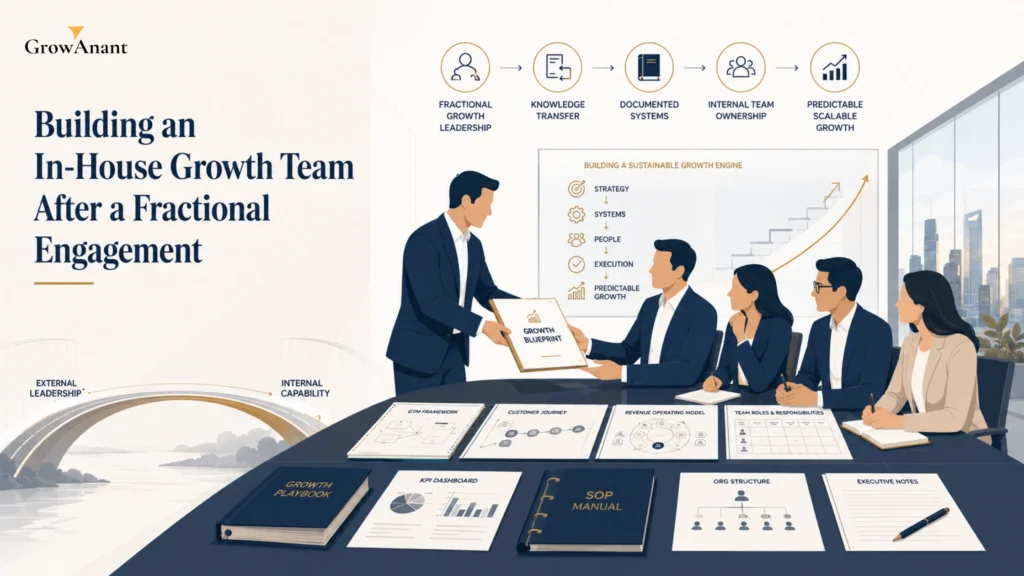
Many companies begin their growth journey with fractional growth leadership because it provides strategic expertise without the cost and commitment of building a complete executive team. As the business matures, however, founders often reach a stage where building in-house growth team capabilities becomes the logical next step.
The transition should never be treated as simply replacing a consultant with employees. Instead, it should build upon the systems, playbooks, reporting structures, and strategic direction established during the engagement. A successful transition protects business momentum while creating long-term internal capability.
Whether your company previously worked with a fractional growth consultant, a fractional chief growth officer, or another strategic advisor, this guide explains how to create an internal team that continues delivering predictable, scalable growth.
Why Companies Transition to In-House Teams
A fractional growth executive is often hired to solve strategic problems, establish repeatable processes, and align marketing, sales, and leadership around measurable business outcomes. Once these systems mature, many organizations choose to internalize execution while maintaining strategic consistency.
For example:
- A B2B SaaS company that has achieved product-market fit may require full-time specialists to support expanding customer acquisition.
- A professional services firm may need dedicated marketing and demand generation resources after entering multiple regional markets.
- A funded startup preparing for aggressive expansion may require full-time leadership across marketing operations, analytics, and revenue functions.
The objective is not to replace strategy. It is to create internal ownership supported by documented systems.
Many businesses that previously invested in growth consulting services discover that the greatest long-term value comes from transferring knowledge into permanent internal capabilities.
Signs Your Company Is Ready
| Indicator | Why It Matters |
| Predictable revenue growth | Provides confidence to invest in permanent talent. |
| Repeatable acquisition channels | Creates stable workloads for dedicated employees. |
| Established growth processes | Reduces onboarding complexity. |
| Leadership alignment | Ensures internal teams work toward common objectives. |
| Documented KPIs | Makes performance management more effective. |
If several of these conditions exist, transitioning toward an internal growth leadership team structure may be appropriate.
Roles to Hire First
Many founders make the mistake of hiring too many specialists before establishing clear ownership.
Instead, prioritize roles that strengthen the existing growth system.
Recommended Hiring Sequence
| Priority | Role | Primary Responsibility |
| 1 | Growth Manager or Head of Growth | Own strategy execution and cross-functional alignment. |
| 2 | Demand Generation Specialist | Build predictable pipeline and campaign execution. |
| 3 | Marketing Operations | Manage automation, CRM, reporting, and attribution. |
| 4 | Content & SEO Specialist | Drive long-term inbound visibility and thought leadership. |
| 5 | Performance Marketing Specialist | Scale paid acquisition once measurement systems are mature. |
Companies expanding rapidly may eventually add specialists in lifecycle marketing, customer success, analytics, product marketing, or revenue operations.
Rather than hiring multiple junior marketers immediately, many organizations benefit from first recruiting an experienced leader capable of coordinating priorities and protecting strategic alignment.
Using the Fractional Playbook as a Blueprint
One of the greatest advantages of working with fractional growth leadership is the creation of reusable operating systems.
Before recruiting new employees, ensure the following assets are documented:
Strategic Documentation Checklist
- Growth strategy
- Customer personas
- Positioning framework
- Go-to-market roadmap
- Demand generation playbooks
- Sales enablement materials
- KPI dashboards
- Reporting cadence
- Marketing technology stack
- Standard operating procedures
These documents significantly reduce onboarding time while helping new hires understand why strategic decisions were made.
Rather than asking new employees to redesign existing systems, allow them to improve and expand proven frameworks. This minimizes disruption and helps preserve business momentum.
Organizations that partner with firms like GrowAnant often prioritize documenting repeatable growth systems alongside execution, making future hiring more structured and scalable.
Budgeting for a Growth Team
Transitioning from a fractional growth consultant to a permanent team requires thoughtful budgeting. Many founders focus only on salaries while overlooking software, recruitment, onboarding, training, and operational costs.
Instead of hiring every role at once, build the team in stages based on business priorities and revenue maturity.
Growth Team Budget Framework
| Investment Area | Purpose |
| Leadership | Oversees strategy execution and cross-functional alignment |
| Marketing Specialists | Execute growth marketing services, SEO, content, paid campaigns, and lifecycle marketing |
| Technology Stack | CRM, automation, analytics, attribution, reporting, and collaboration tools |
| Training & Development | Improves execution quality and supports continuous learning |
| External Expertise | Retain specialized advisors when niche expertise is required |
A phased hiring approach allows companies to maintain financial flexibility while continuing to invest in sustainable business growth consulting initiatives rather than expanding headcount prematurely.
Common Hiring Mistakes
Building an internal team is a long-term investment. Hiring mistakes can create operational bottlenecks that slow growth.
Avoid these common pitfalls:
1. Hiring Before Defining Strategy
Adding marketers without documented objectives often results in disconnected campaigns and inconsistent execution.
2. Recruiting Too Many Specialists
A team filled with channel experts but lacking strategic leadership frequently struggles with prioritization and accountability.
3. Ignoring Cross-Functional Collaboration
Growth depends on alignment between marketing, sales, product, and customer success. Hiring in isolation weakens execution.
4. Overlooking Documentation
If processes remain undocumented, new hires spend unnecessary time recreating systems rather than improving them.
5. Eliminating Strategic Oversight Too Early
Even after an internal team is established, periodic strategic reviews can help prevent execution from drifting away from long-term business objectives.
Hiring Readiness Checklist
Before recruiting, confirm that your organization has:
- Clearly defined business goals
- Documented KPIs
- Standard operating procedures
- Established reporting cadence
- CRM and analytics infrastructure
- Leadership ownership
- Budget for tools and training
- Realistic hiring roadmap
Completing this checklist reduces onboarding time and improves team effectiveness.
Measuring Team ROI
A successful growth team should be evaluated on business outcomes rather than activity levels.
Recommended Performance Framework
| Metric Category | Example KPIs |
| Revenue | Revenue growth, recurring revenue, average deal size |
| Pipeline | Qualified opportunities, pipeline value, conversion rate |
| Marketing | Cost per qualified lead, campaign ROI, attribution accuracy |
| Sales | Win rate, sales cycle length, forecast accuracy |
| Operations | Execution speed, reporting consistency, process adoption |
For example, a SaaS company may measure the impact of its new team by tracking improvements in qualified pipeline and customer acquisition efficiency, while a professional services firm may focus on increasing high-quality inbound opportunities and shortening the sales cycle.
The objective is not simply to increase marketing activity but to strengthen predictable, measurable growth. Some organizations continue working with strategic partners such as GrowAnant on quarterly planning and executive reviews while allowing the in-house team to manage day-to-day execution.
References
Frequently Asked Questions
Most companies should begin with a growth leader or Head of Growth, followed by demand generation, marketing operations, and content specialists. Hiring should reflect business priorities rather than trying to build a large team immediately.
The investment depends on company size, growth stage, and hiring plan. Instead of focusing only on salaries, budget for technology, training, analytics, recruitment, and ongoing operational support to maximize long-term ROI.
Yes. A fractional growth consultant or fractional chief growth officer can help define role requirements, interview candidates, document processes, and ensure new hires align with the established growth leadership team structure and long-term strategy.
Most organizations complete the transition over three to six months. The timeline depends on hiring speed, knowledge transfer, documentation quality, and the complexity of existing growth systems. A phased transition usually minimizes disruption while maintaining momentum and preserving the strategic foundation built during the fractional growth leadership engagement.