
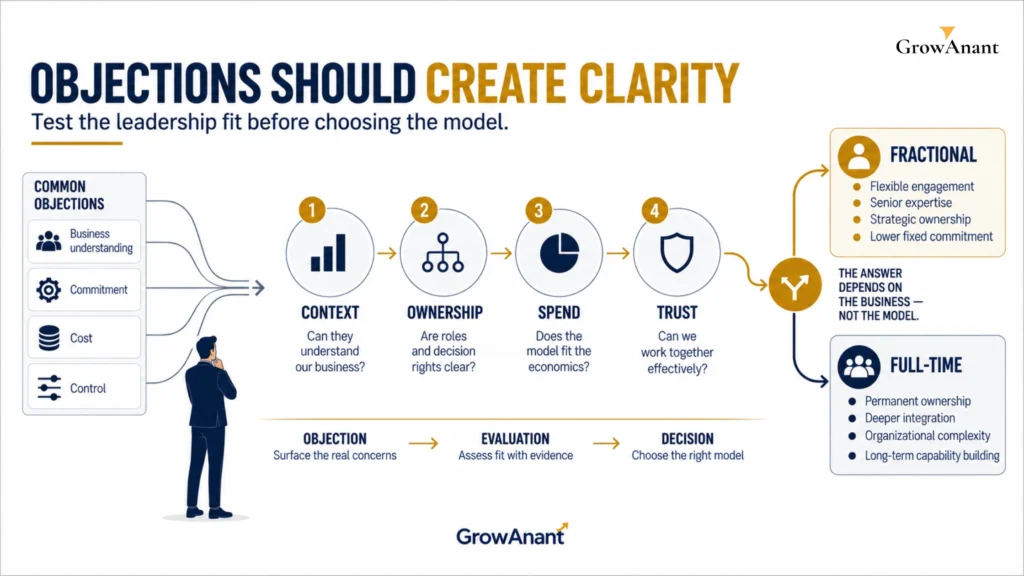
Fractional growth leadership objections are common among founders and CEOs considering senior external leadership. The concerns are understandable: Will a fractional growth consultant understand the business deeply enough? Will they be committed? Is the cost justified? Will the founder lose control?
These questions become particularly important when a company has traction but lacks senior growth ownership. A fractional growth leadership model can provide experienced strategic leadership without immediately creating a full-time executive position, but only when the role, decision rights, expectations, and operating model are clearly defined.
Harvard Business Review notes that fractional leadership has become increasingly relevant for startups and small and medium-sized businesses that need senior expertise but may not need or be able to justify a full-time executive.
The right question, therefore, is not simply whether fractional leadership is cheaper than hiring. It is whether the business has a growth leadership gap that can be effectively addressed through a fractional model.
“It Won’t Understand Our Business”
This is often the most legitimate objection.
A founder may believe that an external fractional growth consultant cannot understand the product, customers, competitive environment, internal politics, and history of the company quickly enough to make meaningful decisions.
There is some truth here. A fractional leader does not automatically possess institutional knowledge.
However, the issue is less about whether the leader is external and more about how the engagement is structured.
A strong fractional growth executive should begin with structured discovery rather than immediately recommending campaigns.
What the first stage should uncover
| Area | Questions |
| Market | Which customer segments have the strongest potential? |
| Positioning | Why do customers choose the company? |
| Product | Where does adoption or retention weaken? |
| Acquisition | Which channels currently generate qualified demand? |
| Sales | Where does pipeline leakage occur? |
| Economics | What are CAC, conversion, retention, and revenue patterns? |
| Organization | Who currently owns growth decisions? |
For example, consider a U.S. B2B SaaS company selling workflow software to healthcare organizations. A new growth leader should not immediately launch performance marketing services USA or redesign the website.
First, they should determine whether the real constraint is market positioning, sales conversion, product adoption, demand generation, or customer retention.
That diagnostic discipline is one reason growth strategy consulting can be more valuable than simply adding another execution resource.
The 30-Day Understanding Test
Founders can reduce this concern by establishing specific expectations:
- Review customer and sales data.
- Interview key internal stakeholders.
- Speak with selected customers.
- Analyze competitors and market positioning.
- Audit the acquisition funnel.
- Identify the three biggest growth constraints.
- Present a prioritized growth roadmap.
If a leader cannot explain the business problem clearly after this process, the concern about business understanding may be justified.
“Fractional Isn’t Committed Enough”
The second objection is about commitment.
Founders sometimes assume that a full-time executive will naturally care more because the company is their only professional responsibility.
But commitment should be evaluated through ownership and accountability, not simply hours on a calendar.
A fractional head of growth should have clearly defined responsibilities, decision-making authority, meeting cadence, KPIs, and deliverables.
Full-Time vs Fractional Leadership
| Factor | Full-Time Executive | Fractional Leader |
| Availability | Dedicated | Defined recurring capacity |
| Strategic ownership | High | Can be high when role is structured correctly |
| Cost | Higher fixed commitment | More flexible |
| Senior expertise | Depends on hire | Can provide experienced leadership |
| Internal integration | Naturally high | Requires deliberate integration |
| Flexibility | Lower | Higher |
| Best fit | Sustained executive workload | Leadership gap requiring senior expertise |
The concern becomes valid when the fractional arrangement is poorly designed.
For example, a founder should be cautious if the proposed engagement only includes occasional strategy calls while the company expects the consultant to own growth.
A genuine fractional growth leadership contract should clarify:
- scope of responsibility
- expected availability
- decision rights
- KPIs
- reporting cadence
- internal stakeholders
- escalation process
- review periods
- transition expectations
This creates accountability without pretending the leader is a full-time employee.
“We Can’t Afford It”
Cost is often the strongest objection, particularly for startups and founder-led companies.
The mistake is comparing the cost of fractional leadership only against the cost of doing nothing.
The better comparison is:
Cost of leadership support vs. cost of unresolved growth problems.
Suppose a SaaS company has a marketing team executing campaigns but no senior growth owner. The company may spend continuously on content, paid acquisition, outbound activity, events, and software while struggling to identify which activities actually create qualified pipeline.
Adding more execution may increase activity without improving strategic direction.
This is where revenue growth consulting can create value by improving prioritization before additional resources are committed.
A Simple Cost Decision Framework
| Situation | Likely Priority |
| No meaningful traction yet | Validate market and product |
| Traction exists but growth is inconsistent | Diagnose growth constraints |
| Marketing team exists but lacks direction | Add strategic leadership |
| Revenue is scaling rapidly | Consider full-time leadership |
| Expansion into the U.S. is planned | Consider market entry strategy USA expertise |
| Multiple channels are active but attribution is weak | Fix measurement and prioritization |
The appropriate model can also evolve.
A company might begin with growth consulting services, move into an advisory relationship, and eventually hire a full-time growth executive once the workload justifies it.
The objective is not to preserve a fractional arrangement indefinitely. It is to solve the leadership gap at the right stage.
“We’ll Lose Control”
Founders often worry that bringing in external leadership means surrendering control over the company’s direction.
In reality, a well-designed fractional growth leadership engagement should make decision ownership clearer, not weaker.
The founder remains responsible for major company-level decisions. The fractional leader provides strategic recommendations, operating discipline, and execution leadership within an agreed scope.
Decision Rights Framework
Founder/CEO owns:
- company vision
- capital allocation
- major strategic changes
- executive hiring
- final positioning decisions
- investor-level decisions
Fractional growth leader owns or leads:
- growth strategy
- growth roadmap
- marketing and demand-generation priorities
- funnel optimization
- experimentation framework
- growth KPIs
- cross-functional growth coordination
Internal teams execute:
- approved campaigns
- content
- sales activities
- product initiatives
- marketing operations
- customer programs
This structure prevents two opposite problems:
Micromanagement: The founder remains involved in every marketing decision.
Abdication: The founder expects the external leader to solve growth without providing access, authority, or resources.
The right model creates strategic alignment with defined ownership.
Addressing Each Concern
The four objections can be evaluated using a simple COST Framework:
| Dimension | Question to Ask | Good Signal |
| C: Context | Can they understand our business? | Structured discovery and customer research |
| O: Ownership | Will they take responsibility? | Defined KPIs and decision rights |
| S: Spend | Does the model fit our economics? | Flexible scope tied to business needs |
| T: Trust | Can we work together effectively? | Transparency, communication, and clear expectations |
Before hiring a fractional chief growth officer or fractional head of growth, founders should conduct a practical evaluation.
Fractional Leadership Checklist
- Does the leader have relevant growth experience?
- Can they diagnose rather than simply execute?
- Will they work directly with the founder or CEO?
- Are responsibilities clearly defined?
- Are KPIs connected to pipeline and revenue?
- Are decision rights documented?
- Is communication frequent enough?
- Can they work effectively with the existing team?
- Is the engagement financially sustainable?
- Is there a clear review point?
This evaluation is also useful when comparing business growth consulting, startup consulting, or conventional growth marketing providers.
The key distinction is leadership ownership.
A provider may execute campaigns effectively while still failing to provide the strategic leadership required to decide which problems deserve attention first.
For a growth-stage SaaS company, fintech startup, healthtech business, or professional services firm, that distinction can materially affect how resources are allocated.
When the Objections Are Valid
Not every objection should be overcome.
Sometimes the founder’s concern is correct.
Fractional leadership may not be the right model when:
- The company needs constant executive availability.
If growth decisions require daily executive involvement across multiple functions, a full-time leader may be more appropriate. - The organization lacks internal execution capacity.
Strategy without people capable of implementation creates another bottleneck. - Decision authority cannot be shared.
If leadership expects strategic ownership but refuses to delegate meaningful decisions, the engagement will struggle. - The growth problem is primarily product-related.
More marketing leadership cannot solve fundamental product-market fit problems. - The company expects instant results.
A fractional leader can establish direction, systems, and experimentation, but sustainable growth requires evidence, iteration, and execution. - There is no leadership alignment.
If founders, sales, product, and marketing leaders disagree about the company’s growth priorities, the first requirement may be organizational alignment rather than another growth resource.
McKinsey’s research on scaling startups similarly emphasizes that growth requires appropriate leadership capabilities, organizational structure, decision-making, and alignment as companies evolve.
The strongest use case for fractional leadership is therefore not “we cannot afford a full-time executive.”
It is:
“We have a meaningful growth leadership gap, but our current stage does not yet justify building a full-time executive function.”
That distinction changes how founders evaluate the investment.
A company should not buy fractional leadership simply because it sounds flexible. It should use the model when senior strategic expertise, ownership, and growth coordination are needed at a level that internal resources cannot currently provide.
For GrowAnant, this means approaching growth leadership as a connected system rather than a collection of marketing activities. The focus is on aligning strategy, demand generation, GTM execution, and revenue measurement so that founders have greater clarity over what is working, what is not, and what deserves investment next.
References
- Harvard Business Review: How Part-Time Senior Leaders Can Help Your Business
- McKinsey & Company: Leadership lessons on scaling start-ups
Frequently Asked Questions
Not necessarily. Commitment should be evaluated through ownership, accountability, availability, decision rights, and measurable responsibilities rather than simply the number of hours worked. A well-structured fractional growth consultant can operate as an accountable member of the leadership team within a defined scope.
Founders retain control over company-level decisions such as vision, capital allocation, major strategic changes, and executive hiring. The fractional leader should have clearly defined authority over the growth responsibilities assigned to them.
The objections are valid when the company requires constant executive availability, lacks execution capacity, cannot delegate decision-making, has fundamental product-market fit issues, or lacks leadership alignment. In those situations, a different organizational solution may be more appropriate.
Evaluate the proposed scope, availability, KPIs, decision rights, communication cadence, leadership involvement, reporting structure, and review process. Ask the candidate to explain how they would approach the first 30, 60, and 90 days and what evidence would determine whether the engagement is working.