
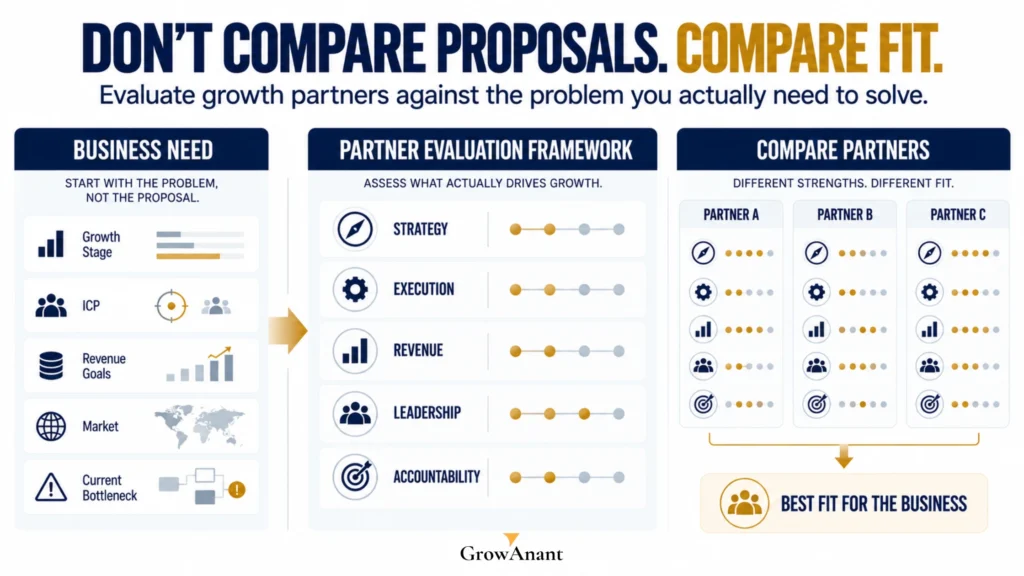
Choosing a growth consultant is not simply a matter of comparing proposals, monthly fees, or the number of services included. For founders, the more important question is how effectively a partner can connect strategy, execution, demand generation, and revenue outcomes.
A structured growth consulting partner comparison framework gives leadership a consistent way to evaluate different firms without allowing presentation quality or pricing alone to determine the decision. This is particularly important when comparing growth strategy consulting, business growth consulting, revenue growth consulting, or a fractional growth consultant.
The right comparison should examine strategic depth, execution capability, commercial understanding, accountability, communication, and fit with the company’s current growth stage.
Why Side-by-Side Comparison Matters
Consulting proposals often look similar on the surface. Two firms may both promise strategic planning, marketing support, growth roadmaps, and ongoing advisory services while operating very differently.
One partner may primarily provide recommendations. Another may work directly with internal teams to implement those recommendations. A third may specialize in demand generation but have limited experience with positioning, pricing, sales alignment, or go-to-market strategy.
That difference matters because businesses are not simply buying consulting hours. They are seeking strategic clarity, predictable execution, stronger pipeline visibility, and better alignment between marketing and revenue.
A side-by-side comparison helps founders answer five questions:
- Does the partner understand our business problem?
- Can they develop a strategy appropriate for our growth stage?
- Can they translate strategy into execution?
- Will they be accountable for meaningful business outcomes?
- Can the relationship scale as our needs change?
For example, a Series A SaaS company may require SaaS growth consulting, demand generation, positioning, and sales alignment. A professional services firm may instead need marketing strategy for service businesses, lead generation, positioning, and a stronger referral-to-inbound system.
The evaluation should therefore begin with business requirements, not vendor capabilities.
Building a Comparison Scorecard
A scorecard converts subjective impressions into a structured evaluation.
A useful scorecard can include:
| Evaluation Area | What to Examine | Key Question |
| Strategic capability | Growth strategy, positioning, GTM thinking | Can they solve the underlying growth problem? |
| Industry experience | Relevant business models and markets | Have they worked with comparable challenges? |
| Execution capability | Marketing, demand generation, sales alignment | Can strategy be translated into action? |
| Revenue orientation | Pipeline, CAC, conversion, revenue metrics | Do they connect activity to commercial outcomes? |
| Leadership access | Founder and executive involvement | Who will actually lead the engagement? |
| Measurement | KPIs, reporting, attribution | How will progress be evaluated? |
| Engagement structure | Scope, cadence, responsibilities | Is ownership clearly defined? |
| Team quality | Seniority and relevant expertise | Who will perform the actual work? |
| Communication | Reporting and decision-making process | How quickly can issues be addressed? |
| Commercial fit | Investment, flexibility, contract terms | Does the model fit the company’s stage? |
This structure can be adapted for growth consulting services, digital growth agency engagements, or more specialized B2B marketing strategy consulting relationships.
The important principle is consistency. Every shortlisted partner should be evaluated against the same criteria.
Weighting Criteria by Priority
Not every criterion deserves equal weight.
A founder may assign 25% of the evaluation to strategic capability, 20% to execution, 15% to revenue orientation, 15% to relevant experience, 10% to leadership involvement, 10% to measurement, and 5% to commercial fit.
The exact percentages should reflect the company’s priorities.
For example:
| Criterion | Suggested Weight |
| Strategic capability | 25% |
| Execution capability | 20% |
| Revenue orientation | 15% |
| Relevant experience | 15% |
| Leadership involvement | 10% |
| Measurement and reporting | 10% |
| Commercial fit | 5% |
A company entering a new geography may increase the weight of market entry strategy USA expertise. A founder-led company struggling with inconsistent pipeline may place greater emphasis on growth marketing services, demand generation, and revenue measurement.
The key is to avoid making price the default decision criterion.
A lower-priced engagement may have a narrower scope, less senior involvement, or limited execution support. A higher-priced engagement may provide deeper strategic ownership. Neither is automatically better. The question is whether the structure matches the business problem.
Harvard Business Review has emphasized the importance of defining the business case for consulting work, including the financial opportunities, risks, value drivers, and metrics that will define success.
A practical weighting model is:
Business Need × Strategic Importance × Expected Impact = Evaluation Weight
This keeps the scorecard connected to the actual growth problem.
Sample Comparison Table
The following framework can be used to compare shortlisted partners.
| Criteria | Partner A | Partner B | Partner C |
| Understands ICP | Strong | Moderate | Strong |
| Growth strategy capability | Strong | Strong | Moderate |
| Demand generation expertise | Moderate | Strong | Strong |
| Sales and marketing alignment | Strong | Moderate | Moderate |
| Senior leadership involvement | High | Low | High |
| Execution support | High | Moderate | Low |
| Revenue measurement | Strong | Moderate | Strong |
| Relevant industry experience | Moderate | Strong | Strong |
| Engagement flexibility | High | Moderate | Moderate |
| Communication model | Strong | Moderate | Strong |
| Commercial structure | Review | Review | Review |
The purpose is not to create a universal ranking. It is to expose differences that matter to the specific business.
For example, a founder seeking startup consulting services USA may prioritize senior involvement and strategic flexibility. A larger B2B company with an internal marketing team may instead need a partner focused on growth roadmap consulting, leadership alignment, and revenue operations.
The scorecard should also include evidence.
Instead of recording “strong demand generation expertise,” ask for:
- Relevant client examples
- Explanation of the demand generation model
- Expected responsibilities
- Measurement framework
- Reporting structure
- Examples of strategic decisions influenced by data
This turns the evaluation from presentation-based judgment into evidence-based comparison.
Making the Final Call
Once proposals have been scored, founders should avoid treating the numerical result as the final answer.
The scorecard is a decision-support tool, not a substitute for judgment.
Before selecting a partner, review four final areas:
Strategic Fit
Does the partner understand the business model, market, ICP, competitive environment, and growth constraints?
Operating Fit
Can the partner work effectively with the existing team, leadership structure, technology stack, sales organization, and internal capabilities?
Accountability Fit
Are responsibilities clear? Does the engagement establish measurable outcomes and decision rights?
Relationship Fit
Will leadership be able to have difficult conversations, challenge assumptions, and make decisions quickly?
This matters because consulting engagements often require changes across multiple functions. McKinsey’s implementation approach, for example, emphasizes connecting strategy with execution, capability building, performance management, and sustained implementation rather than treating strategy as an isolated exercise.
For a founder, the final evaluation should therefore ask:
What problem are we hiring this partner to solve, and does the proposed engagement structure give them the access, authority, expertise, and execution capacity required to solve it?
A strong growth consulting engagement structure should make ownership clear from the beginning.
Before signing, confirm:
- Business objectives are documented
- ICP and growth challenges are understood
- Scope and responsibilities are explicit
- Senior involvement is defined
- Execution responsibilities are clear
- KPIs connect to pipeline and revenue
- Reporting cadence is agreed
- Decision-making authority is understood
- Internal team dependencies are documented
- Contract terms match the expected engagement
- Review points are established
For many growth-stage businesses, the most useful partner is not necessarily the firm with the longest service list. It is the partner whose capabilities align most closely with the company’s current constraints.
GrowAnant approaches this problem from a strategy-first perspective, connecting growth strategy, demand generation, go-to-market planning, and revenue execution. The objective is to operate as a growth partner rather than simply provide isolated digital marketing agency services.
The same principle applies whether a company needs growth consulting, growth marketing, B2B marketing, or broader growth strategy support. The evaluation should begin with the business outcome and work backward toward the required capabilities.
References
Harvard Business Review: How to Tell If Hiring a Consultant Will Be Worth the Investment Harvard Business Review
Frequently Asked Questions
Use the same evaluation criteria for every proposal. Compare strategic capability, relevant experience, execution depth, senior involvement, measurement, accountability, communication, engagement structure, and commercial fit.
Weight the criteria according to the business problem rather than giving every category equal importance.
The highest weights should generally go to the areas most directly connected to the company’s growth challenge.
For a company with weak positioning, strategic capability may matter most. For a company with strong strategy but inconsistent pipeline, demand generation and execution may deserve greater weight. For a company entering a new market, market expertise and go-to-market capability may become more important.
Not necessarily. Price is an important commercial consideration, but evaluating it independently of scope, senior involvement, expertise, and expected value can create misleading comparisons.
The better question is whether the proposed investment is appropriate for the problem being solved and whether the engagement provides a credible path toward measurable business value.
There is no universal number. A practical approach is to shortlist enough qualified partners to create meaningful comparison while keeping the process manageable.
The important factor is not the number of firms but the quality and consistency of the evaluation. A structured growth consulting partner comparison framework can help founders compare qualified options without allowing proposal style or price alone to drive the decision.