
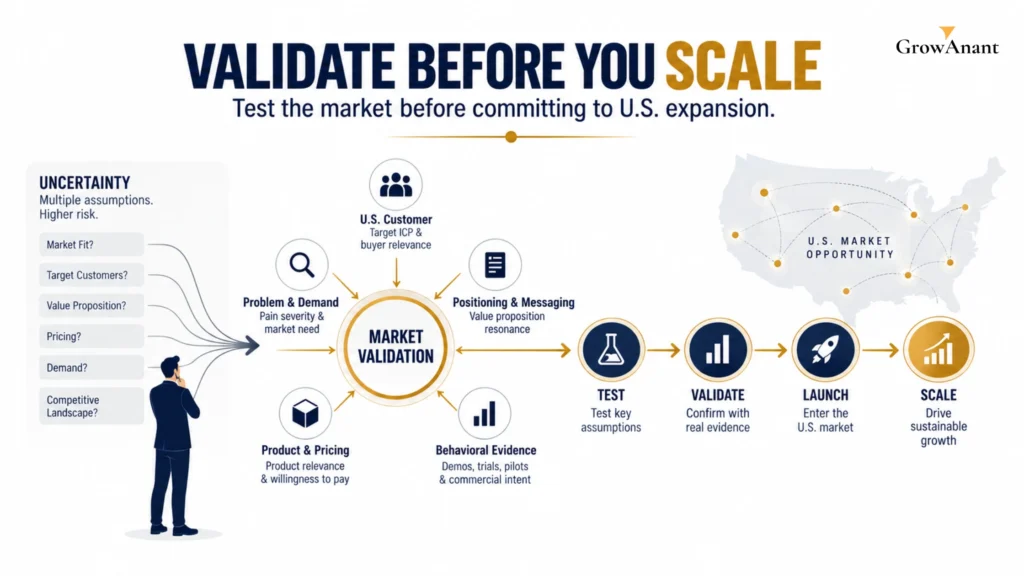
Entering the U.S. market without consumer testing for us market entry can turn a promising product into an expensive market experiment. Companies expanding from India or other international markets may have strong products, existing customers, and successful domestic positioning, but that does not automatically translate into U.S. demand.
Before investing heavily in acquisition, distribution, sales hiring, or brand building, founders should establish whether U.S. buyers understand the problem, value the solution, trust the positioning, and are willing to take the next commercial step.
This is where market validation before scaling becomes important. Validation is not about proving that every buyer will purchase. It is about reducing uncertainty enough to make a rational launch decision.
For a company entering the United States, the objective should be:
Test → Learn → Adapt → Validate → Launch → Scale
Why Testing Before Launch Matters
The U.S. market is large, but its size does not guarantee product-market fit.
A product that succeeds in India may encounter different expectations around pricing, messaging, purchasing behavior, competition, compliance, customer support, distribution, or product experience in the United States.
For example, an Indian SaaS company may discover that its product solves a genuine problem for U.S. businesses, but the way it describes that problem does not resonate with American buyers. Alternatively, the product may attract interest but fail to convert because the pricing model, implementation process, or perceived risk does not match buyer expectations.
This is why go to market strategy consulting should include market evidence rather than relying entirely on assumptions.
What Testing Can Validate
| Area | Question to Validate |
| Customer | Who experiences the problem most strongly? |
| Problem | Is the problem important enough to solve now? |
| Positioning | Do buyers understand the value proposition? |
| Product | Does the solution address the expected use case? |
| Pricing | Is the perceived value consistent with the proposed price? |
| Messaging | Which benefits create the strongest response? |
| Competition | What alternatives do buyers currently use? |
| Purchase intent | Would buyers consider taking the next step? |
Testing is particularly important before major spending on market entry strategy USA, paid acquisition, sales hiring, or national expansion.
A company does not need perfect certainty before launch. It needs enough evidence to identify the strongest assumptions and the risks that remain unresolved.
Designing a Validation Study
A good validation study begins with explicit hypotheses.
Instead of asking, “Do people like our product?”, define measurable questions such as:
- Do U.S. buyers recognize this problem?
- Which customer segment experiences it most frequently?
- Does the current positioning communicate the business value?
- Which product benefit matters most?
- What objections prevent purchase?
- What alternatives are currently being used?
- What pricing range appears commercially credible?
- What would cause a prospect to request a demonstration or trial?
This approach makes growth strategy consulting more evidence-driven.
The U.S. Validation Framework
1. Define the ICP
Identify the specific U.S. customer segment being tested.
2. Define the hypothesis
State what you believe about the customer, problem, value proposition, and buying behavior.
3. Build the test
Use interviews, concept tests, landing-page tests, product demonstrations, surveys, prototypes, or controlled acquisition experiments depending on the hypothesis.
4. Collect behavioral evidence
Separate what participants say from what they actually do.
5. Identify patterns
Look for repeated objections, motivations, use cases, and purchase signals.
6. Update the proposition
Adjust messaging, positioning, product experience, pricing, or target segment.
7. Retest critical assumptions
Do not scale based on one encouraging conversation.
This process is particularly useful for startup growth strategy consulting, where founders must balance speed with limited resources.
What a Validation Study Should Measure
| Signal | Weak Evidence | Stronger Evidence |
| Awareness | “I have heard of this problem” | Problem is actively discussed |
| Interest | “This sounds useful” | Requests more information |
| Relevance | General agreement | Specific use case identified |
| Intent | Positive survey response | Trial, demo, or commercial conversation |
| Value | “I like it” | Willingness to consider the proposed economics |
| Fit | Broad interest | Strong response from the target ICP |
The goal is not to manufacture positive feedback. The goal is to discover where the proposition breaks.
Recruiting U.S. Test Participants
Recruitment quality directly affects validation quality.
If an international company tests its product with people who resemble its target customer only superficially, the findings may create false confidence.
A B2B SaaS company should prioritize participants who match its intended buying environment, role, company size, industry, and business problem.
Participant Selection Framework
Company fit
- Industry
- Revenue or size
- Geography
- Growth stage
- Technology environment
Role fit
- Decision maker
- Budget owner
- Influencer
- End user
Problem fit
- Experiences the problem
- Has attempted to solve it
- Has an existing alternative
- Has a reason to prioritize it
For example, a fintech startup entering the United States should not validate an enterprise financial product primarily with general consumers simply because they are easier to recruit.
Likewise, a healthcare SaaS company should test with the specific stakeholders involved in the relevant purchasing process.
For international companies, us market entry consulting for indian companies can help founders think through these differences before committing resources to acquisition.
Where to Find Participants
Potential sources include:
- existing U.S. customers
- industry communities
- professional networks
- customer referrals
- targeted outbound
- research panels
- LinkedIn outreach
- industry events
- partner ecosystems
The priority should be relevance over volume.
Ten highly relevant conversations can reveal more useful strategic information than hundreds of responses from poorly matched participants.
Interpreting Results
Validation becomes valuable only when founders know how to interpret evidence.
A common mistake is treating positive feedback as proof of demand.
People may say that a product is interesting without having a meaningful business problem, budget, urgency, or authority to purchase.
A better model separates interest from commercial evidence.
Evidence Ladder
Level 1: Awareness
The participant understands the problem.
↓
Level 2: Relevance
The problem applies directly to their business.
↓
Level 3: Pain
The problem creates measurable cost, risk, inefficiency, or lost opportunity.
↓
Level 4: Intent
The participant wants to explore a solution.
↓
Level 5: Action
The participant agrees to a demo, trial, pilot, proposal, or commercial conversation.
The higher the evidence level, the more useful the finding becomes for launch decisions.
This is where business growth consulting should connect research to commercial strategy.
Separate Signal From Noise
| Finding | Interpretation |
| “Interesting product” | Low-confidence signal |
| “We have this problem” | Problem validation |
| “We currently spend resources solving it” | Stronger pain signal |
| “We would evaluate alternatives” | Purchase consideration |
| “Can we run a pilot?” | High-intent signal |
Founders should also segment responses.
If enterprise buyers show strong interest while small businesses show weak interest, the answer may not be “improve the product.” It may be to narrow the ICP.
That insight can materially change the growth roadmap consulting process.
Go/No-Go Decisions
A validation study should end with a decision, not simply a research report.
The decision can be:
GO: Evidence supports the current market, positioning, and commercial hypothesis.
ADAPT: The opportunity appears promising, but important assumptions need refinement.
NO-GO: Evidence indicates that the current proposition, segment, economics, or market opportunity does not justify scaling.
Go/No-Go Scorecard
| Dimension | Go Signal | No-Go Signal |
| Problem | Frequent and meaningful | Weak or infrequent |
| ICP | Clear high-value segment | Broad and uncertain |
| Positioning | Easily understood | Repeated confusion |
| Differentiation | Clear reason to choose | Commodity perception |
| Demand | Consistent interest | Limited interest |
| Commercial intent | Meaningful next-step actions | Positive opinions without action |
| Economics | Plausible value exchange | Weak willingness to pay |
| Acquisition | Testable channels | No credible route to buyers |
A company should not require every indicator to be perfect.
Instead, founders should identify critical assumptions. If one unresolved assumption could invalidate the entire launch, that assumption deserves additional testing before significant investment.
This is especially important when a company is considering business strategy consulting USA, SaaS growth consulting, or broader startup consulting services USA to support expansion.
Common Mistakes
1. Testing Only Existing Customers
Existing customers can validate product satisfaction but may not represent the U.S. market.
2. Asking Leading Questions
“Would you use a product that saves your team five hours a week?” encourages positive responses.
Better questions explore current behavior:
“How does your team currently solve this problem?”
3. Confusing Interest With Purchase Intent
A participant saying “I like it” is not equivalent to requesting a pilot.
4. Testing Too Many Segments
Testing multiple industries and buyer personas simultaneously can make the findings difficult to interpret.
Start with a clearly defined ICP.
5. Changing Everything at Once
If positioning, pricing, product, audience, and acquisition channels all change simultaneously, the company may not know which change affected the outcome.
6. Scaling Before Learning
Investing heavily in growth marketing services, paid acquisition, or a demand generation agency before validating the core proposition can increase the cost of discovering that the strategy is wrong.
Pre-Launch Validation Checklist
- Define the U.S. ICP
- Document core assumptions
- Identify the highest-risk assumption
- Recruit relevant participants
- Test problem severity
- Test positioning
- Test product relevance
- Test pricing assumptions
- Record objections
- Measure behavioral signals
- Segment the results
- Define Go, Adapt, or No-Go criteria
- Create the next-stage growth roadmap
For GrowAnant, market validation fits into a broader strategy-first approach to U.S. expansion. The objective is not to delay execution indefinitely. It is to help founders determine where evidence is strong enough to justify investment and where additional learning is still required.
A disciplined validation process can connect market entry strategy USA, demand generation, positioning, and revenue planning into a more coherent launch system.
The strongest market-entry decision is rarely based on confidence alone. It is based on confidence supported by evidence.
References
- Harvard Business Review: The Hard Truth About Innovative Companies
- U.S. Small Business Administration: Market Research and Competitive Analysis
Frequently Asked Questions
There is no universal participant count that guarantees validation. The appropriate amount depends on the market, product complexity, number of assumptions, and quality of participants. Testing is generally sufficient when the most important launch assumptions have been examined and the evidence is consistent enough to support a Go, Adapt, or No-Go decision.
Recruit participants who closely match the intended U.S. customer profile by industry, company size, role, use case, and problem severity. Sources can include professional networks, targeted outreach, customer referrals, industry communities, research panels, events, and partner ecosystems.
A go decision should be based on multiple signals rather than positive opinions alone. Stronger evidence includes clear problem recognition, strong relevance within the target ICP, differentiated positioning, credible commercial value, consistent purchase interest, and meaningful next-step behavior such as demos, trials, pilots, or commercial discussions.
The cost can include wasted acquisition spend, incorrect positioning, poor lead quality, premature hiring, weak product adoption, ineffective launches, and investment in channels that do not produce qualified demand. The larger the planned U.S. investment, the more valuable it becomes to test the assumptions that could materially change the launch decision.