
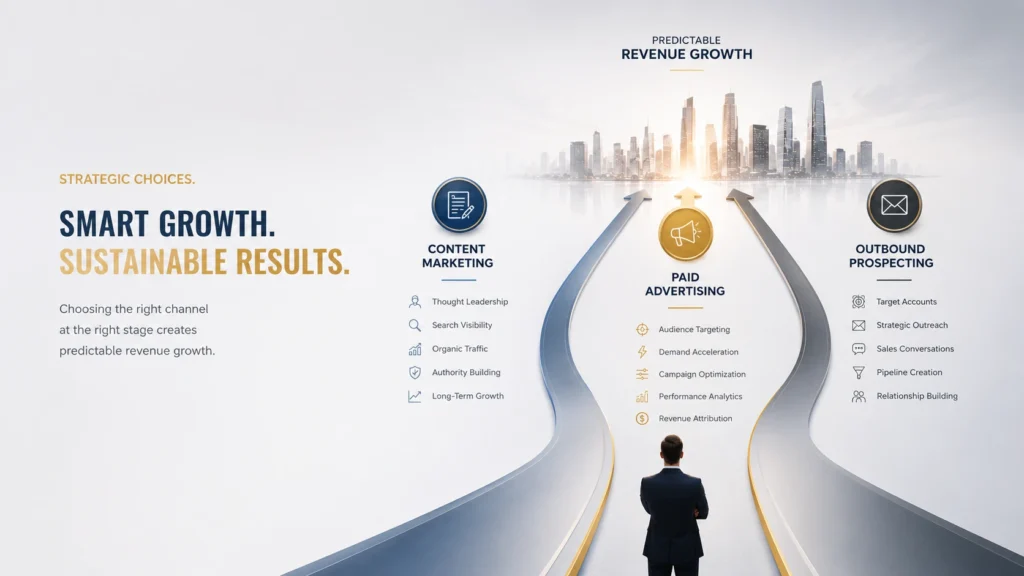
Many founders and growth leaders face the same challenge:
Which channel should receive investment first?
Should resources go toward content marketing, paid advertising, or outbound prospecting?
The answer depends less on channel preference and more on growth stage, market maturity, buyer behavior, and revenue objectives.
Companies often waste significant budgets because they treat channel selection as a marketing decision rather than a strategic growth decision.
Successful growth marketing services strategies align channel investments with business goals, sales capacity, customer acquisition economics, and market readiness.
Organizations working with growth marketing agency USA, demand generation agency, and B2B growth marketing agency partners frequently discover that no single channel wins in every situation.
The businesses that scale efficiently understand when each channel creates leverage and how different channels support one another over time.
Channel Selection by Stage
Different growth stages require different acquisition priorities.
A startup searching for product-market fit should not operate like an established company with predictable revenue.
Similarly, a professional services firm selling six-figure engagements requires a different acquisition model than a SaaS platform with a self-service offering.
Growth Stage Channel Framework
| Business Stage | Primary Goal | Recommended Channel Focus |
| Early Startup | Market validation | Outbound + founder-led selling |
| Growth Stage | Pipeline generation | Content + outbound |
| Scaling Company | Predictable demand | Content + paid ads + outbound |
| Mature Business | Efficiency optimization | Multi-channel growth engine |
Why Channel Choice Changes
Every stage faces different constraints:
Early Stage
Focus on:
- Customer discovery
- Buyer feedback
- Rapid validation
- Short learning cycles
Outbound often performs best because it creates direct conversations quickly.
Growth Stage
Focus shifts toward:
- Pipeline consistency
- Lead quality
- Positioning authority
- Market visibility
This is where B2B lead generation services, growth marketing services, and digital marketing consulting services become increasingly valuable.
Scaling Stage
The objective becomes:
- Revenue predictability
- Lower acquisition risk
- Channel diversification
- Sustainable demand generation
Multiple channels work together rather than independently.
Example
A B2B SaaS company targeting U.S. mid-market buyers may begin with founder-led outbound.
After identifying successful messaging, the company expands into:
- SEO content
- Paid search
- LinkedIn advertising
- Partner programs
The channel evolves as confidence grows.
Channel Selection Checklist
✓ Product-market fit validated
✓ Buyer persona clearly defined
✓ Sales process documented
✓ Customer acquisition economics understood
✓ Revenue targets established
✓ Marketing infrastructure ready
Without these foundations, channel investments often underperform.
Cost vs Time Tradeoffs
One of the biggest misconceptions in growth marketing is believing that the fastest channel is always the best channel.
Every channel creates different tradeoffs.
Channel Comparison Framework
| Channel | Speed | Cost Efficiency | Scalability | Long-Term Asset |
| Content | Slow | High | High | Yes |
| Paid Ads | Fast | Moderate | High | No |
| Outbound | Fast | Moderate | Moderate | No |
| Partnerships | Medium | High | High | Yes |
Content Marketing
Content is often the slowest channel to gain traction.
However, it creates durable assets that continue generating visibility and leads.
Benefits include:
- Organic traffic growth
- Thought leadership
- Trust building
- Lower long-term acquisition costs
This is particularly valuable for companies investing in business growth consulting, growth consulting services, and SaaS growth consulting initiatives.
Paid Advertising
Paid channels create immediate market access.
Advantages include:
- Fast testing
- Audience targeting
- Quick lead generation
- Measurable performance
However, results typically decline when spending stops.
Many organizations use performance marketing services USA to accelerate pipeline creation while longer-term channels mature.
Outbound Prospecting
Outbound provides direct access to target buyers.
Advantages include:
- Faster feedback
- Market validation
- Account targeting
- Sales alignment
Challenges include:
- Limited scalability
- Operational complexity
- Dependence on execution quality
Decision Matrix
Choose content first when:
✓ Market education is required
✓ Sales cycles are long
✓ Trust matters heavily
Choose paid ads first when:
✓ Demand already exists
✓ Offers are validated
✓ Speed matters
Choose outbound first when:
✓ ICPs are narrowly defined
✓ Deal sizes are high
✓ Early validation is needed
Founder Reality
The best channel is not always the cheapest.
The best channel is the one that creates the highest quality learning and revenue opportunities for the current stage of growth.
Hybrid Growth Models
The highest-performing companies rarely depend on one acquisition source.
Instead, they build integrated systems.
This is where modern growth strategy, demand generation, and B2B marketing become more sophisticated.
The Hybrid Growth Model
A hybrid model combines:
- Content
- Paid acquisition
- Outbound
- Partnerships
- Sales enablement
Each channel supports the others.
Example B2B SaaS Framework
| Channel | Purpose |
| SEO Content | Build authority |
| Paid Search | Capture demand |
| LinkedIn Ads | Create awareness |
| Outbound | Target key accounts |
| Partnerships | Expand reach |
Example Professional Services Framework
For consulting, legal, accounting, or technology firms:
| Channel | Purpose |
| Thought Leadership Content | Build trust |
| Outbound Prospecting | Generate conversations |
| Referrals | Accelerate credibility |
| Paid Promotion | Increase visibility |
| Industry Partnerships | Expand pipeline |
This approach supports lead generation for B2B services, marketing strategy for service businesses, and professional services marketing agency growth initiatives.
Hybrid Growth Implementation Framework
Step 1: Validate
Use outbound to test:
- Messaging
- ICP fit
- Buyer pain points
Step 2: Amplify
Use paid media to:
- Increase reach
- Generate demand
- Accelerate learning
Step 3: Compound
Use content to:
- Build authority
- Capture organic demand
- Reduce dependency on paid channels
Step 4: Optimize
Measure:
- Pipeline contribution
- CAC efficiency
- Revenue influence
- Channel attribution
Many growth-stage businesses discover that isolated campaigns create inconsistent outcomes. Growth partners such as GrowAnant focus on connecting channels into a unified revenue system where marketing, sales, and demand generation support predictable business growth.
Channel Prioritization Framework
| Business Situation | First Channel |
| New Startup | Outbound |
| New Market Entry | Outbound + Paid |
| SaaS Growth | Content + Paid |
| Professional Services | Content + Outbound |
| Established Business Scaling | Hybrid Model |
References
Source: Harvard Business Review
Source: McKinsey & Company
FAQs
Outbound and paid advertising typically generate results faster than content marketing. However, speed alone should not determine strategy. The right channel depends on market maturity, buyer behavior, deal size, and revenue goals.
In many cases, yes. Outbound allows startups to validate messaging, understand buyer needs, and generate direct conversations before investing heavily in long-term acquisition channels. It often provides the fastest path to learning and market insight.