
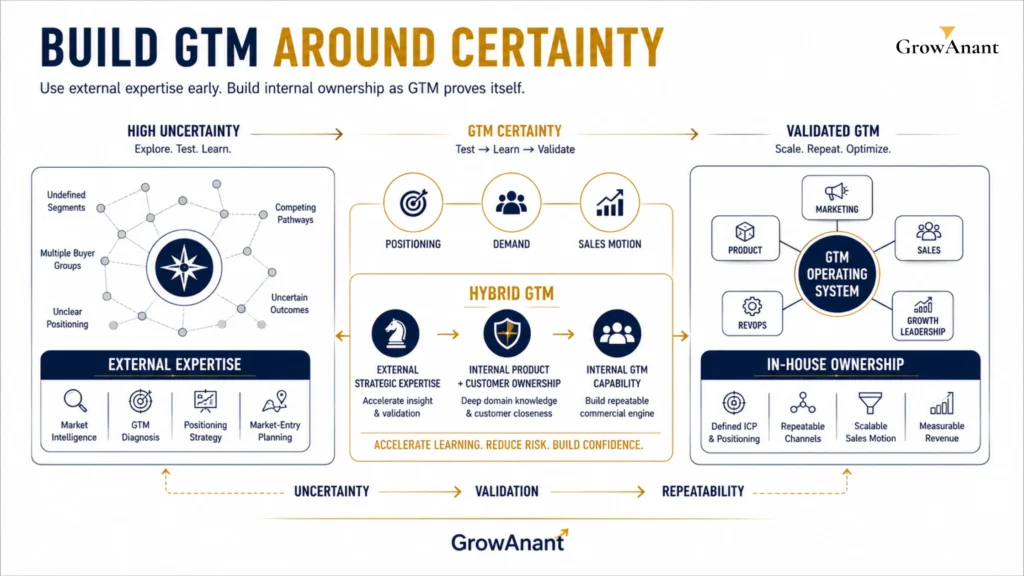
For a cybersecurity startup entering a competitive market, deciding whether to hire internally or bring in external expertise is a strategic capital allocation decision. The question behind startup cybersecurity hire consultants vs build in-house team is not simply who can execute marketing faster. It is who can establish positioning, demand generation, sales alignment, and a repeatable go-to-market system without creating unnecessary cost or organizational complexity.
Cybersecurity buyers often involve multiple stakeholders, technical validation, security reviews, procurement requirements, and significant trust considerations. That makes b2b gtm consulting, go to market strategy consulting, and disciplined market entry planning particularly important when entering the U.S. market.
Why Cybersecurity GTM Is Different
Cybersecurity GTM is different because buyers rarely evaluate a security solution on marketing appeal alone. They need confidence in technical capability, risk reduction, integration, compliance, implementation, and vendor credibility.
A startup can therefore generate traffic and leads without creating meaningful pipeline if its GTM strategy does not answer the questions buyers ask before engaging sales.
Cybersecurity GTM Complexity Framework
| Area | Typical Challenge | GTM Requirement |
| Buyer | Security, IT, compliance, executive stakeholders | Multi-person buying strategy |
| Trust | High perceived vendor risk | Strong proof and credibility |
| Positioning | Crowded security categories | Clear differentiation |
| Sales | Technical evaluation | Sales and technical alignment |
| Demand | Long consideration periods | Education plus intent capture |
| Expansion | Multiple use cases | Segment-specific messaging |
For example, a cybersecurity SaaS startup entering the U.S. market may initially believe its target customer is simply “mid-market companies.” A stronger strategy could identify a specific industry, security problem, buyer role, trigger event, and commercial use case.
This is where market entry strategy USA becomes more than geographic expansion. It requires understanding the market structure, buyer expectations, competitive positioning, channel economics, and sales motion.
A useful test is:
Market clarity + buyer clarity + positioning clarity + sales motion + demand system = GTM readiness
Build In-House: Pros and Cons
Building internally provides ownership and institutional knowledge. A dedicated team can eventually develop deep understanding of the product, customers, competitive environment, and organizational culture.
However, early hiring can create a different problem: assembling several specialists before the company has validated the GTM model.
Advantages
- Strong internal product knowledge
- Long-term organizational capability
- Direct control over priorities
- Easier institutional knowledge retention
- Greater ownership of execution
Limitations
- Higher fixed operating cost
- Recruiting can take time
- Senior GTM talent can be difficult to secure
- Teams may execute before strategy is validated
- Multiple hires may be required across marketing, sales, operations, and strategy
Consider a funded cybersecurity startup with strong engineering capability but limited commercial experience. Hiring a marketer, demand generation specialist, sales leader, and operations resource simultaneously could increase organizational complexity before the company knows which segments and channels deserve investment.
In-House Readiness Checklist
Before building the team, leadership should be able to answer:
- Which customer segment has the strongest commercial potential?
- Which buyer owns the problem?
- What differentiates the product?
- What sales motion fits the market?
- Which acquisition channels are likely to work?
- What pipeline targets justify additional headcount?
- Who will provide senior GTM leadership?
If several answers remain uncertain, hiring a large internal team may be premature.
Hire Consultants: Pros and Cons
External consultants can provide specialized expertise without requiring the startup to immediately build a complete commercial organization.
The strongest use case is not outsourcing responsibility. It is accelerating strategic clarity while the company builds durable internal capability.
Advantages
- Access to senior GTM expertise
- Faster strategic assessment
- Flexible resource commitment
- Exposure to multiple market-entry situations
- Ability to establish processes before permanent hiring
- Lower organizational commitment during validation
A specialized partner can support startup growth strategy consulting, positioning, segmentation, demand generation, sales alignment, and growth roadmap consulting while internal leaders retain ownership of critical decisions.
Limitations
- External knowledge must be transferred effectively
- Consultant quality varies considerably
- Product context takes time to develop
- Internal ownership can become unclear
- Engagements can fail when execution expectations are not defined
For GrowAnant, the relevant model is strategic growth partnership rather than isolated campaign execution. The objective is to connect growth strategy consulting, demand generation, positioning, and revenue execution into one operating framework.
Consultant Evaluation Checklist
A cybersecurity startup should assess:
- Relevant B2B and technology experience
- Understanding of complex buying committees
- U.S. market knowledge
- Ability to connect strategy with execution
- Clear measurement framework
- Defined internal knowledge-transfer process
- Experience aligning marketing and sales
Cost & Speed Comparison
The financial decision should consider total cost, not simply consulting fees versus salaries.
| Factor | Build In-House | Hire Consultants |
| Initial commitment | Higher | Lower |
| Hiring time | Potentially significant | Usually faster to initiate |
| Senior expertise | Requires recruitment | Available through engagement |
| Fixed cost | Higher | More flexible |
| Product knowledge | Builds internally | Develops during engagement |
| Strategic flexibility | Depends on team | Typically higher |
| Long-term capability | Strong | Requires knowledge transfer |
The critical variable is time to strategic clarity, not merely time to launch campaigns.
For a cybersecurity startup with limited market validation, external business growth consulting may help leadership test assumptions before committing to permanent headcount. Once the company identifies repeatable demand, hiring internal leaders can become more rational.
The decision can be framed through four questions:
Need senior expertise now?
Yes → Consider consultants.
GTM model already validated?
Yes → Internal hiring becomes more attractive.
Need flexibility while testing markets?
Yes → Consider a fractional or consulting model.
Need permanent organizational ownership?
Yes → Build toward an internal team.
Hybrid Approaches
For many cybersecurity startups, the strongest option is neither fully internal nor fully external.
A hybrid model combines strategic external leadership with internal ownership of product knowledge, customer relationships, and execution.
Example Hybrid Structure
| Responsibility | Internal | External |
| Product expertise | ✓ | |
| Customer interviews | ✓ | ✓ |
| GTM strategy | ✓ | ✓ |
| Positioning | ✓ | ✓ |
| Demand generation | ✓ | |
| Sales process | ✓ | ✓ |
| Analytics | ✓ | ✓ |
| Hiring roadmap | ✓ | ✓ |
| Long-term ownership | ✓ |
For example, a U.S. cybersecurity startup could have its founder and product leader own customer insight while a fractional growth consultant establishes segmentation, positioning, pipeline architecture, demand generation priorities, and measurement.
As internal capability develops, selected responsibilities can move in-house.
This model is especially useful for companies evaluating SaaS growth consulting, B2B marketing strategy consulting, demand generation, and U.S. expansion simultaneously.
Decision Framework
Use the following scoring model before choosing an operating model.
Score each factor from 1 to 5:
| Decision Factor | 1 | 5 |
| GTM clarity | Unclear | Validated |
| Internal expertise | Limited | Strong |
| Hiring urgency | Low | Immediate |
| Budget flexibility | High need | Low need |
| Market uncertainty | High | Low |
| Execution capacity | Limited | Strong |
| Leadership bandwidth | Limited | Strong |
Decision Logic
High uncertainty + limited expertise + urgent market entry
→ External or hybrid model
Validated GTM + strong internal leadership + predictable hiring needs
→ Build in-house
Validated product + unclear commercial system
→ Consider strategic consulting before expanding headcount
Strong internal execution team + weak strategic leadership
→ Consider fractional leadership
The objective is not to determine whether consultants or employees are universally better. The objective is to match the operating model to the startup’s current level of certainty.
A cybersecurity company entering the U.S. market should also avoid confusing digital growth agency execution with strategic GTM leadership. Paid acquisition, SEO, content, or outbound campaigns can amplify a GTM system, but they cannot compensate for unclear positioning or an undefined buyer.
A strategy-led partner such as GrowAnant can therefore operate as a temporary growth leadership layer, helping connect revenue growth consulting, demand generation, positioning, and execution while the company determines what capabilities should eventually become permanent.
Frequently Asked Questions
Yes. Cybersecurity GTM often involves greater trust requirements, technical evaluation, multiple stakeholders, security reviews, longer consideration periods, and higher perceived switching or vendor risk. The strategy therefore needs to align product positioning, technical credibility, sales enablement, demand generation, and buyer education.
It depends on GTM maturity. If the company has validated its target segment, positioning, sales motion, and acquisition channels, building internal capability can make sense. If those elements remain uncertain, external or hybrid support can provide senior expertise while limiting premature fixed-cost commitments.
The timeline depends on product maturity, market clarity, positioning, available assets, sales readiness, and execution capacity. Consultants can generally begin strategic assessment faster than a company can recruit an entire senior GTM team, but launching activity quickly should not be confused with validating a repeatable GTM model.
A strong hybrid approach keeps product knowledge, customer relationships, and long-term ownership inside the company while using external expertise for strategy, positioning, demand generation, sales process design, analytics, and GTM planning. Responsibilities should be documented clearly so external support strengthens internal capability rather than creating dependency.