
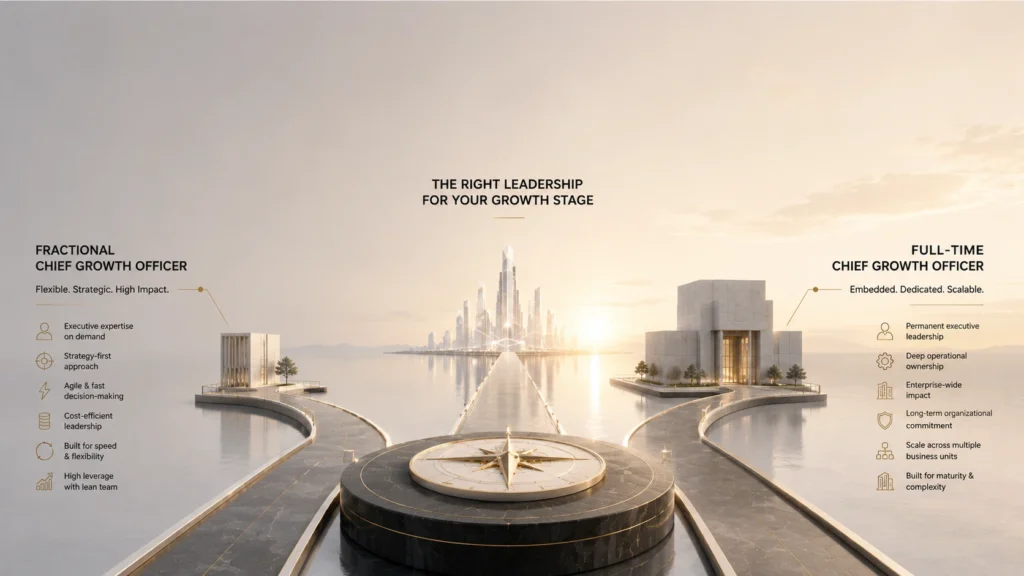
Growth-stage companies often reach a point where marketing execution alone is no longer enough. Revenue becomes unpredictable, customer acquisition costs increase, teams lose alignment, and growth initiatives begin competing for resources. At this stage, businesses frequently need strategic growth leadership rather than additional marketing activity.
One increasingly popular solution is hiring a Fractional Chief Growth Officer instead of committing to a full-time executive. Supported by experienced growth strategy consulting, a fractional growth executive can provide executive-level direction, align marketing and sales, improve go-to-market execution, and build scalable revenue systems without the long-term commitment of a permanent executive hire.
Understanding the differences between these leadership models helps founders and executives make informed decisions that support sustainable business growth and long-term revenue performance.
Understanding the CGO role
A Chief Growth Officer (CGO) is responsible for creating and executing strategies that drive sustainable revenue growth across the organization. Unlike traditional marketing leaders who primarily oversee campaigns, a CGO connects strategy, marketing, sales, customer success, and product initiatives into one measurable growth system.
Organizations investing in growth consulting services, business growth consulting, or growth strategy consulting often recognize that fragmented execution limits growth. A CGO addresses this challenge by ensuring every growth initiative supports broader business objectives.
Core responsibilities
A modern Chief Growth Officer typically oversees:
- Revenue strategy
- Customer acquisition
- Demand generation
- Sales and marketing alignment
- Customer retention and expansion
- GTM planning
- Performance measurement
- Executive growth planning
Rather than focusing on individual campaigns, the CGO is accountable for improving the overall growth engine.
Strategic ownership
| Business Function | Traditional Ownership | CGO Perspective |
| Marketing | Campaign execution | Revenue contribution |
| Sales | Closing opportunities | Pipeline efficiency |
| Customer Success | Retention | Customer lifetime value |
| Product | Feature delivery | Product-market alignment |
| Leadership | Business planning | Sustainable growth strategy |
This cross-functional responsibility enables faster decision-making and stronger alignment across departments.
Business example
Consider a SaaS company with an experienced marketing team, a growing sales organization, and a capable product team. Each department performs well independently, yet pipeline growth remains inconsistent.
The issue is not execution quality. It is the absence of strategic coordination.
A CGO aligns positioning, demand generation, qualification, onboarding, and customer expansion into one integrated growth strategy, improving visibility across the entire revenue lifecycle.
Fractional vs full-time
While both leadership models perform similar strategic responsibilities, they differ significantly in engagement structure, investment, flexibility, and organizational fit.
A Fractional Chief Growth Officer provides executive expertise on a part-time or contract basis, whereas a full-time CGO becomes a permanent member of the executive leadership team.
Comparison table
| Area | Fractional Chief Growth Officer | Full-Time Chief Growth Officer |
| Engagement | Part-time or fractional | Full-time executive |
| Investment | Lower fixed cost | Higher long-term investment |
| Speed to Start | Often within weeks | Lengthy recruitment process |
| Flexibility | High | Limited |
| Strategic Leadership | Executive level | Executive level |
| Operational Involvement | Focused on priorities | Broader organizational oversight |
| Best For | Growth-stage companies | Large organizations with mature growth teams |
Advantages of a fractional model
A fractional growth consultant enables businesses to access senior leadership without immediately expanding executive payroll.
This model is especially valuable for:
- Founder-led businesses
- Seed to Series B SaaS companies
- Professional service firms
- Companies entering the U.S. market
- Organizations building internal growth capabilities
Many businesses also combine a Fractional Chief Growth Officer with internal marketing teams, external specialists, or a digital growth agency to create an efficient growth operating model.
When a full-time CGO is appropriate
A permanent Chief Growth Officer is often a better choice when an organization:
- Operates across multiple business units
- Requires daily executive oversight
- Has mature marketing, sales, and product teams
- Is scaling internationally
- Needs continuous executive leadership across several functions
For many growth-stage organizations, however, hiring a fractional growth executive provides strategic leadership at a stage where flexibility and capital efficiency remain critical.
Businesses working with strategic partners such as GrowAnant frequently begin with fractional growth leadership to establish repeatable revenue systems before expanding their permanent executive team.
Cost comparison
For many growth-stage businesses, the decision is not simply about executive compensation. It is about achieving the greatest strategic impact while preserving flexibility and managing investment risk.
A full-time Chief Growth Officer typically involves a significant long-term commitment that extends beyond salary to include benefits, equity, recruitment costs, onboarding, and executive support. In contrast, a Fractional Chief Growth Officer allows businesses to access experienced leadership based on current business priorities and growth stage.
Executive investment comparison
| Consideration | Fractional Chief Growth Officer | Full-Time Chief Growth Officer |
| Hiring timeline | Shorter onboarding | Executive recruitment can take several months |
| Initial investment | Lower upfront commitment | Higher long-term employment commitment |
| Flexibility | High and scalable | Limited after hiring |
| Executive expertise | Senior strategic leadership | Senior strategic leadership |
| Best suited for | Growth-stage businesses | Mature organizations with ongoing executive needs |
Rather than asking which option is cheaper, founders should ask which option delivers the highest strategic value at their current stage of growth.
For example:
- A Series A SaaS company preparing for rapid expansion may benefit from a Fractional Chief Growth Officer who builds scalable revenue systems before additional executive hiring.
- A regional professional services firm entering multiple U.S. markets may use business growth consulting, go to market strategy consulting, and growth consulting services USA before committing to a permanent executive team.
- An enterprise organization managing multiple product divisions may justify a full-time executive because leadership requirements extend across the entire business every day.
Benefits
The value of a Fractional Chief Growth Officer extends well beyond marketing oversight. Their primary responsibility is creating alignment between strategy, execution, measurement, and revenue outcomes.
Key benefits
| Business Challenge | How a Fractional CGO Helps |
| Unpredictable revenue | Creates measurable growth plans and forecasting processes |
| Weak GTM execution | Improves positioning, segmentation, and launch planning through growth strategy consulting |
| Marketing and sales misalignment | Establishes shared pipeline goals and accountability |
| Rising CAC | Optimizes acquisition channels and prioritizes sustainable growth |
| Slow decision-making | Provides executive-level direction without expanding internal management layers |
| Limited strategic leadership | Brings proven experience from multiple industries and growth stages |
Unlike many tactical consultants, a growth consultant focuses on the systems that influence long-term performance rather than isolated campaigns.
Additional strategic advantages
A Fractional Chief Growth Officer can help organizations:
- Build repeatable revenue processes
- Strengthen growth leadership across departments
- Improve forecasting accuracy
- Create scalable growth systems
- Increase executive visibility into pipeline performance
- Prioritize initiatives with the greatest business impact
- Improve marketing leadership and demand generation leadership
- Support revenue growth consulting initiatives through measurable execution
Many organizations also pair fractional leadership with existing growth consulting services, internal specialists, and external partners to create a flexible operating model that evolves as the business grows.
Example
A funded B2B SaaS company may already have experienced marketers, SDRs, and account executives. However, if pipeline quality remains inconsistent and customer acquisition costs continue increasing, adding additional marketing spend often produces diminishing returns.
A Fractional Chief Growth Officer evaluates positioning, funnel performance, customer journey alignment, pricing strategy, sales enablement, and measurement before recommending where additional investment should occur.
This strategic perspective often helps businesses make more informed growth decisions instead of simply increasing marketing activity.
When each option works
There is no universal answer to whether a Fractional Chief Growth Officer or a full-time executive is the better choice. The right decision depends on your company’s growth stage, internal capabilities, strategic priorities, and long-term leadership requirements.
Choose a Fractional Chief Growth Officer when:
- Your business is preparing for its next phase of business growth but does not yet require a permanent executive.
- Marketing, sales, and customer success teams operate independently without a unified growth strategy.
- You need experienced leadership to improve revenue growth, growth systems, and cross-functional execution.
- You are entering a new market and require growth strategy consulting, go to market strategy consulting, or market entry strategy USA expertise.
- Your company already has execution teams but lacks executive-level direction.
- You need guidance on growth consulting services, business growth consulting, or digital growth agency initiatives before expanding internal leadership.
Choose a full-time Chief Growth Officer when:
- Growth leadership is required every day across multiple business units.
- Your organization has reached a scale where executive ownership is needed for ongoing operations.
- Multiple product lines, international markets, or acquisitions require continuous executive oversight.
- The business has mature revenue operations and long-term executive capacity is justified.
Decision framework
Use the following framework to determine which model aligns with your current business needs.
| Business Situation | Recommended Approach |
| Startup validating product-market fit | Strategic advisory or Fractional Chief Growth Officer |
| Growth-stage SaaS preparing to scale | Fractional Chief Growth Officer |
| Professional services firm expanding into new regions | Fractional Chief Growth Officer supported by growth consulting services |
| Business with execution teams but limited strategic leadership | Fractional Chief Growth Officer |
| Enterprise organization with multiple divisions | Full-Time Chief Growth Officer |
| Company requiring daily executive ownership across departments | Full-Time Chief Growth Officer |
Many businesses also adopt a hybrid approach. A Fractional Chief Growth Officer establishes strategy, operating processes, performance dashboards, and leadership rhythms before helping recruit and transition responsibilities to a permanent executive when the organization reaches the appropriate stage.
Growth partners such as GrowAnant often support this transition by combining executive guidance with structured implementation, ensuring that growth strategy, demand generation, and revenue execution remain aligned throughout the company’s scaling journey.
References
- Harvard Business Review
https://hbr.org - Gartner
https://www.gartner.com
FAQs
A Fractional Chief Growth Officer is an experienced executive who provides part-time or contract-based strategic growth leadership. They oversee growth strategy, revenue planning, cross-functional alignment, and scalable growth initiatives without the long-term commitment of a full-time executive.
In many cases, yes. A Fractional Chief Growth Officer generally requires a lower upfront investment than hiring a permanent executive because businesses avoid full-time employment costs while still accessing senior-level expertise. The best choice, however, depends on the company’s growth stage and leadership needs.
Yes. Startups that have achieved early traction but need experienced guidance for business growth, go-to-market strategy, fundraising preparation, or scaling operations often benefit from a Fractional Chief Growth Officer before building a complete executive team.
A Fractional Chief Growth Officer performs many of the same strategic responsibilities as a full-time Chief Growth Officer, including revenue planning, growth leadership, demand generation, GTM strategy, and cross-functional alignment. The primary difference is engagement model, availability, and long-term organizational commitment rather than strategic capability.