
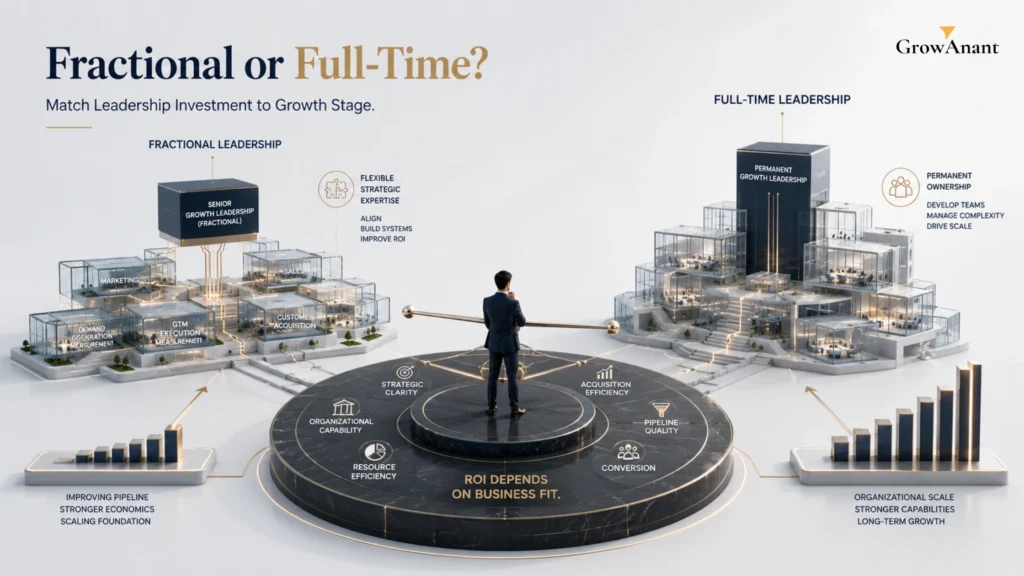
Choosing between a fractional growth consultant and a full-time growth leader is not simply a hiring decision. It is a strategic capital allocation decision that affects growth leadership, execution speed, organizational capabilities, and the company’s ability to build repeatable growth systems.
Growth-stage companies often reach this decision point when customer acquisition becomes inconsistent, marketing investment is difficult to connect to revenue, founders remain responsible for growth decisions, or internal teams execute activities without clear strategic ownership.
A fractional growth consultant can provide experienced fractional growth leadership, strategic direction, and access to specialized growth consulting services without requiring the company to immediately build a full executive function.
A full-time growth leader provides continuous internal ownership, deeper organizational integration, and long-term responsibility for the company’s growth infrastructure.
Neither model automatically delivers better ROI.
The right decision depends on the company’s stage, growth constraints, execution capabilities, leadership needs, financial resources, and long-term organizational strategy.
Role Comparison
A fractional growth consultant provides strategic growth expertise to a business on a part-time, retained, or engagement-based model.
Depending on the scope, the role may resemble a fractional head of growth, fractional chief growth officer, fractional growth executive, or interim growth leader.
The consultant typically evaluates the company’s market, positioning, acquisition channels, funnel performance, sales process, customer economics, and internal capabilities before developing priorities and coordinating execution.
A full-time growth leader is permanently embedded within the organization.
This person typically manages teams, participates in executive decisions, owns budgets, develops internal capabilities, and remains accountable for long-term growth performance.
| Comparison Area | Fractional Model | Full-Time Model |
| Engagement | Part-time or retained | Permanent executive role |
| Strategic focus | Diagnose constraints and prioritize growth opportunities | Own ongoing company growth strategy |
| Organizational integration | Works across leadership and execution teams | Fully embedded in organizational structure |
| Speed of access | Can often be engaged without a lengthy executive hiring process | Requires recruiting, evaluation, onboarding, and integration |
| Internal capability building | Helps teams improve systems and execution | Builds and manages long-term internal capabilities |
| Financial commitment | Variable based on scope and engagement model | Salary, benefits, incentives, recruiting, and organizational costs |
| Best suited for | Companies needing experienced leadership without immediate full-time hiring | Companies with scale, resources, and permanent executive needs |
The decision should begin with the business problem.
A company with an effective growth system that requires continuous executive management may benefit from a full-time leader.
A company experiencing unclear priorities, fragmented execution, founder bottlenecks, or inconsistent customer acquisition may first need growth strategy consulting and senior strategic direction.
GrowAnant approaches this decision by evaluating the company’s current growth system, revenue constraints, internal capabilities, and readiness for permanent executive leadership.
Strategic Ownership
Strategic ownership is one of the most important factors when comparing the two models.
Many businesses already have marketers, sales teams, agencies, and technology platforms.
What they lack is a leader responsible for connecting those resources to measurable business growth.
Without clear ownership:
- Marketing prioritizes activity rather than pipeline.
- Sales pursues opportunities without consistent qualification.
- Product insights remain disconnected from acquisition strategy.
- Customer acquisition costs increase without clear diagnosis.
- Teams launch initiatives without shared priorities.
- Leadership lacks reliable revenue visibility.
A fractional growth consultant can provide strategic ownership by establishing priorities, aligning teams, creating measurement systems, and guiding resource allocation.
The exact scope depends on the engagement.
Some consultants provide advisory recommendations only.
Others operate as outsourced growth leadership, taking responsibility for strategic planning, cross-functional coordination, performance reviews, and implementation oversight.
A full-time growth leader provides deeper organizational ownership.
The leader participates continuously in hiring decisions, budget planning, team development, product strategy, executive meetings, and long-term business planning.
Leadership teams should evaluate strategic ownership through five questions:
| Question | Why It Matters |
| Who owns the complete growth system? | Fragmented ownership creates inconsistent execution |
| Who prioritizes growth investments? | Resources should follow strategic opportunities |
| Who connects marketing to sales and revenue? | Activity must translate into commercial outcomes |
| Who identifies and addresses growth constraints? | Scaling requires continuous diagnosis |
| Who is accountable for building internal capabilities? | Long-term growth requires organizational maturity |
A B2B SaaS company with strong internal teams but no senior growth leader may benefit from a fractional growth consultant who provides immediate strategic direction.
An established company managing several markets, product lines, and large internal teams may require permanent growth leadership.
Execution Responsibility
One common misconception is that fractional consultants only create presentations and recommendations.
Execution responsibility depends on the engagement model.
A strategic advisor may primarily diagnose problems and recommend actions.
A fractional growth consultant operating as an embedded growth partner may help leadership prioritize initiatives, manage execution teams, evaluate performance, and improve decision-making.
A full-time leader typically has greater direct responsibility for internal execution.
The distinction can be understood through four levels:
| Level | Responsibility |
| Advisory | Diagnose problems and recommend strategic actions |
| Strategic | Build the growth strategy, priorities, roadmap, and measurement framework |
| Leadership | Align teams, allocate resources, review performance, and guide execution |
| Operational | Directly manage employees, budgets, processes, and day-to-day delivery |
Businesses should define which level they actually need before selecting a model.
For example, a U.S. professional services firm may already have marketing specialists, salespeople, and external vendors.
Hiring another execution resource may not solve inconsistent pipeline.
The company may need senior leadership to improve positioning, develop a stronger marketing strategy for service businesses, align demand generation with sales priorities, and establish revenue accountability.
In that situation, business growth consulting combined with embedded fractional leadership may create more strategic value than immediately hiring a full-time executive.
Cost Comparison
Cost should be evaluated based on total investment and business value, not salary alone.
A full-time growth leader may require:
- Base compensation.
- Performance incentives.
- Benefits.
- Recruiting costs.
- Executive onboarding.
- Technology and operational resources.
- Supporting team members.
- Long-term employment commitments.
A fractional model typically provides more flexible access to senior expertise.
However, lower cost does not automatically mean better ROI.
A poorly scoped consulting engagement can create reports without implementation.
A premature full-time executive hire can create significant fixed costs before the company has sufficient scale or clarity.
| Cost Consideration | Fractional Model | Full-Time Model |
| Initial commitment | Lower and more flexible | Higher and long-term |
| Recruiting investment | Usually limited | Often significant |
| Compensation structure | Retainer, project, or part-time engagement | Salary, benefits, incentives |
| Supporting infrastructure | Uses existing teams and resources | May require additional hiring |
| Flexibility | Scope can evolve with business needs | Organizational restructuring may be required |
| Risk of wrong fit | Engagement can be adjusted more easily | Executive hiring mistakes can be expensive |
A startup preparing for U.S. expansion may require market entry strategy USA, positioning, go to market strategy consulting, customer acquisition planning, and revenue measurement.
The business may not yet need a permanent executive.
Accessing growth consulting services USA through a fractional model can provide strategic leadership while preserving flexibility.
Conversely, a larger company with predictable revenue, multiple teams, substantial budgets, and long-term leadership requirements may generate stronger value from a full-time executive.
Business Fit
The correct model depends heavily on company maturity.
A fractional growth consultant is often suitable when:
- The company has traction but growth is inconsistent.
- Founders remain responsible for too many growth decisions.
- Marketing and sales teams lack alignment.
- The company needs a growth roadmap consulting process.
- Customer acquisition costs are rising.
- Leadership needs stronger revenue visibility.
- The business is entering a new market.
- Existing execution teams need senior direction.
- The company is not ready for a permanent executive hire.
A full-time growth leader may be more appropriate when:
- Growth strategy is already validated.
- The company manages significant acquisition budgets.
- Multiple teams require permanent executive leadership.
- The organization needs continuous hiring and capability development.
- The business has sufficient complexity to justify a dedicated executive.
- Long-term organizational transformation is required.
The decision can be simplified through the following framework:
| Business Condition | Better Starting Model |
| Strategy is unclear | Fractional |
| Growth has plateaued | Fractional |
| Founder bottleneck exists | Fractional |
| Teams need senior coordination | Fractional |
| New market expansion is being evaluated | Fractional |
| Growth system is validated and scaling rapidly | Full-time |
| Large internal organization requires permanent management | Full-time |
| Long-term executive succession is required | Full-time |
Companies should also evaluate internal execution capacity.
A fractional leader cannot create sustainable results if the company has no resources to implement priorities.
Likewise, hiring a full-time executive before the company has validated its growth model can create unnecessary overhead.
GrowAnant positions fractional leadership as a strategic growth partnership that connects executive priorities, revenue strategy, GTM leadership, marketing leadership, and demand generation leadership with measurable execution.
ROI Comparison
ROI should not be measured only by comparing consulting fees with executive compensation.
The better question is:
Which model helps the business make better growth decisions, reduce inefficient investment, improve execution, and build sustainable capabilities at the current stage?
A practical ROI framework should evaluate six areas:
| ROI Dimension | Measurement Question |
| Strategic clarity | Are teams focused on the right markets, customers, and opportunities? |
| Acquisition efficiency | Is the company improving customer acquisition economics? |
| Pipeline quality | Are marketing and sales producing more qualified opportunities? |
| Conversion performance | Are more opportunities progressing toward revenue? |
| Resource efficiency | Are budgets and teams allocated to the highest-value priorities? |
| Organizational capability | Is the company building stronger long-term growth systems? |
A fractional growth consultant may deliver stronger ROI when the company needs immediate strategic expertise, flexible leadership, growth diagnosis, and cross-functional alignment.
A full-time leader may deliver stronger ROI when the organization has sufficient scale, resources, and complexity to use permanent executive leadership effectively.
Companies should evaluate results using business metrics rather than marketing activity.
Relevant measures can include:
- Qualified pipeline created.
- Pipeline velocity.
- Customer acquisition cost.
- Lead-to-opportunity conversion.
- Opportunity-to-customer conversion.
- Sales cycle length.
- Revenue contribution by channel.
- Customer retention.
- Expansion revenue.
- Marketing efficiency.
- Forecast accuracy.
For example, a funded SaaS startup may be investing in B2B marketing, paid acquisition, outbound sales, and content while struggling with weak positioning and inconsistent conversion.
Hiring more marketers may increase activity without solving the strategic problem.
A fractional leader can diagnose the system, prioritize the highest-impact constraints, improve alignment, and help the company determine what internal capabilities should eventually be built.
A mature business with validated acquisition channels, strong unit economics, several revenue teams, and complex organizational requirements may benefit more from permanent leadership.
GrowAnant works as a growth partner for companies that need strategy-first thinking, stronger revenue systems, and experienced leadership connecting marketing, demand, sales, and scalable execution.
The right model should increase the company’s ability to make disciplined decisions, build repeatable capabilities, and create clearer accountability for growth.
References
FAQs
A fractional growth consultant typically provides strategic expertise, diagnosis, planning, and guidance based on the agreed engagement scope.
A growth leader has broader responsibility for strategic ownership, cross-functional alignment, resource allocation, execution oversight, and long-term organizational capabilities.
Some fractional consultants operate as embedded leaders, making the distinction dependent on scope and accountability rather than employment status alone.
The more cost-effective option depends on business stage, leadership requirements, internal resources, and engagement duration.
A fractional model can provide flexible access to senior expertise without the fixed costs associated with permanent executive hiring.
A full-time leader may create stronger long-term value when the company has sufficient scale and organizational complexity to require continuous executive ownership.
Yes.
A fractional growth consultant can help design and implement positioning frameworks, acquisition systems, demand generation processes, revenue measurement, experimentation models, team workflows, and strategic roadmaps.
Long-term sustainability depends on whether the company adopts these systems, develops internal capabilities, and maintains accountability after the engagement evolves or ends.
Businesses should consider a full-time growth leader when they have validated growth channels, sufficient financial resources, complex internal teams, substantial acquisition investments, and a long-term need for permanent executive ownership.
The role should be justified by organizational requirements rather than the assumption that every scaling company needs another executive title.
Yes.
A fractional model can help companies diagnose growth constraints, establish strategic priorities, build operating systems, define required capabilities, and determine which roles should eventually be hired internally.
This can reduce the risk of building an in-house team before the company understands the capabilities required for its next stage of growth.
Consultants should measure success through business outcomes connected to the engagement objectives.
Depending on the company’s stage, relevant measures may include strategic clarity, qualified pipeline, customer acquisition efficiency, conversion rates, sales velocity, revenue attribution, retention, forecast visibility, team alignment, and the maturity of internal growth systems.
The strongest measurement framework connects strategic decisions and execution improvements to pipeline, revenue, and sustainable organizational capabilities.