
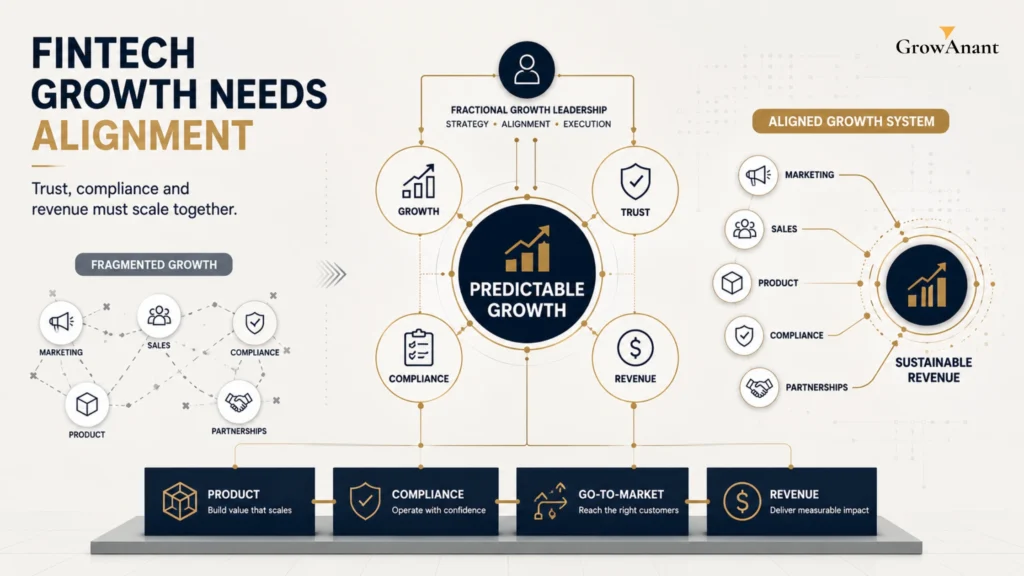
FinTech companies face a different growth equation from conventional SaaS businesses. Product innovation, customer acquisition, trust, regulation, partnerships, and revenue growth must develop together. This makes fractional growth leadership fintech particularly relevant for founders who need senior strategic direction without immediately building a large executive team.
A fractional growth consultant can connect positioning, demand generation, sales, partnerships, customer acquisition, and revenue operations while working alongside product, compliance, and leadership teams.
The goal is not simply more leads. It is a growth system that can scale responsibly.
McKinsey describes the current FinTech environment as one where sustainable, profitable growth has become more important than growth at any cost.
Unique Growth Challenges in FinTech
FinTech growth combines the challenges of technology businesses with the complexity of financial services.
A conventional SaaS company might primarily optimize acquisition, activation, retention, and expansion. A FinTech company may need to address those same areas while also managing regulatory exposure, financial risk, security, trust, fraud prevention, and ecosystem partnerships.
| Growth Area | Typical SaaS Concern | FinTech Concern |
| Acquisition | Cost per customer | Acquisition plus compliance requirements |
| Conversion | Product value | Value plus trust and risk perception |
| Product | Adoption | Adoption, security, and regulatory fit |
| Partnerships | Distribution | Distribution plus financial ecosystem requirements |
| Brand | Differentiation | Differentiation plus credibility |
| Growth | Speed | Sustainable and controlled growth |
This creates several common challenges:
- Long or complex buying cycles
- Multiple decision-makers
- High trust requirements
- Regulatory uncertainty
- Dependence on banking or technology partners
- Difficulty communicating technical products simply
- Marketing claims requiring careful review
- Pressure to demonstrate efficient growth
A fractional chief growth officer or fractional head of growth can help leadership prioritize these competing requirements rather than allowing marketing, sales, product, and compliance to operate independently.
The role becomes especially valuable when a FinTech has capable execution teams but lacks a senior leader responsible for connecting growth activity to commercial outcomes.
Compliance-Aware Growth Strategy
Compliance should not be treated as a final approval step after the marketing strategy has already been created.
For FinTech companies, compliance considerations can influence product positioning, messaging, customer targeting, partnerships, onboarding, and market expansion.
Deloitte’s recent FinTech research highlights the importance of integrating risk and compliance into innovation and marketing processes rather than treating them as end-stage checkpoints.
A practical operating model is:
Growth Strategy → Product → Compliance → Marketing → Sales → Revenue
Instead of:
Growth Strategy → Marketing → Compliance Review
The first model reduces the likelihood of developing campaigns or positioning that cannot be deployed effectively.
A fractional growth leader should therefore establish a shared growth framework.
Compliance-aware growth checklist
- Define claims that marketing can safely communicate
- Identify regulated customer segments
- Establish approval workflows
- Align product positioning with compliance requirements
- Document acceptable proof points
- Review landing pages and campaigns before launch
- Track compliance-related friction in the funnel
- Include risk and compliance stakeholders in major GTM decisions
This approach does not mean growth has to become slow.
The objective is to make compliance part of the growth system so that teams can move faster with greater clarity.
McKinsey similarly notes that strong compliance capabilities can support customer experience, productivity, and resilient growth when business and compliance leaders work together.
For FinTech founders, this is an important distinction: compliance is not merely a constraint. When communicated properly, trust, security, reliability, and responsible operations can become part of the value proposition.
Trust & Positioning Challenges
Financial products require a higher level of confidence than many ordinary software products.
A buyer evaluating accounting software may focus heavily on usability and functionality. A buyer evaluating payments infrastructure, lending technology, financial data, or embedded finance may also ask:
- Can I trust this company?
- Is my data protected?
- Will the platform remain reliable?
- Does the company understand regulatory requirements?
- What happens if something goes wrong?
- Can this provider support us as we scale?
This means FinTech positioning should connect functionality + business value + trust evidence.
For example, instead of positioning a payments platform simply around “faster payments,” the company could communicate the operational problem it solves, the relevant customer outcome, and the evidence supporting its reliability.
Trust should also appear throughout the customer journey.
| Funnel Stage | Trust Signal |
| Awareness | Educational expertise |
| Consideration | Security and compliance information |
| Evaluation | Customer evidence and documentation |
| Purchase | Clear implementation process |
| Retention | Reliability, support, and transparency |
McKinsey research has found that FinTech companies can achieve trust levels comparable with traditional financial institutions, reinforcing that trust can become a competitive advantage rather than simply an incumbent advantage.
A fractional growth executive can help make this trust architecture consistent across website messaging, sales enablement, content, partnerships, and customer communications.
Channel Strategy for FinTech
There is no universal “best” FinTech marketing channel.
Channel selection should depend on the ICP, transaction size, buying cycle, regulatory environment, and customer acquisition economics.
A B2B payments infrastructure company may prioritize partnerships, founder-led sales, industry events, account-based outreach, and educational content.
A consumer-facing FinTech may require a different combination of search, partnerships, referrals, paid acquisition, lifecycle marketing, and product-led growth.
A useful decision framework is:
| Situation | Potential Priority |
| Complex enterprise product | Partnerships + sales-led GTM |
| Technical B2B product | Thought leadership + targeted demand generation |
| Consumer FinTech | Product-led acquisition + lifecycle marketing |
| Embedded finance | Strategic partnerships |
| Early-stage FinTech | Founder-led selling + focused market validation |
The objective is not to activate every channel. It is to identify the channels capable of reaching the right customers at acceptable economics.
This is where SaaS growth consulting principles can be useful, but they should be adapted to FinTech’s trust, compliance, and partnership environment.
A fractional leader can establish the channel hierarchy:
Primary channel → supporting channels → experimental channels
This prevents the common mistake of spreading a small growth team across too many acquisition activities.
A FinTech Growth Scenario
Consider a hypothetical U.S. B2B FinTech startup providing financial infrastructure to mid-market businesses.
The company has:
- Strong technology
- An experienced product team
- Several early customers
- A small marketing team
- Inconsistent pipeline
- No senior growth leader
The founder initially considers increasing paid advertising.
A fractional growth leader might instead diagnose the system first.
Step 1: Identify the ICP
Determine which customer segment has the strongest combination of need, willingness to buy, implementation readiness, and commercial value.
Step 2: Review positioning
Determine whether the company clearly communicates the business problem, differentiation, and trust evidence.
Step 3: Map the buying journey
Identify where prospects move from awareness to evaluation, sales conversation, technical validation, compliance review, and purchase.
Step 4: Prioritize channels
Select the two or three channels most likely to produce qualified demand instead of spreading resources across every available platform.
Step 5: Establish revenue metrics
Track qualified pipeline, conversion rates, sales cycle, acquisition efficiency, customer value, and retention alongside marketing activity.
Step 6: Create operating cadence
Marketing, sales, product, compliance, and leadership review the same growth priorities and commercial data.
This is the practical value of fractional growth leadership. The leader is not simply managing campaigns. They create the structure through which the company makes growth decisions.
Best Practices
A strong FinTech growth system should follow several principles.
1. Start with business constraints
Identify the actual growth bottleneck before selecting channels.
2. Connect compliance to strategy
Include compliance considerations during positioning, product launches, campaigns, and market expansion.
3. Make trust measurable
Track evidence such as conversion changes, sales objections, customer references, security engagement, and retention.
4. Prioritize qualified demand
A smaller volume of high-fit opportunities can be more valuable than a large volume of poorly qualified leads.
5. Build shared accountability
Marketing should not operate separately from sales, product, compliance, and leadership.
6. Use a focused scorecard
A practical monthly scorecard can include:
- Qualified pipeline
- Pipeline velocity
- Lead-to-opportunity conversion
- Opportunity-to-customer conversion
- Customer acquisition cost
- Sales cycle
- Revenue generated
- Retention
- Channel efficiency
- Compliance-related funnel friction
7. Build for sustainable growth
McKinsey’s FinTech research recommends measured growth around a stable core, cost discipline, and strategic partnerships as important components of sustainable growth.
For founders without the immediate need or budget for a full-time executive, a fractional growth leadership contract can provide senior direction while internal teams continue executing.
GrowAnant approaches this type of engagement as a growth partnership: strategy, demand generation, GTM planning, and revenue execution are connected rather than managed as isolated marketing activities.
References
- McKinsey & Company: Fintechs: A New Paradigm of Growth
- Deloitte: Accelerating with Controls: How Fintechs Can Balance Innovation, Risk, and Compliance for Growth
Frequently Asked Questions
FinTech growth combines technology-driven acquisition and product adoption with financial-services considerations such as trust, risk, compliance, security, and regulatory requirements. Growth therefore needs to balance commercial speed with responsible execution.
Compliance can influence positioning, product claims, customer targeting, partnerships, onboarding, and campaign execution. Integrating compliance early can reduce rework and help teams develop growth initiatives that can actually be deployed.
The best channel depends on the FinTech’s customer, product, sales cycle, and economics. B2B FinTech may benefit from partnerships, targeted demand generation, thought leadership, and sales-led approaches, while consumer FinTech may rely more heavily on product-led acquisition, lifecycle marketing, referrals, and paid acquisition.
Yes. A fractional leader can coordinate growth strategy across marketing, sales, product, compliance, and leadership. However, the leader should work within the company’s regulatory framework and collaborate closely with qualified legal, compliance, and risk professionals.