
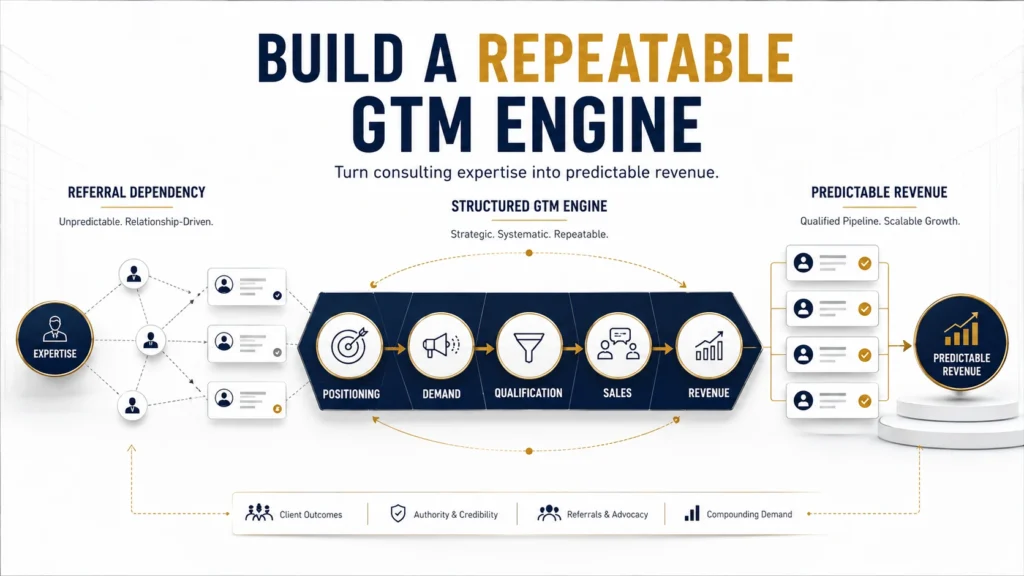
A go-to-market strategy for consulting services is the system a consulting or professional services firm uses to identify the right clients, communicate its expertise, generate demand, convert opportunities, and build repeatable revenue. Unlike SaaS, consulting firms sell expertise, outcomes, trust, and access to specialized talent.
That makes go to market strategy consulting particularly important for firms that have historically depended on referrals, founder relationships, or individual partners for new business. A strong GTM model creates a more predictable path from market positioning to qualified conversations and revenue.
For a consulting firm considering growth strategy consulting services startup priorities, the objective is not simply to generate more leads. It is to build a commercial system that consistently attracts the right clients without weakening the firm’s positioning.
Why GTM Looks Different for Services Firms
SaaS companies can package a product into a repeatable commercial offering. Consulting firms often sell a combination of expertise, methodology, people, and expected outcomes.
This creates several fundamental GTM differences.
| SaaS | Consulting and Professional Services |
| Product-led value proposition | Expertise-led value proposition |
| Standardized product | Often customized engagement |
| Product demos | Discovery and credibility-building |
| Product trials | Consultative conversations |
| Scalable delivery | People-intensive delivery |
| Feature differentiation | Expertise and outcome differentiation |
| Digital conversion | Trust-driven conversion |
For example, a U.S. cybersecurity SaaS company might target a defined industry with a standardized product. A cybersecurity consulting firm may instead sell risk assessments, transformation programs, compliance advisory, or ongoing expertise.
The GTM strategy therefore needs to answer:
Who specifically needs our expertise, what problem do they have, why are we credible, and why should they engage with us now?
This aligns with research from Harvard Business Review emphasizing that professional services firms need clear strategic positioning and disciplined client selection rather than pursuing every available opportunity.
For firms exploring business strategy consulting USA, this means market selection should come before channel expansion.
Positioning Around Expertise
The most important GTM asset for a professional services firm is often its positioning.
“Full-service consulting firm” is rarely enough.
Strong positioning connects:
Specific buyer + specific problem + specific expertise + business outcome
For example:
We help U.S. mid-market manufacturers modernize their sales operations and build predictable B2B pipeline.
This is more commercially useful than:
We provide business consulting and digital transformation services.
A practical positioning framework is:
| Positioning Element | Question |
| ICP | Who benefits most from our expertise? |
| Problem | What expensive problem do they face? |
| Trigger | What causes them to seek help? |
| Expertise | Why are we qualified to solve it? |
| Differentiation | Why choose us instead of alternatives? |
| Outcome | What business improvement does the engagement support? |
This is where business growth consulting, growth roadmap consulting, and growth strategy consulting should connect to the firm’s actual commercial priorities.
A professional services firm entering the U.S. market may also need market entry strategy USA thinking. Its positioning may need to be adapted for U.S. buyers, competitive alternatives, terminology, pricing expectations, and purchasing behavior.
The goal is not to claim expertise in everything. It is to become easier for the right buyer to recognize as relevant.
Referral-to-Demand-Gen Transition
Referrals can be an excellent source of professional services business. The problem occurs when referrals become the firm’s only dependable acquisition mechanism.
A referral-dependent model can create:
- Unpredictable pipeline
- Limited market reach
- Overreliance on partners
- Difficulty forecasting revenue
- Inconsistent client quality
- Limited control over demand creation
The answer is not to eliminate referrals.
It is to build additional demand-generation mechanisms around them.
Referral + Demand Generation Model
Client outcomes → referrals → authority content → targeted visibility → qualified demand → discovery → proposal → engagement
A consulting firm might combine:
- Executive thought leadership
- Industry-specific content
- Case studies
- Search-driven educational content
- LinkedIn content
- Webinars
- Strategic partnerships
- Account-based outreach
- Email nurturing
- Industry events
The right mix depends on the firm’s ICP and sales cycle.
For example, an IT consulting firm serving U.S. manufacturers could publish content around ERP modernization, supply-chain technology, and operational efficiency rather than broad articles about “digital transformation.”
This creates demand around problems the firm is equipped to solve.
A strong demand generation agency or B2B lead generation services partner should therefore be judged by lead quality and commercial relevance, not simply by lead volume.
Referrals can remain an important channel. HBR’s recent work also emphasizes that referral growth becomes more useful when firms systematically identify, track, and understand the value of referral sources.
Pricing & Packaging in GTM
Pricing is part of GTM because it influences positioning, qualification, sales conversations, and perceived value.
One common problem is selling every engagement as fully customized.
This can make it difficult for buyers to understand what they are purchasing and difficult for the firm to forecast demand.
A better approach can be to create structured engagement models while preserving customization where necessary.
For example:
| Engagement Structure | Best Use |
| Diagnostic | Identify problems and priorities |
| Strategy project | Develop roadmap and recommendations |
| Implementation engagement | Execute defined initiatives |
| Retainer | Provide ongoing expertise and execution |
| Advisory | Support leadership decisions |
| Transformation program | Address complex cross-functional change |
This does not mean turning consulting into a rigid product.
Instead, it creates a clearer commercial architecture.
For example, a growth consulting firm might structure its journey as:
Growth diagnostic → Strategic roadmap → Demand generation implementation → Ongoing growth leadership
This can make the buying process easier to understand while allowing the actual work to remain tailored.
For firms considering growth consulting services, the key question is:
Does the commercial structure make the firm’s expertise easier to buy?
If not, the problem may be positioning rather than pricing.
Building a Repeatable Sales Process
A repeatable sales process does not mean turning consulting sales into a scripted transaction.
It means creating consistent stages, qualification criteria, decision points, and follow-up.
A practical services sales process can be:
Target → Engage → Qualify → Diagnose → Recommend → Propose → Decide → Onboard
Each stage should have clear criteria.
Example Qualification Framework
Fit: Does the company match the firm’s ICP?
Problem: Is there a meaningful business problem?
Urgency: Is there a reason to act now?
Authority: Are the right decision-makers involved?
Economics: Is there a viable commercial opportunity?
Capability: Can the firm realistically deliver the required outcome?
This prevents consultants from spending significant senior time on poorly qualified opportunities.
For professional services, this is particularly important because senior partners often perform both delivery and business development.
HBR’s research on professional services rainmakers highlights the importance of modernizing business development and collaboration rather than relying exclusively on traditional partner-led selling.
A firm using B2B marketing strategy consulting should therefore connect marketing activity with sales stages.
For example:
| Marketing Activity | Sales Impact |
| Industry content | Creates problem awareness |
| Case study | Builds credibility |
| Executive insight | Supports trust |
| Webinar | Creates engagement |
| Lead nurturing | Maintains consideration |
| Sales enablement | Improves discovery |
| CRM reporting | Improves pipeline visibility |
The objective is not to make marketing responsible for every closed deal. It is to create a connected commercial system.
Common Mistakes
1. Trying to serve everyone
Broad positioning makes expertise difficult to recognize.
2. Treating referrals as the entire GTM strategy
Referrals are valuable, but dependence on one acquisition source creates pipeline risk.
3. Marketing capabilities instead of client problems
Listing services does not automatically communicate relevance.
4. Publishing generic thought leadership
Content should demonstrate expertise around the problems the target buyer actually faces.
5. Creating too many service offerings
A large service catalog can make the firm harder to understand and harder to sell.
6. Leaving sales entirely to individual partners
Individual relationships matter, but the firm’s commercial process should not disappear when one partner is unavailable.
7. Measuring only leads
A consulting firm’s GTM system should track qualified opportunities, proposal volume, win rate, sales cycle, average engagement value, pipeline coverage, and revenue.
8. Separating strategy from execution
A GTM roadmap without execution becomes a document. Execution without strategy becomes disconnected activity.
For a growth-stage consulting firm, GrowAnant can serve as a strategy-first growth partner by connecting growth consulting services, demand generation, positioning, GTM planning, and revenue-focused execution into one operating system.
Frequently Asked Questions
SaaS GTM typically centers on selling a standardized product, while professional services GTM centers on expertise, trust, client problems, and business outcomes. Services firms therefore need stronger emphasis on positioning, credibility, qualification, relationship development, and consultative selling.
Do not eliminate referrals. Build additional acquisition systems around them. Develop targeted thought leadership, industry-specific SEO, executive content, partnerships, events, webinars, outbound programs, and demand generation that attract prospects outside existing networks.
Services should be structured clearly enough for buyers to understand the engagement, problem addressed, expected scope, and commercial model. A firm can use diagnostics, strategy projects, implementation engagements, retainers, advisory models, or transformation programs while still tailoring delivery to individual clients.
A repeatable consulting sales process typically moves from target identification through engagement, qualification, diagnosis, recommendation, proposal, decision, and onboarding. Each stage should have clear qualification criteria, ownership, next steps, and measurable outcomes.