
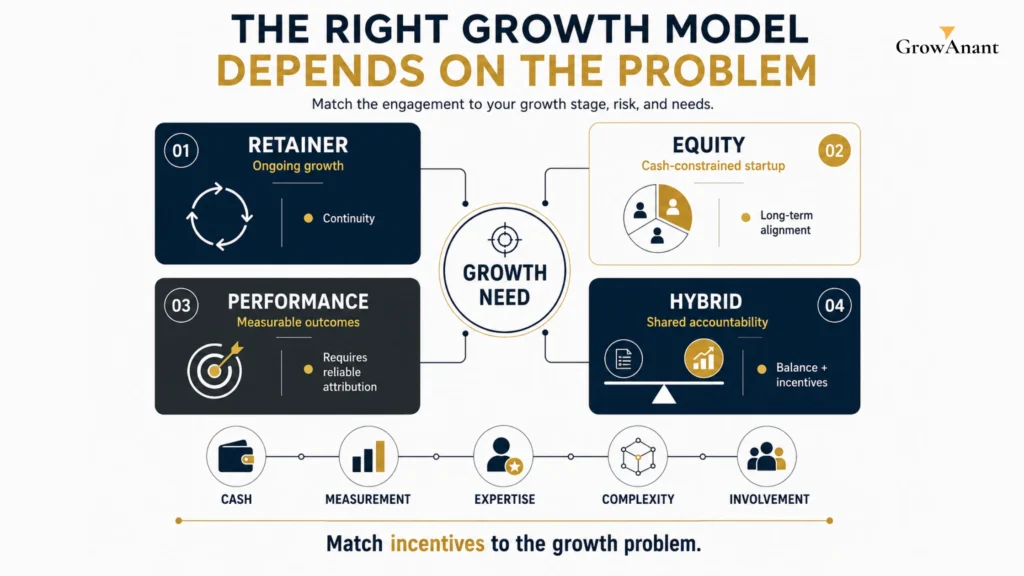
Choosing between different growth consulting business models is not simply a pricing decision. It determines how a company manages strategic ownership, execution expectations, financial risk, accountability, and access to senior growth expertise.
For a founder deciding between a growth consultant, fractional growth consultant, or longer-term growth strategy consulting, the right model should match the company’s stage, cash position, growth challenge, and ability to measure outcomes. A SaaS startup preparing for a U.S. expansion may need a different structure from an established B2B services company trying to fix inconsistent pipeline.
The key question is not, “Which model is cheapest?” It is, “Which engagement structure creates the right incentives and accountability for the growth problem we need to solve?”
Retainer-Based Consulting
A retainer model provides ongoing access to strategic and execution support for a defined monthly fee. It is one of the most practical growth consulting services models for companies that need continuous leadership rather than a single strategic project.
A retainer can cover areas such as:
- Growth strategy
- Demand generation
- GTM planning
- Funnel optimization
- Performance analysis
- Sales and marketing alignment
- Leadership advisory
- Monthly growth planning
This model works particularly well when the company has an ongoing growth problem rather than a one-time challenge.
For example, a B2B SaaS company may require continuous support across positioning, content, paid acquisition, sales enablement, and pipeline analysis. A professional services firm may need ongoing business growth consulting to reduce dependence on referrals and build a more predictable acquisition system.
Retainer vs Project-Based
| Model | Best For | Main Advantage | Main Risk |
| Retainer | Ongoing growth | Continuity | Scope creep |
| Project | Defined problem | Clear deliverable | Limited continuity |
| Fractional | Leadership gap | Senior expertise | Requires internal execution |
| Advisory | Strategic decisions | Executive perspective | Limited implementation |
HubSpot’s service-pricing guidance also recognizes retainer, project-based, fixed-price, and other structures as viable approaches, with the appropriate model depending on the nature of the service and client relationship.
The critical issue is defining the growth consulting engagement structure clearly. A good retainer should specify priorities, responsibilities, meeting cadence, deliverables, decision rights, and measurement.
Equity-for-Services Models
An equity-for-services model involves receiving ownership in a business instead of, or in addition to, conventional consulting fees.
This structure can appeal to early-stage startups with limited cash but significant long-term potential.
For example, a founder may need startup growth strategy consulting but lack the budget for a conventional engagement. Equity can potentially bridge that gap.
However, equity changes the risk profile for both parties.
Potential Advantages
- Lower immediate cash requirement
- Stronger long-term alignment
- Potential upside if the company grows significantly
- Useful when strategic involvement is substantial
Potential Risks
- Equity may never become liquid
- Business valuation can change
- Ownership expectations can become complicated
- Consulting responsibilities may expand unnecessarily
- Both parties may disagree about the value of future work
Equity should therefore never be treated as “free consulting.” The agreement should define the equity percentage, vesting conditions, scope of work, duration, decision rights, and what happens if either party exits.
For founders, the strategic question is whether the consultant is genuinely providing ongoing leadership-level value or simply replacing a cash fee with uncertain future compensation.
Performance-Based Consulting
Performance-based consulting links some or all compensation to predefined business outcomes.
Depending on the engagement, those outcomes might include:
- Qualified pipeline
- New customers
- Revenue
- Sales-qualified opportunities
- Conversion improvements
- Customer acquisition milestones
This model can appear attractive because it seems to transfer risk from the company to the consultant. In reality, attribution can become complicated.
A consultant may influence demand generation, while pricing, sales execution, product quality, market conditions, and customer retention also influence revenue.
Therefore, performance compensation should be based on controllable and measurable outcomes, not vague promises.
For example:
| Weak Metric | Stronger Metric |
| Website traffic | Qualified opportunities |
| Leads generated | Sales-accepted leads |
| Impressions | Target-account engagement |
| Ad clicks | Pipeline influenced |
| Content published | Qualified conversations |
Performance-based arrangements can make sense when tracking systems are mature. Companies investing in revenue growth consulting should first establish reliable attribution and reporting.
Hybrid Models
A hybrid model combines a fixed consulting fee with a variable component.
For many growth-stage businesses, this can create a more balanced structure.
For example:
Base retainer + performance component
The retainer covers strategic leadership, planning, analysis, and ongoing work. The variable component is connected to clearly defined commercial milestones.
This approach can work particularly well when a company wants senior expertise but also wants some compensation to reflect measurable progress.
A hybrid structure should answer four questions:
- What does the fixed fee cover?
- What outcome triggers variable compensation?
- How is the outcome measured?
- Which factors are outside the consultant’s control?
A fractional growth leader supporting growth strategy consulting, demand generation, and GTM execution might therefore have a fixed component for leadership responsibilities and a variable component tied to agreed pipeline milestones.
The structure should encourage collaboration rather than create incentives to pursue short-term metrics at the expense of long-term growth.
Which Model Fits Which Company
There is no universal best model. The appropriate choice depends on business maturity, cash availability, measurement capability, and the complexity of the growth challenge.
| Company Situation | Recommended Model | Why |
| Defined strategic problem | Project | Clear scope |
| Ongoing growth challenge | Retainer | Continuous support |
| No senior growth leader | Fractional | Leadership capacity |
| Early startup with limited cash | Equity or hybrid | Preserves cash |
| Mature attribution system | Performance or hybrid | Measurable outcomes |
| Complex GTM transformation | Retainer or hybrid | Requires sustained involvement |
A founder should also evaluate internal execution capacity.
If the company already has capable marketers but lacks strategic direction, a fractional leadership structure may be more appropriate than buying tactical growth marketing services.
If execution capacity is weak, the engagement may need broader strategic and operational responsibilities.
This is where a growth partner such as GrowAnant can operate differently from a conventional vendor. The focus can be on connecting strategy, demand generation, GTM decisions, and revenue execution rather than simply delivering isolated marketing activities.
Decision Framework
Before choosing a model, score the company across five areas:
Cash availability → Measurement maturity → Internal expertise → Growth complexity → Required involvement
If cash is constrained but measurement is weak, avoid aggressive performance commitments.
If cash is available and the challenge requires ongoing leadership, a retainer may provide greater clarity.
If the company has strong internal execution but lacks senior direction, a fractional structure may be appropriate.
Risks of Each Model
Every pricing structure creates different incentives.
| Model | Primary Risk | How to Reduce It |
| Retainer | Scope expansion | Define responsibilities clearly |
| Equity | Uncertain future value | Formalize valuation and vesting |
| Performance | Attribution disputes | Establish measurement rules first |
| Hybrid | Complexity | Document fixed and variable components |
The most important protection is not simply the contract. It is clarity.
Before signing, document:
- Business objectives
- Scope
- Responsibilities
- KPIs
- Reporting cadence
- Decision ownership
- Attribution methodology
- Review periods
- Exit conditions
The right growth consulting engagement structure should make accountability easier, not harder.
For a company evaluating growth consulting, the strongest model is ultimately the one that aligns financial incentives with the actual growth problem, provides sufficient strategic involvement, and creates clear visibility into business outcomes.
References
- HubSpot: Guide to Pricing & Packaging Services HubSpot reference
- Harvard Business Review: Business Case Studies and consulting-related resources Harvard Business Review reference
Frequently Asked Questions
An equity-for-services model compensates a consultant partly or entirely with ownership in the company rather than conventional cash fees. It can be useful for cash-constrained startups, but the agreement should clearly define ownership, vesting, scope, and exit conditions.
It can be appropriate when outcomes are measurable and the consultant has meaningful influence over those outcomes. It becomes risky when revenue attribution is unclear or results depend heavily on factors outside the consultant’s control.
For early-stage startups, project, equity, or hybrid models can be appropriate depending on cash availability and the consultant’s expected involvement. Companies should avoid choosing a model purely because it minimizes upfront cost.
Retainers can create scope creep, equity arrangements carry uncertainty around future value, performance models can create attribution disputes, and hybrid models can become complicated if variable compensation is poorly defined. Clear scope, measurement rules, and responsibilities reduce these risks.