
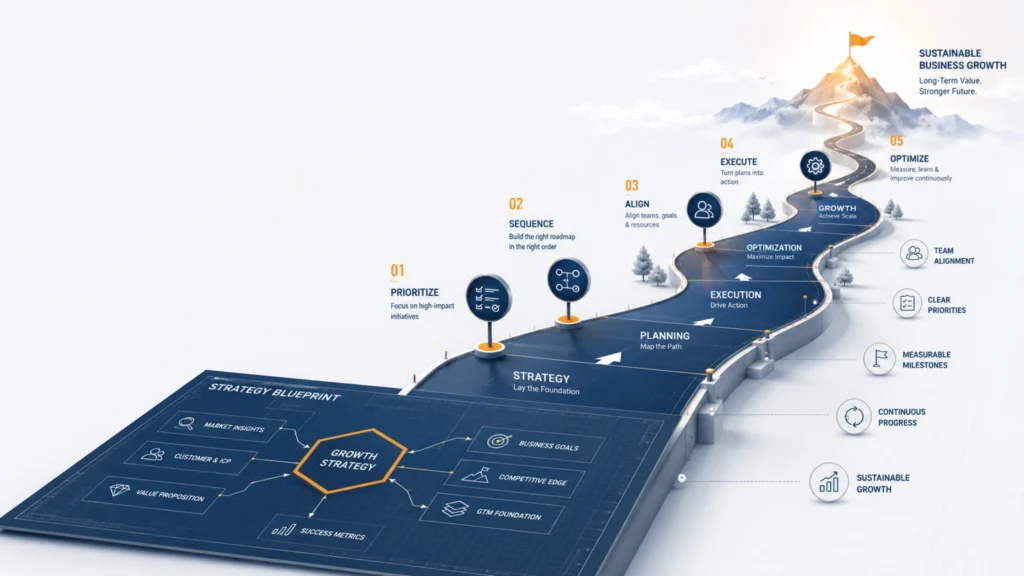
Many companies understand the importance of strategy. They run workshops, define growth goals, and document opportunities across marketing, sales, and product.
Yet progress often stalls after the strategy phase.
Teams return to daily operations. Priorities compete for attention. Initiatives launch without sequencing. Months later, leadership realizes that the strategy never translated into consistent execution.
This is where growth roadmap consulting becomes critical. A growth roadmap turns strategic direction into structured action. It clarifies what should happen first, what can wait, and how teams coordinate across departments to move the business forward.
Without a roadmap, strategy remains conceptual. With a roadmap, strategy becomes operational.
For founders and growth leaders, the roadmap serves as a decision framework. It aligns teams around priorities, prevents scattered execution, and connects everyday activities to measurable outcomes. Many growth consulting services use this roadmap stage to translate high-level growth strategy into actionable initiatives that support long-term business growth.
What a Growth Roadmap Includes in Growth Consulting Services
A growth roadmap is more than a task list. It is a structured plan that connects strategic objectives with execution timelines and measurable milestones.
In effective growth roadmap consulting and growth consulting services engagements, the roadmap typically includes five elements.
Strategic Objectives in Business Growth Consulting
The roadmap begins with clear objectives. These are not generic growth ambitions like “increase traffic” or “generate more leads.”
Instead, objectives are tied to measurable outcomes such as:
- increasing qualified pipeline
- improving conversion rates
- expanding average deal size
- reducing customer acquisition cost
Strategic objectives provide direction. Without them, roadmaps quickly turn into operational checklists disconnected from revenue.
In many business growth consulting engagements, these objectives are derived directly from revenue constraints and broader growth strategy consulting insights.
Prioritized Initiatives in Growth Strategy Consulting
Once objectives are defined, initiatives are identified and ranked.
Examples might include:
- refining the ideal customer profile
- improving positioning and messaging
- optimizing conversion paths
- launching a targeted outbound program
- strengthening demand generation channels
Growth roadmap consulting focuses heavily on prioritization.
Many companies attempt to run too many initiatives at once. The roadmap forces trade-offs so teams can focus on the highest-leverage opportunities first.
This prioritization is a core capability in both business growth consulting and startup growth strategy consulting engagements.
Ownership and Accountability in Growth Consulting Services
Every roadmap initiative needs an owner.
Without ownership, initiatives drift between teams. Marketing assumes sales will follow up. Sales assumes marketing will refine targeting. Operations assumes leadership will clarify priorities.
A well-designed roadmap assigns responsibility clearly. Each initiative has:
- a primary owner
- supporting contributors
- defined checkpoints
This accountability prevents execution gaps and ensures growth consulting services USA teams can maintain momentum during implementation.
Metrics and Success Criteria for Revenue Growth Consulting
A roadmap also defines how success will be measured.
For example:
- improving demo-to-close conversion from 20% to 30%
- increasing qualified opportunities per month
- reducing sales cycle duration
- improving customer acquisition efficiency
Metrics ensure that roadmap activities remain tied to business outcomes rather than activity levels.
In many revenue growth consulting engagements, these metrics directly link roadmap initiatives to revenue impact.
Dependencies and Sequencing in Growth Roadmap Consulting
Finally, the roadmap identifies dependencies.
Certain initiatives must occur before others. For instance:
- ICP clarity should precede large-scale paid acquisition
- messaging refinement should precede outbound scaling
- funnel tracking should precede performance optimization
Growth roadmap consulting emphasizes sequencing because poor sequencing is a common source of wasted effort.
Many growth consulting frameworks focus on sequencing initiatives so that execution builds logically over time rather than creating fragmented activity.
30-60-90 Day Growth Roadmap Example for Business Growth Consulting
While every company’s roadmap is different, many growth initiatives follow a phased structure. A 30–60–90 day framework helps organizations move from diagnosis to execution without overwhelming internal teams.
| Timeframe | Focus | Example Initiatives |
| 0–30 Days | Diagnosis & clarity | Audit growth metrics, refine ICP, identify pipeline constraints |
| 30–60 Days | Strategy activation | Positioning updates, funnel improvements, targeted demand experiments |
| 60–90 Days | Execution scaling | Expand successful channels, refine sales process, optimize conversion points |
The first phase focuses on understanding the current system.
This often includes analyzing:
- lead sources
- conversion rates across the funnel
- sales feedback
- channel performance
- customer segments
These diagnostic stages are common in growth strategy consulting and business strategy consulting USA engagements.
The second phase activates strategy through targeted improvements.
Rather than launching broad campaigns, teams focus on a few high-impact initiatives such as:
- clarifying messaging
- adjusting acquisition channels
- improving lead qualification processes
The final phase focuses on scaling what works.
Experiments that show early traction are expanded. Underperforming initiatives are discontinued. Data collected during the first two phases informs further roadmap adjustments.
This phased structure prevents organizations from moving directly into execution without diagnosis.
Strategy vs Execution Mistakes in Growth Strategy Consulting
One of the biggest reasons companies pursue growth roadmap consulting is the gap between strategy and execution.
Several common mistakes contribute to this gap.
Strategy Without Prioritization
Many companies produce strategic plans that include dozens of initiatives.
While the ideas may be valuable, the absence of prioritization makes execution difficult.
Teams become overwhelmed. Initiatives compete for attention. Leadership struggles to determine which efforts matter most.
A roadmap solves this by identifying the few initiatives that deserve immediate focus.
Execution Without Strategy
The opposite mistake is also common.
Teams launch campaigns, redesign websites, or run outbound programs without a clear strategic foundation.
Activity increases, but results remain inconsistent.
Growth roadmap consulting bridges this gap by translating strategy into practical steps.
Misaligned Departments
Another frequent issue involves misalignment between departments.
Marketing may prioritize lead generation while sales prioritizes closing high-value accounts. Product teams may focus on features that do not support the core ICP.
Without a shared roadmap, each department optimizes independently.
The roadmap acts as a unifying framework, ensuring that marketing, sales, and operations work toward the same objectives.
This cross-functional alignment is often a key deliverable in growth consulting services USA engagements.
Overreliance on Short-Term Tactics
Short-term tactics can create quick wins, but they rarely produce durable growth.
For example:
- aggressive discounting may increase short-term revenue but reduce margins
- temporary ad bursts may spike traffic but fail to create sustained demand
Growth roadmaps emphasize structural improvements that support long-term business growth and scalable revenue systems.
How Growth Roadmaps Reduce Wasted Spend and Improve Business Growth
Marketing and sales budgets are often larger than companies realize. Yet much of this spending produces limited impact.
A growth roadmap helps reduce waste in several ways.
Focused Investment
By prioritizing initiatives, the roadmap prevents organizations from spreading budgets across too many channels.
Instead of experimenting everywhere, teams concentrate resources where they have the highest probability of success.
Faster Learning Cycles
Structured roadmaps introduce disciplined experimentation.
Initiatives are tested, measured, and refined in defined intervals. This creates faster learning cycles and prevents prolonged investment in ineffective tactics.
Better Coordination Across Teams
Wasted spend often occurs when teams operate in silos.
For example:
- marketing launches campaigns without sales readiness
- sales pursues accounts outside the ICP
- operations struggles to support new customer segments
The roadmap aligns teams around shared priorities, reducing these inefficiencies.
Clear Decision Criteria
A roadmap also defines when to continue, adjust, or discontinue initiatives.
Without these criteria, organizations tend to keep investing in underperforming efforts simply because they have already committed resources.
Growth roadmap consulting introduces disciplined decision-making, ensuring that resources shift toward initiatives demonstrating real progress.
In many cases, this clarity reduces overall marketing spend while improving results.Some strategy-led growth teams, including GrowAnant, focus heavily on this roadmap stage because it bridges the gap between strategic planning and operational execution across growth consulting services, revenue growth consulting, and long-term growth strategy initiatives.
Frequently Asked Questions About Growth Roadmap Consulting
Most growth roadmaps are reviewed quarterly. However, high-growth companies may revisit priorities monthly as new data emerges. The roadmap should remain flexible enough to incorporate learning without losing strategic direction.
Ownership typically sits with a senior growth leader, such as a head of growth, chief marketing officer, or founder. While multiple teams contribute to execution, a single owner ensures alignment and accountability.
A roadmap should be detailed enough to define priorities, owners, timelines, and success metrics. However, it should avoid excessive granularity that prevents adaptation as new insights emerge.
Yes. In fact, smaller companies often benefit more because they operate with limited resources. A clear roadmap helps them focus on the initiatives most likely to produce meaningful business growth.
No. A roadmap actually strengthens experimentation by structuring when and how experiments occur. It ensures that tests align with strategic objectives rather than happening randomly.
Initial roadmaps are typically implemented over a 90-day cycle. However, the broader growth roadmap evolves over time as new data and market conditions influence priorities.
A strong strategy provides direction. A strong roadmap provides momentum.
Growth roadmap consulting bridges the space between the two—ensuring that strategic thinking turns into coordinated execution, measurable progress, and sustainable growth.