
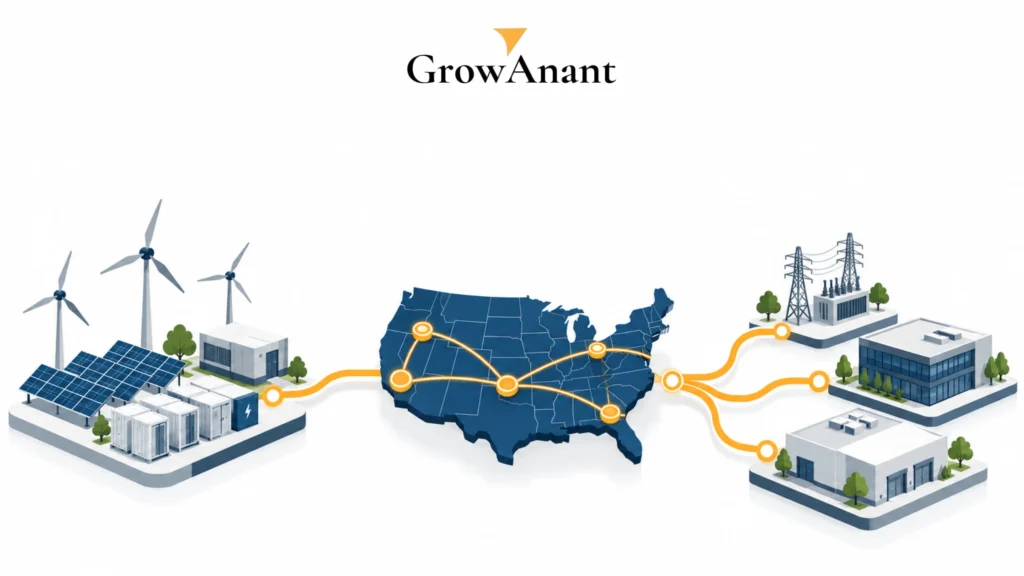
Entering the U.S. clean energy market requires more than a promising technology and a strong sustainability proposition. Successful cleantech us market entry depends on identifying the right customer segment, understanding regional energy markets, navigating applicable incentives, and building a route to commercial adoption. For international founders, b2b market entry usa planning must connect technical differentiation with procurement requirements, project economics, and long sales cycles.
A go-to-market (GTM) strategy defines how a company will reach its target customers, communicate its value, establish distribution or delivery partnerships, and convert market opportunities into revenue. In CleanTech, this strategy must account for industry-specific buying processes and infrastructure constraints alongside conventional marketing and sales priorities.
The objective is to enter the market with a focused commercial plan, validate demand before scaling investment, and build a repeatable path to customer acquisition.
Why CleanTech GTM Differs From Software GTM
CleanTech companies often sell technologies that affect physical infrastructure, energy consumption, industrial processes, or long-term operating costs. Unlike many software products, adoption may require equipment installation, engineering validation, site assessments, financing, permits, interconnection approvals, and coordination with multiple stakeholders.
This changes how companies should approach go to market strategy consulting and market validation.
Consider a European energy storage startup entering the U.S. market. Its product may perform well technically, but customers may also need evidence of safety, compatibility with existing systems, project economics, installation capability, and long-term service support. A compelling product demonstration alone may not resolve these concerns.
Key differences in the buying process
| Factor | Typical software GTM | CleanTech GTM |
| Adoption requirements | Software evaluation, integration, and onboarding | May require engineering, installation, permits, or infrastructure changes |
| Decision-makers | IT, business leaders, users, and procurement | Utilities, engineers, finance teams, facility owners, regulators, and procurement |
| Value proposition | Productivity, efficiency, or business performance | Energy savings, reliability, emissions reduction, operating economics, or resilience |
| Sales process | Often demonstrated through pilots and subscriptions | May involve feasibility studies, project approvals, financing, and deployment |
| Commercial risk | Adoption, integration, security, and switching costs | Technical performance, capital expenditure, project delivery, and regulatory dependencies |
A focused market entry strategy USA should begin by defining the company’s first commercially viable customer segment rather than targeting the entire renewable energy market.
For example, an industrial energy management startup might prioritize U.S. manufacturing facilities with high energy costs and measurable efficiency opportunities. This segment provides a specific buyer, a clear business problem, and a basis for evaluating potential return on investment.
The company should then validate customer demand, identify competitors, test pricing assumptions, and assess the resources required to deliver its solution. Structured growth strategy consulting can help prioritize these decisions before significant sales and marketing investment.
Navigating U.S. Incentive and Subsidy Programs
U.S. incentive programs can influence project economics, purchasing decisions, manufacturing plans, and investment timing. However, incentives should be treated as variables in the commercial model, not as the entire value proposition.
Depending on the technology and project, relevant support may include federal tax credits, state incentives, utility programs, grants, financing initiatives, or procurement opportunities. Eligibility, application requirements, deadlines, and availability vary by program and can change with legislation and administrative guidance.
The Internal Revenue Service maintains information on federal energy-related credits and deductions, including provisions applicable to qualifying businesses and energy projects.
How incentives affect GTM planning
| GTM consideration | Question to investigate | Commercial implication |
| Customer economics | Could an eligible incentive affect the customer’s total project cost? | May change purchasing priorities |
| Eligibility | Does the product, project, buyer, or manufacturer qualify under current rules? | Determines whether an incentive can be included in the business case |
| Timing | Are applications, allocations, construction, or placed-in-service deadlines relevant? | Can influence launch and sales planning |
| Financing | Can the customer secure sufficient capital even if incentives are available? | Affects purchase feasibility |
| Messaging | Can the company substantiate its claims about incentives and savings? | Reduces the risk of misleading marketing |
For example, a company selling energy efficiency equipment to U.S. commercial building owners should not assume every customer qualifies for the same tax benefit. The relevant treatment may depend on the equipment, project structure, ownership, and applicable rules.
Founders should work with qualified tax, legal, and policy specialists to verify eligibility before incorporating incentives into sales materials or financial projections.
A practical incentive research process is:
- Identify federal programs potentially relevant to the technology and customer.
- Research applicable state, utility, and local programs in the initial target geography.
- Verify eligibility and current requirements with authoritative sources and qualified advisors.
- Model project economics both with and without the relevant incentive.
- Explain assumptions clearly in proposals and customer-facing materials.
This approach prevents the GTM strategy from depending entirely on a benefit that may be unavailable, delayed, or subject to conditions.
For international companies, startup consulting services USA can also involve coordinating market research, commercial planning, and local expertise. The aim is to understand how incentives influence buyer decisions while ensuring the business remains commercially viable on a realistic basis.
Utility and Enterprise Buyer Cycles
Utility and enterprise sales cycles can be lengthy because purchasing decisions may involve technical validation, procurement, budget approval, risk assessment, regulatory requirements, and multiple decision-makers.
The U.S. electricity market is not uniform. Utilities have different ownership structures, and wholesale and retail market arrangements vary by region. The U.S. Energy Information Administration and the Federal Energy Regulatory Commission provide resources that can help companies understand electricity providers and market structures.
A CleanTech business should therefore avoid treating the United States as a single homogeneous market.
Identify the buying group
Depending on the product, relevant stakeholders may include:
- Technical evaluators: Engineers, facilities managers, and energy specialists who assess performance and integration.
- Economic buyers: CFOs, procurement leaders, or business-unit executives responsible for investment decisions.
- Operational owners: Teams responsible for installation, maintenance, reliability, and ongoing use.
- External stakeholders: Utilities, project developers, engineering firms, financing partners, or relevant authorities.
Each group evaluates different aspects of the proposition. Technical teams may prioritize reliability and compatibility, while finance leaders focus on payback periods, capital requirements, and downside risk.
A GTM strategy should map these stakeholders and develop evidence appropriate to each one.
| Sales stage | Required progress | Evidence to prepare |
| Initial qualification | Confirm a relevant problem and suitable customer | Customer profile and discovery questions |
| Technical evaluation | Establish feasibility and performance fit | Specifications, test results, and integration requirements |
| Business case | Demonstrate commercial value | Cost model, savings assumptions, and sensitivity analysis |
| Procurement and approvals | Resolve contractual, operational, and approval requirements | Security, safety, compliance, and procurement documentation as applicable |
| Deployment | Deliver the agreed solution | Implementation plan, responsibilities, and support arrangements |
There is no single typical sales-cycle duration for every utility or enterprise buyer. A smaller commercial energy efficiency project may move faster than a utility-scale storage deployment or a project involving extensive infrastructure approvals.
Companies should validate expected timelines through customer interviews and early opportunities. Their forecasts should distinguish initial interest from qualified projects, approved budgets, signed contracts, and completed deployments.
This distinction is important for growth roadmap consulting because a large pipeline of early-stage conversations may not translate into near-term revenue.
Channel Partnerships in Energy Markets
Channel partnerships can help CleanTech companies access customers, establish credibility, and deliver projects without building every capability internally. However, the right partner depends on the product, customer segment, geography, and delivery requirements.
Potential partners include engineering, procurement, and construction firms; energy service companies; equipment distributors; project developers; installers; consultants; and technology integrators.
For example, an international manufacturer of commercial battery systems might partner with established U.S. installers or engineering firms that already serve its target customers. These partners could help with project assessment, installation, local relationships, and after-sales support, depending on the agreement.
Compare partnership options
| Partner type | Potential value | What to validate |
| Engineering and installation firms | Technical implementation and local delivery | Capability, certifications, service coverage, and project experience |
| Distributors and equipment suppliers | Market access and established customer relationships | Account overlap, margins, incentives, and sales commitment |
| Project developers | Access to project pipelines and development expertise | Project quality, decision rights, and commercial terms |
| Energy consultants and service companies | Customer education and energy project expertise | Independence, customer trust, and fit with the offering |
| Strategic technology partners | Integration into broader solutions | Technical compatibility, support obligations, and ownership of customer relationships |
Partnerships should be assessed as commercial channels, not simply as logos to display on a website.
Before entering an agreement, clarify the target customer, lead ownership, geographic coverage, sales responsibilities, pricing, implementation obligations, and support expectations. Test the relationship through a defined pilot or limited set of target accounts before expanding it.
A focused business growth consulting approach can help founders compare direct sales, channel-led acquisition, and hybrid models. The most suitable route depends on customer economics and the level of control required over the customer relationship.
GrowAnant’s strategy-first approach emphasizes connecting market positioning, demand generation, and execution priorities. For CleanTech businesses, that means choosing channels based on how customers buy and how the product is delivered, rather than adopting a generic digital marketing plan.
Common Mistakes
CleanTech companies entering the U.S. market can lose time and capital when they scale commercial activity before validating the conditions required for adoption.
Watch for these common mistakes:
- Targeting the entire U.S. market: Different states, utilities, customer segments, and energy market structures can require different approaches. Start with a defined geography and customer profile.
- Leading only with environmental benefits: Sustainability may matter, but buyers also need a credible business case based on cost, reliability, performance, or operational needs.
- Assuming incentives guarantee demand: Incentives do not replace customer validation, financing, technical feasibility, or a sustainable underlying value proposition.
- Underestimating procurement complexity: Technical approval, contracting, and deployment requirements can delay revenue even after a customer expresses interest.
- Choosing partners without clear accountability: A partnership may generate introductions without producing qualified opportunities or successful project delivery.
- Scaling marketing too early: More advertising or content will not fix weak positioning, an unclear ICP, or an offer that lacks evidence.
- Using unrealistic sales forecasts: Treating early conversations as committed revenue can lead to poor budget and hiring decisions.
A pre-entry readiness checklist
Before committing to a major U.S. launch, confirm that you can answer the following questions:
- Which customer segment has the strongest evidence of demand?
- What business problem does the technology solve, and how is its value measured?
- Which geographic market offers the best initial fit?
- What technical, commercial, and regulatory requirements must be addressed?
- Which incentives are relevant, and has eligibility been verified?
- Who influences and approves the purchase?
- Will sales be direct, partner-led, or a combination?
- What milestones will demonstrate commercial validation before expansion?
A useful initial plan should identify a target segment, a set of qualified customer conversations, a validated value proposition, a realistic sales process, and measurable milestones. Expansion should follow evidence of demand and delivery capability rather than assumptions about market size alone.
References
- U.S. Energy Information Administration, Electricity Explained: Electricity in the United States
- Internal Revenue Service, Credits and Deductions Under the Inflation Reduction Act of 2022
Frequently Asked Questions
CleanTech market entry often involves technical validation, infrastructure requirements, project financing, procurement complexity, and regional energy market differences. Companies must validate not only customer demand but also deployment feasibility, project economics, channel access, and the operational requirements needed to deliver the solution.
Yes. Applicable incentives can influence customer economics, project timing, manufacturing decisions, and purchasing priorities. However, eligibility and program rules vary and may change. Companies should verify current requirements with authoritative sources and qualified tax or legal professionals before including incentives in projections or marketing claims.
There is no universal timeline. Sales cycles depend on the technology, project size, procurement process, technical requirements, financing, and approval structure. Smaller commercial projects may move faster than utility-scale deployments involving infrastructure and multiple stakeholders. Founders should validate timing with prospective buyers and track each stage of the sales process separately.
Relevant partners may include engineering and installation firms, distributors, project developers, energy service companies, technology integrators, and specialist consultants. The right partners depend on the customer segment and delivery model. Evaluate their market access, technical capability, commercial incentives, and ability to support successful implementation before committing to a partnership.