
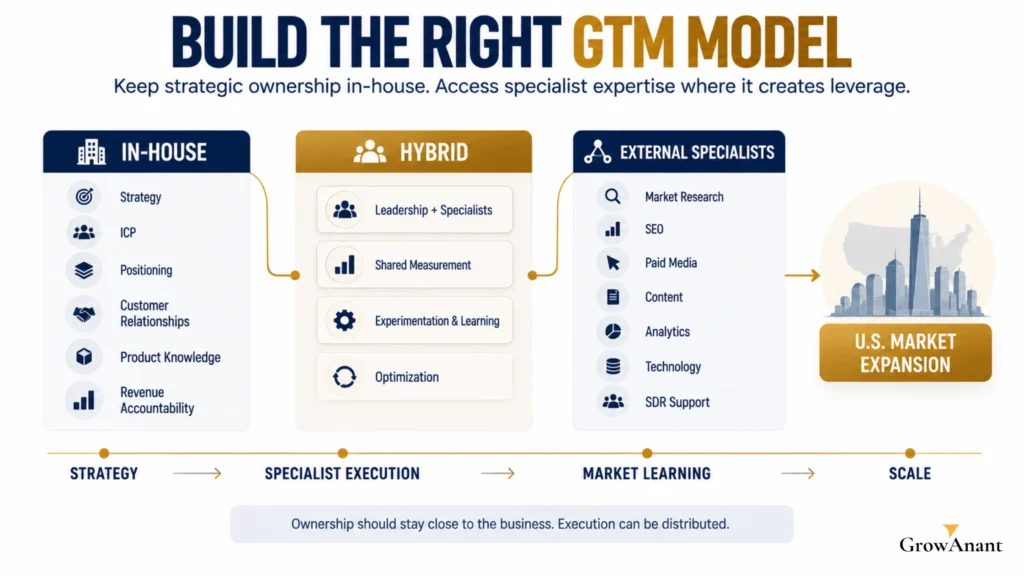
Expanding into a new market creates a difficult resource decision: which go-to-market capabilities should the company build internally, and which should it access externally?
Effective market entry support is not about outsourcing everything that feels difficult. It is about deciding which capabilities are strategically important to own, which require specialist expertise, and which can be accessed more efficiently through partners.
For a company entering the U.S., this decision becomes even more important. A business may need market research, positioning, demand generation, sales development, localized content, paid acquisition, partnerships, compliance support, and customer operations without having the resources to build every capability immediately.
A practical market entry strategy USA framework therefore separates strategic ownership from specialist execution.
McKinsey recommends designing marketing operating models around clear strategic direction, organizational structure, governance, capabilities, and an appropriate mix of internal expertise and external partners.
The objective is simple:
Keep strategic knowledge and critical customer relationships close to the business. Access specialized capabilities where external expertise can accelerate execution.
Categorizing GTM Functions
Before deciding what to outsource, divide GTM activities into four categories.
| Category | Typical functions | Recommended ownership |
| Strategic | ICP, positioning, GTM strategy, pricing direction | Primarily in-house |
| Specialist | SEO, paid media, research, creative, technology | Often external or hybrid |
| Customer-facing | Sales, partnerships, key accounts | Primarily in-house |
| Operational | Content production, campaign execution, reporting support | Flexible |
This distinction prevents a common mistake: outsourcing an activity simply because the company does not currently have the capability.
For example, a U.S.-bound SaaS company may outsource paid media execution while retaining ownership of its ICP, positioning, pricing logic, and customer relationships.
A professional services firm entering a new state may use external business strategy consulting USA expertise for market research while keeping client acquisition and relationship management internally.
The decision should also consider four questions:
- Is this capability a source of competitive advantage?
- Does the business need deep internal knowledge to perform it?
- How frequently will the capability be required?
- Is specialist expertise difficult or expensive to build internally?
This creates a more useful distinction than simply asking whether outsourcing is cheaper.
What to Outsource Early
Early expansion often creates temporary capability requirements. Building permanent teams for every requirement can be inefficient before demand has been validated.
External partners can be useful for capabilities such as:
Market research
External research support can help assess competitors, customer segments, demand signals, and market structure before major investment.
Specialized demand generation
Companies can use growth marketing services, paid acquisition specialists, SEO resources, content teams, or a demand generation agency when internal expertise is limited.
Localization and content
A company entering the U.S. may understand its product well but lack familiarity with U.S. terminology, buyer expectations, search behavior, or industry-specific messaging.
Technical implementation
Analytics, CRM configuration, marketing automation, tracking, website development, and other technical work can often be accessed through specialist providers.
Specialized sales support
For limited periods, companies may use external research, appointment-setting, or sales development support while building internal commercial capabilities.
A practical outsourcing test is:
| Question | Outsource may make sense when… |
| Expertise | Specialized knowledge is required |
| Frequency | The capability is needed periodically |
| Speed | Internal hiring would delay market entry |
| Scale | Demand does not yet justify a full-time role |
| Objectivity | External perspective would improve decisions |
| Execution | The work is repeatable and measurable |
McKinsey notes that specialist partnerships and outsourcing can remain important components of a modern marketing capability model, particularly when organizations need expertise they cannot efficiently build internally.
For an Indian company entering the U.S., us market entry consulting for indian companies can similarly provide temporary strategic and market-specific expertise while the company develops its permanent operating capabilities.
What to Keep In-House
Not everything should be outsourced.
The closer a function is to competitive advantage, customer knowledge, strategic decision-making, or long-term organizational learning, the stronger the case for keeping ownership internally.
1. Strategic direction
The company should retain ownership of:
- Business objectives
- ICP definition
- Market priorities
- Positioning
- Strategic trade-offs
- Growth priorities
- Resource allocation
External growth strategy consulting can inform these decisions, but leadership should ultimately own them.
2. Customer relationships
For B2B businesses, relationships with strategic accounts should generally remain close to the company.
The company needs to learn directly from:
- Customer objections
- Buying processes
- Product requirements
- Implementation challenges
- Competitive alternatives
- Retention issues
3. Product knowledge
Product strategy, customer feedback loops, roadmap decisions, and product-market learning are difficult to outsource effectively because they depend on accumulated organizational knowledge.
4. Revenue accountability
External partners can contribute to pipeline and acquisition, but executive leadership should retain accountability for commercial outcomes.
This principle aligns with McKinsey’s guidance that core strategic capabilities should remain close to the organization while execution and specialist capabilities can be distributed across an ecosystem of internal and external partners.
The rule is not “never outsource strategy.” The rule is do not outsource strategic ownership.
Building a Hybrid Team
For most growth-stage companies, the practical answer is neither fully internal nor fully outsourced.
A hybrid model combines:
Internal leadership + external specialists + shared measurement
For example, a U.S. SaaS expansion team could look like this:
| Function | Internal | External |
| Market strategy | CEO / growth leader | Research support |
| ICP | CEO + sales | Strategic consulting |
| Positioning | Leadership | Messaging specialist |
| Demand generation | Marketing leader | Paid/content/SEO specialists |
| Sales | Internal sales team | Limited SDR support |
| Partnerships | Internal | Market research support |
| Analytics | Internal owner | Technical implementation |
| Content | Internal subject experts | Production support |
| GTM governance | Leadership | Strategic advisor |
The critical element is having one operating model.
Without that, the company can accumulate multiple vendors that each optimize their own work while nobody owns the complete market-entry system.
This is why go to market strategy consulting can be useful before hiring multiple specialists. The strategy should establish the priorities, responsibilities, metrics, and sequencing that external partners execute against.
Hybrid team operating model
Leadership owns:
Strategy → priorities → budget → decisions
Internal teams own:
Customer knowledge → relationships → product → commercial accountability
External partners own:
Specialist execution → additional capacity → technical expertise
Shared:
Measurement → experimentation → learning → optimization
GrowAnant’s role as a growth consulting partner fits this type of model by connecting strategic growth leadership with execution rather than functioning as an isolated campaign vendor.
Vendor Evaluation Tips
The wrong vendor can create more complexity than it removes.
When evaluating a partner for market entry support, assess strategic fit before comparing proposals.
Vendor evaluation scorecard
| Criterion | Key question |
| Market knowledge | Do they understand the target market? |
| ICP understanding | Can they identify the right buyers? |
| Strategic alignment | Can they connect activity to GTM priorities? |
| Execution capability | Can they actually deliver the required work? |
| Measurement | How will performance be evaluated? |
| Communication | Who owns the relationship? |
| Flexibility | Can the scope adapt as the market is validated? |
| Knowledge transfer | Will the internal team learn from the engagement? |
| Accountability | Are responsibilities clearly documented? |
Avoid choosing a partner solely because it offers the lowest cost.
The right question is:
What capability gap are we solving, and how will this partnership strengthen the overall GTM system?
This is particularly relevant when evaluating startup consulting services USA, SaaS growth consulting, or digital growth agency partners.
A vendor should also be able to explain what it will not own. Clear boundaries are often a sign of a healthier engagement.
Common Mistakes
1. Outsourcing strategy completely
A company can use growth consulting services for strategic support, but leadership should retain ownership of critical decisions.
2. Hiring too many vendors
Multiple specialists can create duplicated work, inconsistent messaging, fragmented reporting, and unclear accountability.
3. Outsourcing customer learning
External partners can collect insights, but leadership should remain close to customers and prospects.
4. Treating external partners as order takers
The best external relationships include strategic context, feedback, experimentation, and shared objectives.
5. Building permanent teams too early
A company entering a new market may not yet know which capabilities need permanent investment. Some specialist capabilities can be accessed externally until demand and requirements become clearer.
6. Measuring vendors independently
If SEO, paid media, content, and sales development are each measured separately, leadership may miss the bigger question: are these activities creating qualified pipeline?
7. Failing to establish decision rights
Before an expansion begins, define who owns:
- ICP
- Positioning
- Budget
- Campaign priorities
- Sales qualification
- Customer relationships
- Performance reporting
- Strategic changes
McKinsey’s research on marketing operating models emphasizes clear governance and coordinated teams, while warning that fragmented partner structures can create duplication and conflicting objectives.
GTM outsourcing checklist
Before signing a partner, confirm:
- The strategic owner is identified.
- The outsourced capability is clearly defined.
- Internal and external responsibilities are documented.
- KPIs connect to business outcomes.
- Customer data remains accessible to the company.
- Reporting standards are agreed.
- Communication cadence is defined.
- Knowledge transfer is included.
- Exit or transition requirements are understood.
- The engagement supports the broader growth strategy.
For a company entering the U.S., the objective should not be to build the largest possible GTM team immediately. It should be to build the right capability at the right stage.
A hybrid approach can allow the company to retain strategic control while accessing specialist expertise, testing the market, and learning which capabilities deserve permanent investment.
Frequently Asked Questions
Specialist and variable-capacity functions are often the first candidates for outsourcing. Examples include market research, SEO, paid acquisition, content production, creative, analytics implementation, marketing technology, and certain sales development activities.
The right choice depends on the company’s internal capabilities, market-entry timeline, budget, and strategic requirements.
Strategic ownership, core customer relationships, product knowledge, critical market learning, and ultimate revenue accountability should generally remain inside the company.
External experts can support business growth consulting, growth roadmap consulting, or specialist execution, but leadership should retain decision-making authority over the company’s strategic direction.
Evaluate vendors against market expertise, relevant experience, strategic understanding, execution capability, measurement, communication, flexibility, knowledge transfer, and accountability.
The evaluation should focus on the capability gap being solved rather than simply comparing vendor prices.
The biggest mistake is outsourcing a function without establishing who owns the overall GTM strategy. When multiple vendors execute without a central strategic framework, companies can end up with fragmented campaigns, inconsistent positioning, duplicated work, and limited visibility into revenue impact.