
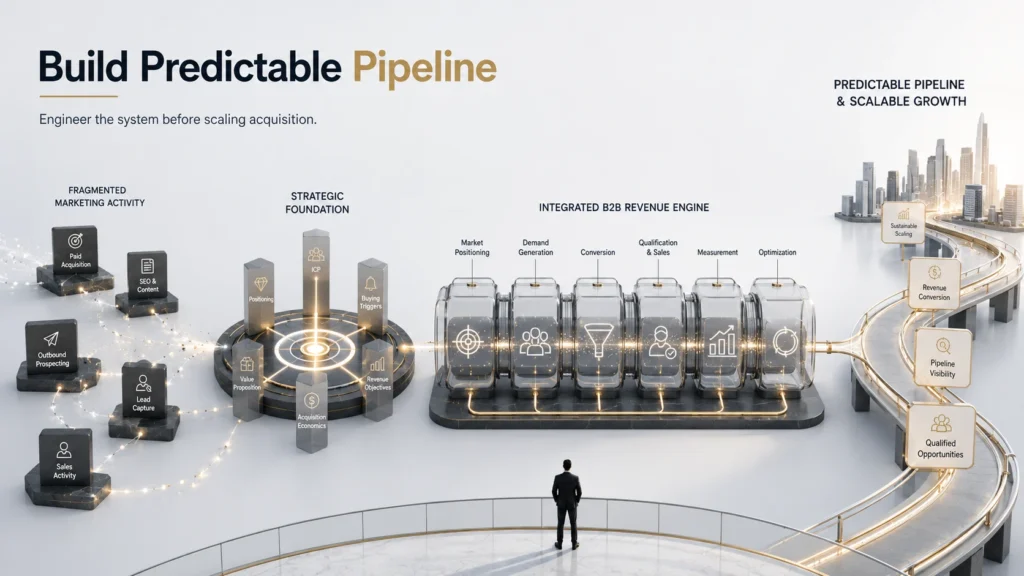
Building predictable lead generation for B2B services requires more than launching campaigns, generating form submissions, or increasing website traffic. A reliable acquisition engine connects market positioning, demand generation, conversion systems, sales execution, measurement, and continuous optimization.
Many B2B companies struggle because their marketing activities produce occasional leads without creating a predictable pipeline. Founders increase advertising budgets, sales teams expand outbound activity, and marketing teams publish more content, yet revenue growth remains inconsistent.
Predictability comes from building an integrated growth system where every stage can be measured, diagnosed, and improved. Effective B2B lead generation services should therefore focus on the complete revenue journey rather than isolated lead volume.
What predictable pipeline means
A predictable pipeline is a revenue system that consistently creates qualified opportunities through repeatable acquisition, conversion, and sales processes.
Predictability does not mean generating the same number of leads every month. Markets change, competitors respond, channel costs fluctuate, and buyer behavior evolves.
Instead, predictability means leadership understands:
- Where qualified opportunities originate
- Which customer segments convert most efficiently
- How prospects move through the buying journey
- Where funnel leakage occurs
- How efficiently marketing investment creates pipeline
- Which channels influence revenue
- How much pipeline coverage is required to support growth objectives
A simple pipeline model can be represented as:
Market Demand → Qualified Traffic → Lead Capture → Qualification → Sales Opportunity → Pipeline → Revenue
Every stage affects the next.
For example, a U.S. professional services company may generate 300 leads each month. If only 15 match its ideal customer profile and three become legitimate sales opportunities, increasing lead volume alone will not solve the underlying growth problem.
The company must diagnose targeting, positioning, qualification, conversion, and sales execution before increasing acquisition spending.
| Pipeline Question | Strategic Metric |
| Are we reaching the right market? | ICP engagement and account coverage |
| Are prospects showing meaningful intent? | Qualified engagement rate |
| Are leads becoming opportunities? | Lead-to-opportunity conversion |
| Is pipeline progressing efficiently? | Pipeline velocity |
| Are opportunities becoming customers? | Win rate |
| Is acquisition financially sustainable? | CAC and revenue contribution |
Companies that treat B2B marketing as a measurable revenue system gain better visibility into why growth accelerates, slows, or becomes unpredictable.
Foundation first
Predictable acquisition begins before selecting channels.
Companies frequently invest in paid advertising, SEO, outbound prospecting, and content before establishing the strategic foundations required for efficient customer acquisition.
The foundation includes five elements:
- Clearly defined ideal customer profile
- Specific business problems and buying triggers
- Differentiated market positioning
- Compelling value proposition
- Measurable customer acquisition economics
A founder-led SaaS company, for example, may describe its target market as “mid-sized businesses.” That definition is too broad to guide effective growth marketing services or sales execution.
A stronger ICP identifies company size, industry, technology environment, growth stage, buying committee, operational problems, urgency signals, and economic value.
This creates the foundation for more precise B2B marketing strategy consulting, channel selection, messaging, and qualification.
Foundation readiness checklist
Before scaling acquisition, leadership should confirm:
- The ICP is documented and validated.
- Priority customer segments are clearly ranked.
- Buying triggers are understood.
- Positioning explains why customers should choose the company.
- Marketing and sales use consistent qualification criteria.
- Funnel stages have measurable definitions.
- Customer acquisition economics are visible.
- Pipeline targets connect directly to revenue objectives.
If these foundations are missing, additional marketing investment can increase activity without improving business outcomes.
Strategic partners such as GrowAnant approach lead generation for B2B services through this broader growth-system perspective, connecting growth strategy consulting, customer acquisition, pipeline development, and revenue execution before recommending aggressive channel expansion.
Demand generation
Lead generation captures existing interest. Demand generation creates awareness, educates potential buyers, builds market trust, and increases the number of qualified prospects who eventually enter the pipeline.
This distinction matters because many B2B businesses depend almost entirely on buyers who are already searching for solutions.
A sustainable acquisition system must also influence future demand.
A demand generation agency or internal growth team may use educational content, executive thought leadership, SEO, research, webinars, paid distribution, industry insights, and strategic account engagement to build familiarity before prospects enter an active buying process.
The relationship can be represented as:
Market Education → Trust → Problem Recognition → Buying Intent → Lead Capture → Sales Opportunity
For example, a cybersecurity SaaS company targeting U.S. mid-market businesses may discover that decision-makers do not immediately search for software.
They first research compliance requirements, security risks, breach prevention, vendor evaluation frameworks, and implementation challenges.
Publishing valuable resources around those problems allows the company to create demand before attempting to capture contact information.
| Demand Creation Activity | Primary Objective |
| SEO content | Capture existing and emerging market interest |
| Executive thought leadership | Build authority and trust |
| Research and industry insights | Create differentiated market perspectives |
| Paid distribution | Expand qualified audience reach |
| Webinars and educational resources | Increase buyer understanding |
| Retargeting | Maintain visibility during long buying cycles |
Strong growth marketing integrates demand creation with conversion infrastructure.
Companies should therefore evaluate whether their growth marketing agency USA, B2B growth marketing agency, or internal team can connect market education to pipeline creation rather than measuring success only through impressions, clicks, and marketing-qualified leads.
Conversion optimization
Generating demand and attracting qualified prospects does not automatically create pipeline. The acquisition system must convert buyer interest into measurable sales opportunities.
Conversion optimization within lead generation for B2B services requires businesses to examine every transition in the buyer journey rather than focusing only on landing page conversion rates.
The complete conversion path may include:
Qualified Visitor → Engaged Prospect → Lead → Qualified Lead → Sales Conversation → Opportunity → Customer
Weakness at any stage can reduce the effectiveness of the entire acquisition engine.
For example, a U.S. IT consulting firm may invest successfully in performance marketing services USA and generate qualified traffic from technology leaders. However, if its website uses generic messaging, unclear differentiation, and a high-friction contact process, the company may experience low conversion despite reaching the right audience.
The solution is not necessarily more traffic. It is improving the path from buyer interest to business conversation.
Conversion optimization framework
| Funnel Stage | Common Problem | Strategic Improvement |
| Website visit | Unclear positioning | Align messaging with ICP priorities |
| Content engagement | No logical next step | Create contextual conversion paths |
| Lead capture | Excessive friction | Match information requirements to buyer intent |
| Qualification | Too many poor-fit leads | Introduce clear ICP and intent criteria |
| Sales conversation | Weak problem discovery | Improve consultative discovery processes |
| Opportunity | Unclear business case | Connect the solution to measurable business outcomes |
Leadership teams should monitor conversion rates between stages rather than relying on one aggregate website conversion metric.
A declining visitor-to-lead rate may indicate weak offers or messaging. A strong lead volume combined with poor opportunity creation may indicate qualification problems. A healthy opportunity pipeline with a low win rate may point to positioning, pricing, sales execution, or competitive differentiation issues.
Effective digital marketing consulting services should therefore connect conversion optimization to the complete revenue system.
Practical conversion checklist
Before increasing acquisition investment, companies should evaluate:
- Does the website clearly communicate the business problem being solved?
- Can buyers quickly understand the company’s differentiation?
- Are conversion offers appropriate for different levels of buyer intent?
- Are high-intent prospects given a direct path to sales conversations?
- Are qualification criteria documented?
- Can marketing identify which sources generate sales opportunities?
- Does sales provide structured feedback about lead quality?
- Are conversion experiments prioritized according to potential pipeline impact?
Conversion optimization becomes valuable when improvements are measured through qualified opportunities and revenue contribution, not simply more form submissions.
Sales alignment
A predictable acquisition engine cannot exist when marketing and sales operate as separate systems.
Marketing may optimize campaigns for lead volume while sales evaluates success based on opportunities and closed revenue. Without shared definitions, goals, and feedback loops, companies frequently experience poor lead quality, inconsistent follow-up, and limited pipeline visibility.
Strong B2B lead generation services require alignment around a shared revenue process.
That process should define:
- The ideal customer profile.
- What qualifies as a lead.
- What makes a lead sales-ready.
- When ownership transfers from marketing to sales.
- Expected follow-up timelines.
- Reasons opportunities are accepted or rejected.
- How pipeline and revenue influence future marketing decisions.
Consider a B2B SaaS company generating 200 marketing leads per month.
Marketing reports increasing lead volume, but sales accepts only 30 leads and converts six into legitimate opportunities. Without a structured feedback process, marketing may continue investing in campaigns that create activity but limited commercial value.
A better model connects both teams around shared performance indicators.
| Marketing and Sales Metric | Strategic Question |
| Qualified lead rate | Are acquisition programs attracting the right companies? |
| Sales acceptance rate | Does sales agree with marketing qualification? |
| Speed to lead | How quickly are high-intent prospects contacted? |
| Lead-to-opportunity conversion | Are qualified leads creating pipeline? |
| Opportunity win rate | Are acquisition programs attracting customers the company can win? |
| Pipeline contribution | How much commercial opportunity originates from marketing? |
| Revenue contribution | Which acquisition investments influence actual customers? |
For companies with fragmented execution, growth consulting services can help establish operating rhythms that connect marketing, sales, revenue operations, and leadership around shared objectives.
GrowAnant approaches this challenge as a growth partner by helping businesses align strategy, demand generation, customer acquisition, and revenue execution instead of treating marketing and sales as disconnected functions.
Measurement
Predictability depends on measurement.
A company cannot build a predictable pipeline if leadership cannot determine which activities create qualified opportunities, how efficiently prospects move through the funnel, and where acquisition investment is being wasted.
However, measuring everything does not create better decisions.
Businesses need a measurement architecture that connects operational activity to pipeline and revenue growth.
A practical measurement hierarchy includes:
Business Outcomes → Revenue Metrics → Pipeline Metrics → Funnel Metrics → Channel Metrics
Measurement framework
| Measurement Level | Example Metrics | Executive Purpose |
| Business outcomes | Revenue growth, market expansion, customer growth | Evaluate strategic progress |
| Revenue metrics | New revenue, CAC, LTV, payback period | Assess economic sustainability |
| Pipeline metrics | Pipeline created, pipeline coverage, velocity | Evaluate future revenue potential |
| Funnel metrics | Stage conversion rates, win rate, sales cycle | Diagnose revenue system performance |
| Channel metrics | Cost per opportunity, qualified traffic, engagement | Optimize acquisition execution |
Executives should prioritize metrics that help answer specific business questions.
For example:
Are we generating enough pipeline to support revenue objectives?
Measure pipeline coverage and pipeline creation.
Are marketing programs attracting commercially valuable prospects?
Measure opportunity creation, sales acceptance, and revenue contribution.
Where is the funnel losing potential customers?
Measure stage-to-stage conversion rates.
Are customer acquisition investments financially sustainable?
Measure CAC, LTV, payback period, and customer profitability.
Companies using growth marketing services or B2B growth marketing agency partners should require reporting that connects marketing activity to pipeline outcomes.
Channel metrics such as impressions, clicks, cost per lead, and website traffic remain useful for optimization. However, they should not replace business-level measurement.
The objective is to create an operating system where leadership can identify what is working, understand what is failing, and allocate resources according to measurable commercial impact.
Scaling
Scaling lead generation for B2B services should happen only after the business has established repeatable acquisition, conversion, sales, and measurement processes.
Increasing budgets before the system is ready usually magnifies existing weaknesses. Poor targeting creates more unqualified leads. Weak positioning increases acquisition costs. Funnel leakage wastes additional demand. Sales misalignment creates larger backlogs of poorly managed opportunities.
A scalable growth engine requires disciplined expansion.
Scaling readiness framework
| Scaling Requirement | Question Leadership Should Ask |
| ICP validation | Are we consistently acquiring customers from clearly defined segments? |
| Channel repeatability | Can successful acquisition programs produce qualified opportunities consistently? |
| Conversion stability | Are funnel conversion rates measurable and reasonably stable? |
| Sales capacity | Can sales teams manage additional opportunity volume effectively? |
| Unit economics | Are CAC, payback period, and customer value economically sustainable? |
| Attribution | Can leadership identify which investments influence pipeline and revenue? |
| Operating capacity | Can internal teams maintain execution quality as volume increases? |
If several of these conditions are missing, companies should strengthen the underlying growth system before increasing acquisition investment.
Practical scaling process
- Validate the foundation. Confirm ICP, positioning, customer economics, and buying triggers before expanding channels.
- Identify repeatable acquisition sources. Determine which growth marketing services, outbound programs, partnerships, SEO initiatives, and paid channels consistently create qualified opportunities.
- Fix conversion bottlenecks. Improve the weakest stage of the funnel before sending additional demand into the system.
- Align sales capacity with pipeline growth. Ensure teams can qualify, follow up, and manage additional opportunities without reducing execution quality.
- Increase investment incrementally. Scale budgets and channel activity in controlled stages while monitoring CAC, conversion, pipeline velocity, and revenue contribution.
- Expand only after proving repeatability. New channels, customer segments, and markets should be added when the existing system provides enough visibility to understand what is changing.
For example, a U.S. B2B SaaS company may discover that SEO, founder-led content, and targeted outbound consistently generate qualified opportunities from mid-market customers. Instead of immediately launching five additional acquisition channels, leadership can first increase investment in the proven system, strengthen conversion infrastructure, and build sales capacity.
Once performance remains stable, the company can test additional channels through controlled experiments.
This is where growth strategy consulting and business growth consulting can provide strategic value. The objective is not to scale activity. It is to build a growth system capable of absorbing additional investment without losing efficiency, visibility, or alignment with revenue outcomes.
GrowAnant supports growth-stage companies by connecting strategy, demand generation, customer acquisition, conversion, sales alignment, and measurement into scalable growth systems. This approach reinforces GrowAnant’s role as your growth partner for scalable, predictable revenue growth.
References
FAQs
Predictable lead generation for B2B services comes from building repeatable systems rather than depending on individual campaigns.
The system requires a validated ICP, clear positioning, consistent demand generation, measurable acquisition channels, effective conversion paths, documented qualification criteria, sales alignment, and revenue-focused measurement.
Predictability improves when leadership can forecast pipeline creation, identify funnel bottlenecks, understand acquisition economics, and make investment decisions based on measurable performance.
There is no universal best channel for B2B lead generation services.
The right channel depends on ICP behavior, deal size, buying cycle, market maturity, competitive intensity, internal capabilities, and customer acquisition economics.
For example, SEO and educational content may support long-term demand creation, paid search can capture existing buyer intent, outbound can reach targeted accounts, partnerships can create trusted distribution, and executive thought leadership can build authority in complex B2B markets.
Companies should select channels based on their ability to create qualified pipeline efficiently rather than following industry trends.
The timeline depends on market conditions, existing brand awareness, sales cycle length, channel maturity, positioning quality, and the strength of the company’s current growth infrastructure.
Paid acquisition and outbound may generate market feedback relatively quickly, while SEO, content, and broader demand generation programs generally require longer-term investment.
Businesses should evaluate progress through leading indicators such as qualified engagement, opportunity creation, conversion improvement, and pipeline development rather than expecting immediate revenue results.
Pipeline should be measured using both volume and quality indicators.
Leadership teams should track pipeline created, pipeline coverage, opportunity value, source contribution, stage conversion rates, pipeline velocity, sales cycle length, win rate, CAC, and revenue contribution.
The objective is to understand whether the company’s acquisition system is generating enough qualified commercial opportunity to support sustainable revenue growth while maintaining efficient customer acquisition economics.