
For many B2B companies, lead generation feels unpredictable.
One month the pipeline is full. The next month opportunities slow down, sales teams struggle to hit targets, and leadership begins questioning marketing investments.
The problem is rarely a lack of activity.
Most organizations are running campaigns, creating content, investing in outreach, or testing paid acquisition channels.
The real issue is that campaigns are often mistaken for systems.
A predictable lead generation engine is different.
It is a repeatable process that consistently creates qualified opportunities and supports revenue growth over time.
Businesses investing in lead generation for B2B services, B2B lead generation services, and demand generation agency partnerships are typically seeking more than leads. They are looking for predictability, pipeline visibility, and sustainable growth.
This is where strategic planning becomes critical. Effective growth consulting services, business growth consulting, and growth strategy consulting focus on building systems that connect demand generation, qualification, sales execution, and revenue outcomes.
Lead Engine vs Campaigns
One of the biggest mistakes growth-stage companies make is confusing lead generation campaigns with lead generation engines.
Campaigns are temporary.
Lead engines are ongoing systems.
A campaign may generate a short-term spike in activity.
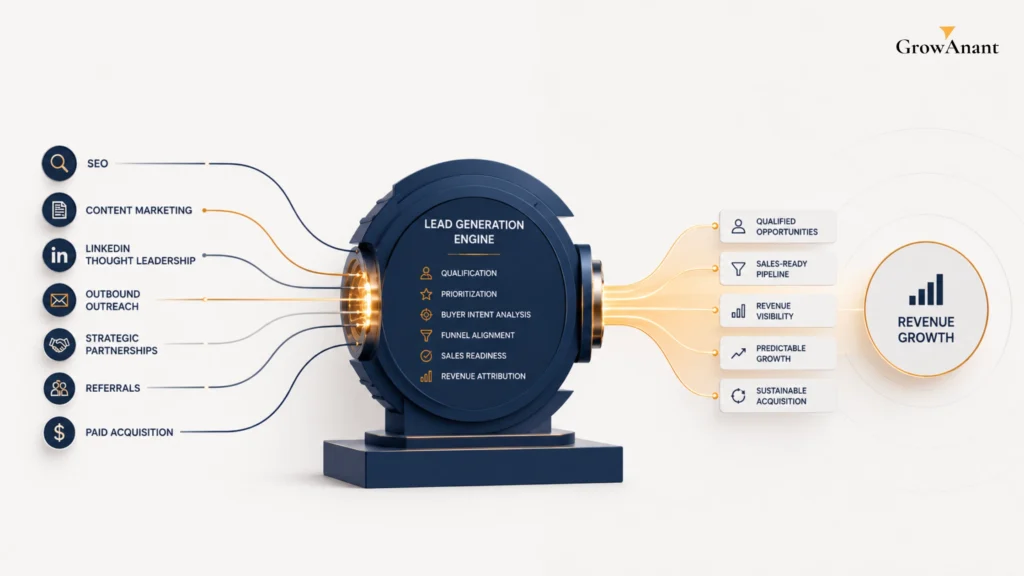
A lead engine continuously creates awareness, captures interest, qualifies prospects, and moves opportunities through the funnel.
Campaign Characteristics
- Limited duration
- Specific tactical objective
- Channel-focused
- Short-term results
- Often dependent on budget increases
Lead Engine Characteristics
- Long-term infrastructure
- Multiple acquisition channels
- Consistent qualification process
- Revenue-focused measurement
- Continuous optimization
| Campaign Approach | Lead Engine Approach |
| Focuses on leads | Focuses on pipeline |
| Temporary activity | Continuous system |
| Channel-specific | Multi-channel |
| Measures volume | Measures revenue impact |
| Often reactive | Strategically planned |
Why campaigns fail to create predictability
Consider a professional services company running LinkedIn ads for three months.
Leads increase while ads are active.
When spending decreases, lead flow drops immediately.
The company becomes dependent on continuous budget allocation.
Now compare that with an organization combining:
- SEO
- Content marketing
- Outbound outreach
- Partnerships
- Referral programs
- Paid acquisition
Each channel supports the others.
Lead generation becomes more resilient.
This is the foundation of a scalable growth engine.
Many organizations working with a B2B growth marketing agency or growth marketing agency USA discover that diversification is often more important than simply increasing ad budgets.
Characteristics of a Predictable Lead Engine
A strong lead generation engine includes:
✓ Clear ideal customer profile
✓ Consistent positioning
✓ Defined acquisition channels
✓ Lead qualification criteria
✓ Revenue attribution
✓ Sales and marketing alignment
✓ Ongoing optimization
Without these elements, organizations often experience pipeline volatility and inconsistent growth.
Channel Mix Logic
Many businesses ask:
“What is the best channel for B2B lead generation?”
The reality is that there is rarely a single best channel.
Effective B2B growth comes from channel alignment rather than channel selection alone.
The right mix depends on:
- Market maturity
- Buying behavior
- Sales cycle length
- Average deal value
- Available resources
Channel Roles in a B2B Growth Engine
Different channels serve different purposes.
| Channel | Primary Function |
| SEO | Demand capture |
| Content Marketing | Trust building |
| Audience engagement | |
| Outbound Sales | Opportunity creation |
| Partnerships | Relationship leverage |
| Paid Media | Demand acceleration |
| Webinars | Buyer education |
| Referrals | High-intent acquisition |
SaaS Example
A B2B SaaS company may prioritize:
- SEO
- Product-led content
- LinkedIn thought leadership
- Free trial acquisition
- Retargeting campaigns
This approach aligns with common SaaS growth consulting strategies.
Professional Services Example
A consulting firm may rely more heavily on:
- Authority content
- Executive networking
- Strategic partnerships
- Outbound prospecting
- Referral programs
This is often seen in marketing strategy for service businesses engagements.
Channel Mix Framework
A practical allocation model includes:
Demand Creation
- Thought leadership
- Industry content
- Speaking opportunities
- Social engagement
Demand Capture
- SEO
- Search advertising
- Website conversion optimization
Demand Conversion
- Sales outreach
- Nurture campaigns
- Consultation offers
- Qualification processes
Organizations investing in growth marketing services, digital marketing consulting services, and performance marketing services USA often achieve better outcomes when these functions operate together rather than independently.
Common Channel Mistakes
Many growth leaders encounter:
- Overreliance on paid ads
- No organic acquisition strategy
- Weak content infrastructure
- No referral system
- Lack of channel attribution
These weaknesses create fragile growth systems.
A predictable engine requires balance.
Lead Qualification Framework
Generating leads is only one part of the equation.
Qualification determines whether leads become revenue opportunities.
One of the most expensive mistakes in B2B growth is passing low-quality leads to sales teams.
This creates:
- Lower conversion rates
- Sales frustration
- Poor forecasting
- Increased acquisition costs
Why qualification matters
A predictable lead engine does not optimize for lead volume.
It optimizes for qualified pipeline.
Many businesses working with go to market strategy consulting, B2B marketing strategy consulting, and revenue growth consulting partners discover that qualification improvements often generate more revenue than increasing lead volume.
Lead Qualification Framework
| Qualification Area | Key Question | Importance |
| Company Fit | Is this the right type of business? | High |
| Industry Fit | Is the market aligned with the solution? | High |
| Problem Severity | Is there a meaningful challenge? | High |
| Budget Readiness | Can they invest in a solution? | Medium |
| Decision Authority | Is the contact involved in buying decisions? | High |
| Timeline | Is there urgency? | Medium |
| Strategic Alignment | Does the solution fit long-term goals? | High |
Revenue-Focused Qualification Process
Step 1: Define Ideal Customer Profiles
Identify:
- Company size
- Industry
- Geography
- Growth stage
- Revenue range
Step 2: Define Qualification Criteria
Determine:
- Business challenges
- Budget expectations
- Buying readiness
- Stakeholder involvement
Step 3: Score Opportunities
Assign scores based on fit and intent.
Step 4: Prioritize Sales Resources
Direct sales attention toward the highest-value opportunities.
Qualification Checklist
Before passing a lead to sales:
✓ Clear business challenge identified
✓ Appropriate company profile
✓ Relevant decision-maker engaged
✓ Timeline understood
✓ Potential budget fit established
✓ Strategic need confirmed
This process helps transform marketing-generated interest into sales-ready pipeline.
Organizations using growth roadmap consulting, startup consulting services USA, and business strategy consulting USA frameworks often treat qualification as a strategic growth function rather than a sales administration task.
Building a Long-Term Lead Generation System
The strongest lead generation engines share several characteristics:
| Component | Purpose |
| Positioning | Creates differentiation |
| Content | Builds trust |
| Demand Generation | Creates awareness |
| Qualification | Improves lead quality |
| Sales Alignment | Improves conversion |
| Analytics | Enables optimization |
| Revenue Tracking | Measures business impact |
Many growth-stage businesses discover that lead generation challenges are rarely caused by a single channel.
More often, they result from disconnected systems.
Growth partners such as GrowAnant frequently focus on aligning demand generation, qualification, sales execution, and measurement into a single operating framework. This approach helps organizations move beyond short-term campaigns and build scalable growth systems that support predictable revenue generation.
References
Source: Gartner
Source: HubSpot
FAQs
Most B2B organizations require several months to establish a predictable lead generation engine. The timeline depends on market complexity, sales cycle length, content maturity, channel selection, and internal execution capabilities. Building a sustainable system generally takes longer than launching a campaign but creates more durable results.
The most scalable channels often include SEO, content marketing, outbound prospecting, strategic partnerships, referrals, LinkedIn thought leadership, and targeted paid acquisition. The optimal mix depends on the business model, buyer behavior, deal size, and market conditions.