
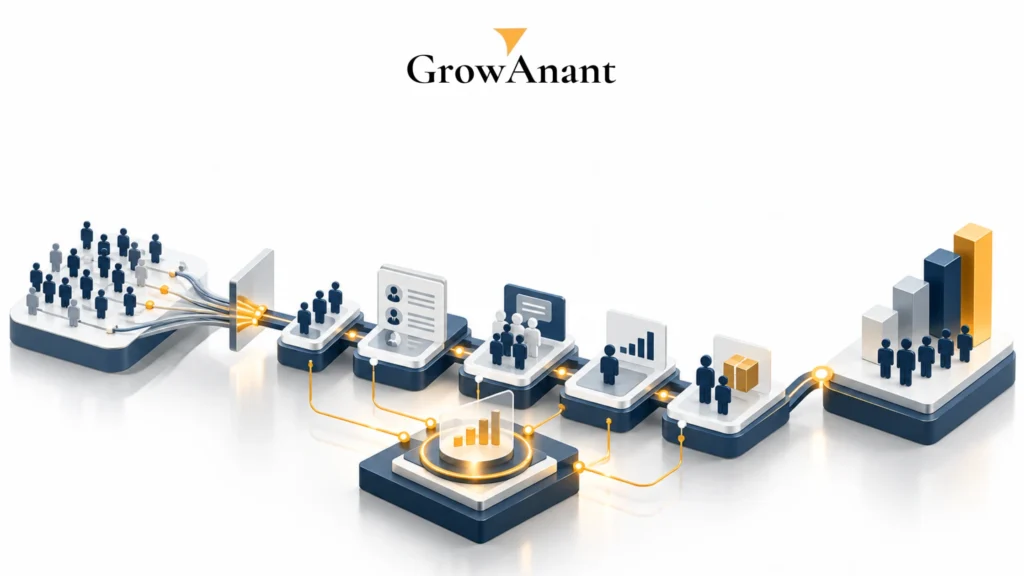
For growth-stage businesses, revenue acceleration is not simply about selling more. It is about identifying what limits revenue performance and improving the systems responsible for attracting, converting, and retaining customers. Companies evaluating best-rated sales growth consultants for revenue acceleration should look for expertise that connects sales performance, marketing effectiveness, customer acquisition, and commercial strategy.
A revenue growth consultant helps leadership diagnose revenue constraints, prioritize high-impact opportunities, and build a practical plan to improve performance. This support is particularly valuable when a company has market traction but experiences inconsistent pipeline, declining conversion rates, rising acquisition costs, or stalled growth.
The objective is to make revenue performance more measurable and repeatable, not to promise immediate results without understanding the business.
What “Revenue Acceleration” Actually Means
Revenue acceleration is the process of improving how efficiently and consistently a business generates revenue by addressing constraints across its customer acquisition, sales, conversion, pricing, and retention systems.
Rather than increasing marketing activity indiscriminately, revenue acceleration focuses on finding where commercial performance is breaking down and concentrating resources on the most consequential problems.
For example, a U.S. B2B SaaS company may generate a healthy volume of marketing leads but struggle to convert them into qualified sales opportunities. Increasing advertising spend could increase lead volume without improving revenue. A revenue acceleration engagement would investigate lead quality, messaging, qualification criteria, sales follow-up, and conversion rates before recommending additional investment.
The four levers of revenue acceleration
| Revenue lever | Questions to investigate | Potential improvement |
| Demand generation | Are we attracting the right buyers? | Improve audience targeting and lead quality |
| Funnel conversion | Where do qualified prospects drop off? | Reduce friction between marketing and sales |
| Sales effectiveness | Are opportunities progressing efficiently? | Improve qualification, prioritization, and sales processes |
| Customer value | Are pricing, retention, and expansion opportunities being managed? | Improve revenue quality and customer lifetime value |
The right priorities depend on the company’s business model. A professional services firm that relies on referrals may need a more consistent acquisition system. A SaaS company with strong lead generation but low close rates may need better sales qualification and positioning. A manufacturing business may need to improve pricing discipline and account expansion.
Revenue acceleration therefore begins with diagnosis, not a predetermined list of tactics.
A structured growth strategy consulting engagement can help leadership establish a baseline, identify the largest constraints, assign ownership, and create a sequence of measurable improvements.
How It Differs From General Growth Consulting
Revenue acceleration consulting and general growth consulting share a common goal: improving business performance. The difference lies primarily in the immediate focus and scope of the engagement.
General growth consulting may address market selection, business models, positioning, new revenue streams, geographic expansion, or long-term growth strategy. Revenue acceleration typically concentrates on improving the commercial system that converts existing market opportunities into revenue.
| Dimension | Revenue acceleration consulting | General growth consulting |
| Primary focus | Improving revenue performance and commercial execution | Identifying and planning broader growth opportunities |
| Starting point | Existing revenue or pipeline constraints | Business objectives, market opportunities, and strategic gaps |
| Typical scope | Lead quality, conversion, sales productivity, pricing, and funnel efficiency | Positioning, market expansion, business model, GTM, and growth roadmap |
| Time horizon | Often prioritizes near-term improvements alongside structural fixes | May span near-term initiatives and longer-term strategic development |
| Success measures | Conversion rates, sales cycle, pipeline quality, revenue efficiency | Market traction, strategic milestones, new segments, and sustainable growth |
These models are complementary rather than mutually exclusive. A company may need a broader growth strategy before it can determine which revenue constraints deserve attention. Another company may have a sound strategy but need help improving execution.
For instance, a funded SaaS startup may have validated its product and target market but struggle with inconsistent opportunity creation. Revenue acceleration could focus on improving campaign-to-sales alignment, lead qualification, and opportunity conversion. A startup still deciding which customer segment to serve may need broader market validation and positioning work first.
A growth consultant or fractional growth consultant should be able to explain which problem the engagement will address and why that problem takes priority.
When evaluating growth consulting services, ask whether the proposed scope addresses the actual business constraint or simply introduces additional marketing activities. The best engagement is the one that solves the most important problem, even when that means reducing activity in underperforming channels.
Signs a Company Needs Acceleration Support
Revenue acceleration becomes relevant when a business has a viable offer and evidence of market demand but cannot consistently translate its commercial activity into expected results.
The following signals can help founders determine whether external support is warranted.
1. Revenue is unpredictable
Monthly revenue fluctuates significantly, and leadership cannot confidently explain what drives the changes. Pipeline coverage, deal progression, customer concentration, or inconsistent lead generation may be contributing factors.
2. Lead volume is healthy, but lead quality is weak
Marketing reports strong traffic or lead numbers, yet sales teams reject a large share of prospects. This often indicates a mismatch between targeting, messaging, qualification, and the ideal customer profile.
3. Customer acquisition costs are increasing
The business spends more to acquire customers without a corresponding improvement in customer value. The problem may involve inefficient channel allocation, weak conversion rates, poor retention, or an offer that fails to communicate differentiated value.
4. Sales cycles are becoming longer
Qualified opportunities remain open without progressing. Unclear buying criteria, weak discovery, poor follow-up, pricing concerns, or multiple decision-makers may be slowing deals.
5. Marketing and sales operate separately
Marketing measures leads and campaign engagement, while sales focuses on closed deals. Without shared definitions and feedback loops, the organization struggles to understand which activities contribute to pipeline and revenue.
6. Growth has plateaued despite increased activity
The company publishes more content, runs more campaigns, or expands its sales team, but results remain flat. This can indicate that the underlying bottleneck has not been addressed.
Use this readiness checklist before engaging a consultant:
- We have an established product or service and evidence of customer demand.
- We can access basic sales, marketing, and revenue data.
- We can identify a performance problem that requires investigation.
- Leadership is willing to change processes or reallocate resources.
- An internal owner can support implementation and decision-making.
If several of these conditions are missing, the first step may be better measurement, market validation, or foundational strategy rather than a full acceleration engagement.
For companies that need senior oversight across functions, business growth consulting can help connect strategic priorities with execution. GrowAnant approaches this challenge by aligning growth strategy, demand generation, and commercial performance instead of treating marketing and sales as separate activities.
Typical Engagement Scope
A revenue acceleration engagement should produce a clear diagnosis, a prioritized action plan, and a method for evaluating progress. The exact scope depends on the company’s size, data maturity, sales model, and primary constraint.
A typical engagement can be organized into four phases.
| Phase | Activities | Deliverables |
| 1. Diagnose | Review funnel data, sales processes, customer acquisition, pricing, and retention | Baseline assessment and constraint analysis |
| 2. Prioritize | Rank opportunities by potential impact, effort, cost, and confidence | Prioritized initiatives and business case |
| 3. Implement | Test changes to targeting, messaging, qualification, conversion, or sales processes | Defined experiments, process improvements, and ownership |
| 4. Optimize | Review performance, analyze results, and adjust priorities | Performance review and updated roadmap |
For example, a B2B professional services firm may discover that its sales pipeline depends heavily on referrals. The engagement could identify a specific target segment, refine its offer, develop a repeatable outreach and demand generation process, and introduce a consistent qualification framework.
A SaaS business might instead prioritize improving demo-to-opportunity conversion and shortening the time between first contact and sales follow-up.
An engagement may include growth strategy consulting, sales process analysis, funnel optimization, positioning improvements, marketing-to-sales alignment, and reporting design. Broader needs may require revenue growth consulting across multiple teams.
Before signing, clarify the scope, internal responsibilities, access to data, implementation support, and decision-making cadence. A consultant who identifies problems but cannot help the organization prioritize or operationalize solutions may leave the business with another strategy document rather than measurable progress.
Measuring Acceleration Results
Revenue acceleration should be evaluated through a combination of business outcomes, operational indicators, and evidence that the underlying commercial system is improving.
A useful measurement framework separates three categories.
| Measurement category | Example metrics | What leaders learn |
| Revenue outcomes | Revenue growth, gross margin, new customer revenue, expansion revenue | Whether commercial performance is improving |
| Pipeline performance | Qualified opportunities, pipeline value, win rate, sales cycle length | Whether the sales system is becoming more effective |
| Operational efficiency | Lead-to-opportunity conversion, cost per qualified lead, follow-up time, acquisition cost | Where resources and processes need improvement |
Not every metric should become a primary KPI. Select a small set aligned with the diagnosed constraint.
If lead quality is the issue, qualified lead rate and sales acceptance may be more useful early indicators than total leads. If sales conversion is weak, opportunity-to-close rate and the reasons for lost deals may be more relevant. If acquisition costs are rising, evaluate acquisition cost alongside customer value and contribution margin.
Establish a baseline before measuring improvement
A practical measurement process follows five steps:
- Document the baseline. Record current performance over a relevant period and note seasonality or major changes.
- Identify the constraint. Determine which part of the revenue process is limiting results.
- Set a measurable target. Define the intended direction and threshold based on business economics, not an arbitrary benchmark.
- Assign ownership. Give each initiative a responsible person, timeline, and review cadence.
- Review evidence. Compare results with the baseline and adjust the plan based on what the data supports.
For example, if a company improves its demo qualification process, it should track not only the number of demos booked but also how many become qualified opportunities and how those opportunities progress. Otherwise, an apparent improvement in lead volume could conceal a decline in pipeline quality.
McKinsey’s research on commercial excellence highlights the importance of using data to identify capability gaps, prioritize improvements, and connect commercial initiatives to business performance.
When evaluating consultants, review their measurement approach alongside their proposed work. A growth consulting case study red flags assessment should question claims that lack a baseline, clear attribution, or relevant business context. Similarly, a growth consulting contract red flags review should identify vague deliverables, unclear reporting responsibilities, and promises that depend on factors outside the consultant’s control.
A thorough growth consulting reference check can also help confirm whether a consultant communicates clearly, works effectively with internal teams, and translates recommendations into practical action.
The objective is not to attribute every revenue change to one engagement. It is to develop a credible view of what changed, why it changed, and which improvements deserve continued investment.
References
- McKinsey & Company, Commercial Excellence: Your Path to Growth
- McKinsey & Company, Insights to Impact: Creating and Sustaining Data-Driven Commercial Growth
Frequently Asked Questions
Revenue acceleration consulting helps businesses identify and address constraints that limit revenue performance. It can involve improving lead quality, sales conversion, pipeline management, pricing, customer acquisition efficiency, and alignment between marketing and sales. The engagement typically begins with a performance diagnosis and leads to a prioritized improvement plan.
Revenue acceleration consulting focuses more directly on improving the effectiveness of existing commercial systems. Growth strategy consulting can cover broader questions such as market selection, positioning, business models, new revenue streams, and expansion. Companies may need either approach or a combination, depending on whether their primary challenge is strategic direction or execution performance.
Common triggers include unpredictable revenue, weak pipeline quality, rising customer acquisition costs, declining conversion rates, long sales cycles, and growth that has stalled despite increased marketing or sales activity. Support is most useful when the business has some evidence of demand but cannot consistently convert its opportunities into revenue.
The timing depends on the problem, sales cycle, available data, implementation capacity, and market conditions. Initial diagnostic findings and process improvements may emerge relatively early, while reliable evidence of revenue impact may require several sales cycles. Companies should agree on baseline metrics, early indicators, review milestones, and realistic expectations before beginning the engagement.