
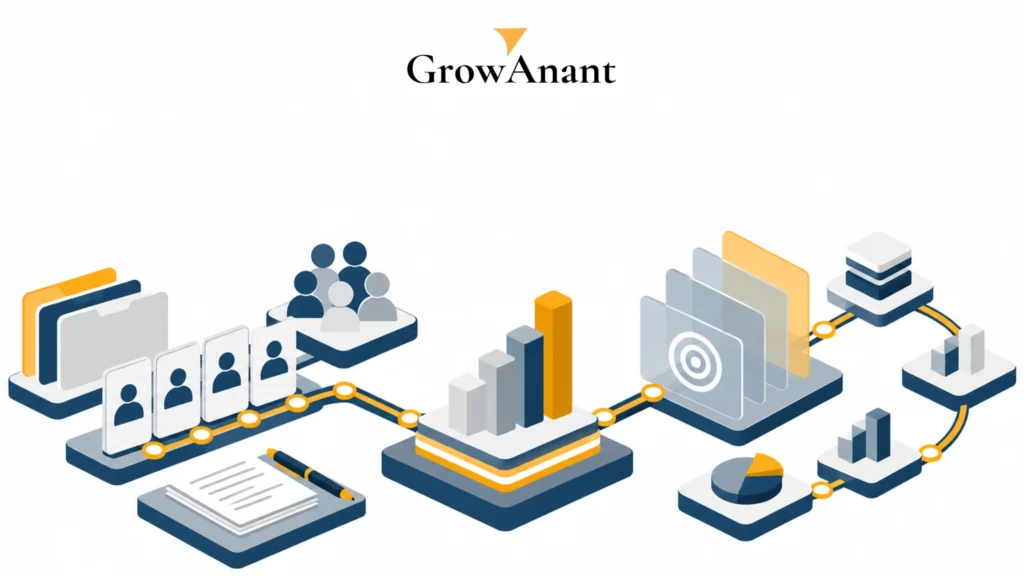
Choosing between sales and marketing expertise starts with understanding where revenue performance is breaking down. Businesses searching for best-rated sales growth consultants for revenue acceleration may assume they need stronger sales execution, but the actual problem could be weak positioning, inconsistent demand generation, or poor lead quality.
Sales growth consulting focuses on improving how opportunities move through the sales process and become customers. Marketing growth consulting focuses on attracting the right audience, creating demand, and generating qualified opportunities. Both contribute to revenue, but they address different parts of the commercial system.
For a B2B SaaS company, for example, increasing website traffic will not solve a sales team that consistently loses qualified opportunities. Equally, improving sales conversion will not solve a pipeline that lacks enough suitable prospects.
The right decision depends on identifying the primary revenue bottleneck before investing in additional resources. A structured growth strategy consulting approach helps businesses understand whether they need better customer acquisition, stronger sales execution, or a coordinated growth strategy.
Diagnosing Your Revenue Bottleneck: Sales, Marketing or Growth Strategy?
A revenue problem is rarely explained by one metric. Low revenue may result from insufficient demand, poor lead quality, weak sales execution, pricing issues, or a disconnected customer journey.
Founders should examine the complete journey from market awareness to closed revenue before deciding which consulting capability they need. This is an important part of business growth consulting, because improving individual activities without understanding their effect on the wider revenue system can lead to inefficient investment.
| Business symptom | Possible underlying problem | Consulting priority |
| Website traffic is low and few prospects discover the business | Weak visibility and market positioning | Marketing growth consulting |
| Leads arrive but rarely match the ideal customer profile | Poor targeting or qualification | Marketing growth consulting |
| Qualified opportunities repeatedly stall | Weak sales process or follow-up | Sales growth consulting |
| Sales representatives struggle to close deals | Discovery, objection handling, or negotiation gaps | Sales growth consulting |
| Marketing generates leads but sales does not convert them | Sales and marketing misalignment | Combined growth approach |
| Revenue remains unpredictable despite regular campaigns | No coordinated growth strategy or revenue ownership | Broader growth consulting |
A useful starting point is to examine five indicators:
- Lead volume: Is the business generating enough potential customers?
- Lead quality: Do prospects match the company’s ideal customer profile?
- Opportunity conversion: Are qualified leads progressing into sales opportunities?
- Win rate: Are opportunities converting into paying customers?
- Customer acquisition efficiency: Are acquisition costs and sales resources aligned with customer value?
For example, a U.S. IT consulting firm may generate 100 inquiries each month but receive very few from businesses with the required budget or project needs. Hiring additional sales representatives may increase operating costs without solving the targeting problem.
The business may need growth strategy consulting to refine its audience, positioning, and acquisition approach before expanding sales capacity. A broader growth roadmap consulting engagement could also help prioritize the activities required to establish a more predictable pipeline.
What Sales Growth Consulting Fixes: Sales Processes, Pipeline and Conversion
Sales growth consulting helps businesses improve the systems, processes, and leadership responsible for converting qualified opportunities into customers.
It is particularly relevant when a company has a defined market, a credible offer, and sufficient buyer interest but struggles to turn that interest into predictable revenue.
Typical areas of responsibility include:
- Sales process design and optimization.
- Pipeline management and forecasting.
- Lead qualification and opportunity prioritization.
- Sales team structure, coaching, and accountability.
- Discovery calls, proposals, and negotiation processes.
- CRM adoption and sales reporting.
- Account management and strategic customer development.
Consider a B2B SaaS company selling workflow automation software to mid-market manufacturers. Its marketing team consistently generates qualified opportunities, but sales representatives struggle to demonstrate financial value to operations leaders. Deals remain open for months, and forecasts frequently change.
A sales growth consultant would investigate qualification standards, sales conversations, decision-maker involvement, objection handling, and deal progression. This may involve sales process consulting to improve the way opportunities are managed and sales pipeline consulting to strengthen forecasting, reporting, and conversion visibility.
The goal is to identify where qualified opportunities lose momentum and improve the company’s ability to convert them.
Sales growth consulting is generally appropriate when:
- Lead generation is reasonably consistent.
- The target customer and value proposition are established.
- Qualified opportunities exist but conversion is weak.
- Sales processes differ significantly across representatives.
- Leadership lacks reliable pipeline visibility.
Businesses evaluating best-rated sales growth consultants for revenue acceleration should assess experience with their sales model, customer buying process, CRM environment, and commercial complexity. A consultant should be able to explain how sales performance will be diagnosed and measured, rather than simply recommending more sales activity.
The right consultant should also understand how sales performance contributes to broader revenue growth consulting objectives, including predictable pipeline development, customer acquisition, and sustainable revenue improvement.
What Marketing Growth Consulting Fixes: Demand Generation and Customer Acquisition
Marketing growth consulting addresses the systems responsible for positioning a business, attracting suitable buyers, generating demand, and supporting customer acquisition.
It is valuable when a business struggles to create a consistent flow of qualified opportunities or when marketing activity is disconnected from pipeline and revenue.
Typical responsibilities include:
- Market research and ideal customer profile development.
- Positioning, differentiation, and messaging.
- Demand generation strategy and channel selection.
- Content marketing, SEO, and generative engine optimization for B2B SaaS.
- Paid acquisition and B2B paid media channels.
- Lead generation and conversion optimization.
- Campaign attribution and performance measurement.
- Marketing and sales alignment.
For example, a U.S.-based cybersecurity consulting firm may rely heavily on referrals. Although its services are valuable, it has no consistent inbound acquisition system and limited visibility among its target decision-makers.
Marketing growth consulting could help define the priority industries, refine the service positioning, develop educational content, and establish a targeted demand generation approach.
Depending on the business model, this may include growth marketing services, B2B lead generation services, and performance marketing services USA. A business may also work with a demand generation agency or a B2B growth marketing agency when specialist execution is needed to support its acquisition strategy.
The objective is not simply to increase traffic or lead volume. It is to attract prospects who have a relevant business problem, understand the company’s value, and are more likely to enter a qualified sales conversation.
Marketing growth consulting is generally appropriate when:
- Lead generation is inconsistent.
- Target customers are unclear or too broadly defined.
- Positioning does not communicate meaningful differentiation.
- Marketing channels generate activity without measurable pipeline contribution.
- Customer acquisition costs are difficult to evaluate.
- The company needs a structured go-to-market approach.
A capable B2B growth marketing agency or growth consulting partner should connect marketing priorities to commercial objectives rather than measure success through isolated campaign metrics.
For growth-stage companies, marketing strategy consulting should also account for the relationship between organic visibility, paid acquisition, content, and sales enablement. The right mix depends on the target audience, buying cycle, market maturity, and available resources.
Sales and Marketing Alignment: How Both Functions Impact Revenue Growth
Sales and marketing are different functions, but their performance is interconnected. A weak handoff, inconsistent messaging, or disconnected reporting can create problems that neither function can resolve independently.
For example, marketing may define a lead as qualified based on content downloads, while sales considers only prospects with an identified budget and purchasing authority to be qualified.
Both teams may report strong activity while the business experiences weak pipeline progression.
Research from Gartner highlights the commercial importance of sales and marketing collaboration. Its research found that organizations sharing buyer journey insights were more likely to report stronger sales conversion and revenue performance.
The practical implication is that revenue accountability should connect both functions. Effective B2B marketing strategy consulting should consider how marketing-generated demand progresses through the sales pipeline and contributes to closed revenue.
| Area | Marketing responsibility | Sales responsibility | Shared outcome |
| Ideal customer profile | Identify target audiences | Validate buyer fit | Better targeting |
| Lead qualification | Establish lead criteria | Confirm sales readiness | Higher-quality opportunities |
| Messaging | Communicate value proposition | Reinforce value in conversations | Consistent buyer experience |
| Pipeline | Generate qualified demand | Progress opportunities | Stronger pipeline visibility |
| Attribution | Track acquisition sources | Record opportunity and deal outcomes | Better investment decisions |
Two concepts are particularly relevant:
- Account-based marketing vs marketing automation: Account-based marketing concentrates resources on selected high-value accounts, while marketing automation supports communication and workflows across defined audiences. The choice depends on deal size, sales complexity, and buying behavior.
- Growth marketing agency comparison: Businesses should compare providers based on strategic capability, measurement, sales alignment, and execution responsibility, not simply the number of channels offered. A meaningful growth marketing agency comparison should examine whether a provider can connect acquisition activity to qualified pipeline and revenue outcomes.
A shared CRM, agreed qualification definitions, consistent reporting, and regular pipeline reviews can help close these gaps.
For companies with more complex buying processes, an integrated approach to growth marketing and sales execution can help improve the entire customer journey rather than optimize individual channels independently.
How to Choose Between Sales and Marketing Growth Consulting Based on Your Revenue Bottleneck
The right consulting partner should address the business constraint with the greatest impact on revenue performance.
Use the following decision framework before making an investment.
| Your current situation | Recommended starting point |
| Not enough qualified prospects | Marketing growth consulting |
| Strong lead volume but poor lead quality | Marketing strategy and targeting |
| Qualified opportunities are not closing | Sales growth consulting |
| Sales forecasting is unreliable | Sales process and pipeline consulting |
| Marketing and sales operate independently | Integrated growth consulting |
| Entering a new market without a clear acquisition strategy | Go-to-market and growth strategy consulting |
| Multiple teams execute without shared revenue priorities | Strategic growth leadership |
Before selecting a consultant, work through this checklist:
- Identify the constraint: Where does the customer journey lose the most momentum?
- Review the data: Examine lead sources, conversion rates, sales cycle, win rates, and acquisition costs.
- Clarify ownership: Determine whether sales, marketing, or both functions need stronger leadership.
- Define success measures: Connect consulting responsibilities to qualified pipeline, conversion, and revenue indicators.
- Evaluate the engagement: Confirm scope, implementation support, reporting, and leadership involvement.
For growth-stage businesses, the answer may require more than one specialist. However, that does not mean every business needs separate sales and marketing consultants immediately.
GrowAnant approaches these challenges through growth consulting services that connect business priorities, positioning, demand generation, sales execution, and revenue accountability. The objective is to establish a coordinated growth system rather than improve individual activities in isolation.
Unlike a traditional digital marketing agency focused primarily on channel execution, GrowAnant approaches business growth through strategy, prioritization, and hands-on execution. This includes connecting business growth consulting, go-to-market strategy consulting, and demand generation with measurable commercial priorities.
For companies evaluating a growth marketing agency USA, digital growth agency, or broader consulting partner, the important consideration is whether the engagement addresses the actual revenue bottleneck and provides the strategic direction required to improve performance.
If your organization is experiencing inconsistent leads, weak conversion, or unpredictable revenue, start by diagnosing the bottleneck before deciding which capability to add. A focused assessment can clarify whether the immediate requirement is sales improvement, marketing performance, or broader growth leadership.
References
- Gartner: Boost Revenue Growth With Marketing and Sales Collaboration
- McKinsey & Company: The Power of Partnership: How the CEO-CMO Relationship Can Drive Outsize Growth
Frequently Asked Questions About Sales and Marketing Growth Consulting
Your problem is more likely marketing-related when the business struggles to attract suitable prospects, communicate its value, or generate qualified opportunities. It is more likely sales-related when qualified prospects already exist but deals stall, conversion rates are weak, or forecasting is unreliable. Review the full customer journey and identify where performance declines before selecting a consulting partner.
Yes, depending on the consultant’s experience and the complexity of the business. A growth consultant with sales and marketing expertise can diagnose cross-functional problems, establish priorities, and coordinate execution. However, specialized support may still be necessary when the business requires deep expertise in areas such as enterprise sales, paid acquisition, or technical marketing.
Common signs include a consistent flow of qualified leads, low opportunity-to-customer conversion, deals that repeatedly stall, inconsistent sales follow-up, weak forecasting, and difficulty communicating value during sales conversations. These indicators suggest that improving sales processes, qualification, and deal management may be more valuable than increasing marketing activity.
Hire a sales growth consultant when the company has qualified demand but struggles to convert opportunities into revenue. Choose marketing growth consulting when the business lacks consistent qualified demand, clear positioning, or an effective customer acquisition system. If both functions are disconnected, consider a growth consulting partner who can assess the complete revenue system and prioritize the most important constraint.