
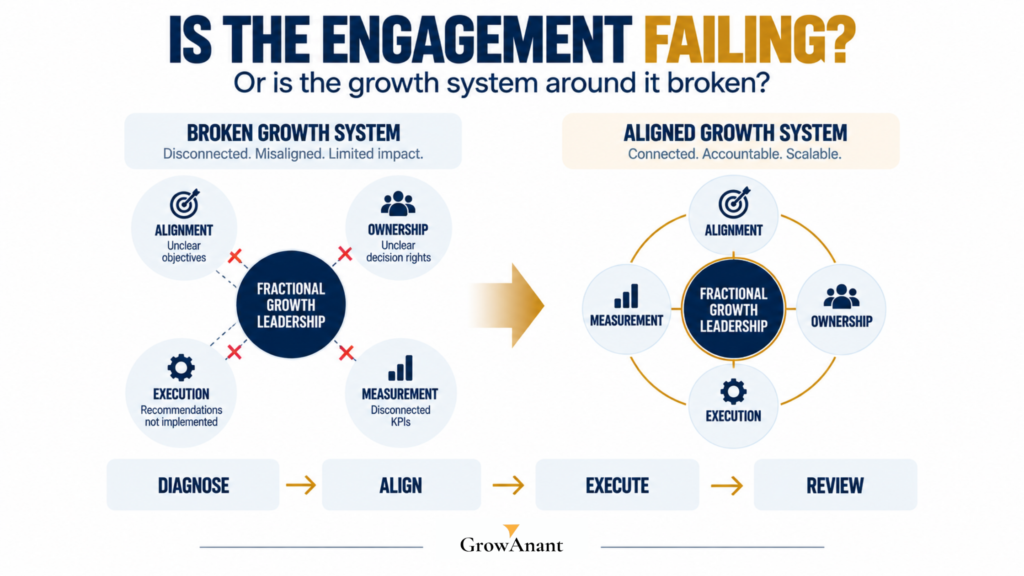
A fractional growth engagement not working does not always mean the fractional growth consultant is ineffective. In many cases, the underlying issue is unclear ownership, weak fractional growth leadership onboarding, unrealistic expectations, poor communication, or insufficient internal commitment.
A fractional leader is brought in to connect strategy, execution, accountability, and revenue priorities. Whether the role is a fractional growth executive, fractional chief growth officer, or fractional head of growth, success depends on how effectively that leader works with the existing organization.
For growth-stage SaaS companies, professional services firms, funded startups, and founder-led businesses, identifying problems early matters. A stalled engagement can create more than wasted consulting spend. It can leave marketing activity disconnected from pipeline, create confusion across teams, and delay important growth decisions.
The goal is not to determine who is at fault. The goal is to identify whether the engagement can be repaired, what needs to change, and when continuing no longer makes strategic sense.
Warning Signs to Watch For
The earliest warning signs usually appear in the operating relationship before they appear in revenue numbers.
A useful way to evaluate a fractional growth leadership engagement is to examine five areas:
| Area | Healthy Engagement | Warning Sign |
| Strategy | Clear priorities and roadmap | Constantly changing priorities |
| Ownership | Defined decision rights | Everyone assumes someone else owns the decision |
| Communication | Consistent executive communication | Irregular or reactive communication |
| Execution | Strategy translates into action | Recommendations remain unimplemented |
| Measurement | Shared business KPIs | Focus remains on disconnected activity metrics |
Common warning signs include:
- Strategic priorities change every few weeks without a clear reason.
- The fractional leader receives incomplete information or limited access to decision-makers.
- Internal teams treat the leader as an external vendor rather than part of the growth leadership structure.
- Marketing, sales, and leadership continue operating against different objectives.
- Recommendations are repeatedly approved but never implemented.
- Meetings focus on reporting activity rather than resolving growth constraints.
- There is no agreed definition of success.
- The founder or CEO continues making every important growth decision without delegation.
For example, a U.S. B2B SaaS company may hire a fractional growth consultant to improve pipeline generation. If the consultant identifies positioning and qualification problems but the company continues investing heavily in acquisition without addressing those issues, the engagement can appear ineffective even though the strategic diagnosis is sound.
The first question should therefore be:
Is the engagement failing, or is the organization preventing the engagement from functioning as designed?
Misaligned Expectations
A major reason for a fractional growth engagement not working is a mismatch between what the business expects and what the engagement was designed to deliver.
A fractional leader is not necessarily a replacement for a marketing department, sales leader, or execution team. The role is usually focused on strategic direction, prioritization, cross-functional alignment, measurement, and leadership.
A clear engagement should define:
| Dimension | Question to Answer |
| Objective | What business problem are we solving? |
| Scope | Which growth functions are included? |
| Authority | What decisions can the fractional leader make? |
| Resources | Which internal people and partners are available? |
| Metrics | Which business outcomes determine progress? |
| Timeline | What should happen during the first 30, 60, and 90 days? |
This becomes particularly important when using growth consulting services, growth strategy consulting, business growth consulting, or revenue growth consulting.
For example, a founder might expect immediate revenue acceleration while the engagement is initially designed to rebuild positioning, demand generation, sales qualification, and reporting. Without agreeing on these stages beforehand, both sides may interpret progress differently.
The Alignment Test
Before changing the engagement, leadership should ask:
- Are the business objectives documented?
- Are responsibilities clearly assigned?
- Does the fractional leader have access to the information required to make decisions?
- Are internal teams expected to implement agreed initiatives?
- Are success metrics tied to business outcomes?
- Are priorities protected from constant executive changes?
If several answers are no, the problem may be engagement design rather than individual performance.
Communication Breakdowns
Communication is not simply about having more meetings. It is about creating a reliable decision-making system.
A fractional growth leadership contract should establish how information moves between the fractional leader, CEO, marketing, sales, and other relevant functions.
A practical communication structure can include:
| Cadence | Purpose |
| Weekly Growth Review | Review priorities, blockers, and performance |
| Biweekly Strategy Session | Reassess initiatives and strategic assumptions |
| Monthly Executive Review | Review pipeline, revenue indicators, and resource allocation |
| Quarterly Planning | Revisit growth priorities and strategic direction |
The key is to keep communication connected to decisions.
If weekly meetings become long status updates without decisions, the engagement can gradually lose strategic value.
This is particularly relevant when a fractional growth executive is coordinating existing marketing teams, sales representatives, agencies, technology partners, and leadership. The role requires enough visibility to identify where the growth system is breaking.
McKinsey has similarly highlighted the importance of connecting organizational structure, governance, capabilities, and strategic direction within marketing operating models.
Lack of Internal Buy-In
A fractional leader can provide senior expertise, but they cannot create organizational commitment by themselves.
Internal buy-in means that the people responsible for execution understand the strategy, accept their responsibilities, and have the authority and resources to act.
This is especially important for companies with an established growth leadership team structure.
Consider a professional services firm that hires a fractional leader to improve lead generation. The strategy recommends narrowing the target market, changing qualification criteria, improving messaging, and creating a more focused demand generation process. If the sales team continues pursuing every opportunity and the marketing team continues targeting broad audiences, the strategy will struggle to produce meaningful change.
The issue is not necessarily the strategy. The operating system around it is incomplete.
Internal Buy-In Checklist
Before concluding that the engagement is failing, leadership should verify:
- The CEO or executive sponsor actively supports the engagement.
- Internal teams understand the growth priorities.
- Owners are assigned to major initiatives.
- Teams have the resources required for execution.
- Decisions are not repeatedly reversed without new evidence.
- Performance reviews include agreed growth metrics.
- The fractional leader has access to relevant customer, sales, and marketing data.
This matters across different environments, including fractional growth leadership fintech, fractional growth leadership healthtech, and other regulated or complex sectors where multiple stakeholders may influence execution.
How to Course-Correct
When an engagement is underperforming, the first step should be diagnosis rather than immediate termination.
A simple course-correction framework is:
Diagnose → Align → Prioritize → Execute → Review
1. Diagnose
Identify the actual source of friction.
Is the problem strategy, execution, resources, communication, data, decision-making, or ownership?
2. Align
Reconfirm the business objective and define what success means.
For a SaaS company, this might involve pipeline quality, sales conversion, customer acquisition efficiency, or expansion readiness rather than simply increasing marketing activity.
3. Prioritize
Reduce the number of active initiatives.
A fractional leader should help leadership distinguish between urgent operational work and strategic growth priorities.
4. Execute
Assign every major initiative an owner, deadline, dependency, and measurable outcome.
5. Review
Create a fixed review cycle to determine whether the changes are producing meaningful progress.
A fractional growth advisory board or executive review group can also provide additional accountability when multiple stakeholders are involved.
The objective is to make the engagement operationally effective, not simply to increase activity.
GrowAnant approaches this type of challenge from a strategy-first perspective, connecting growth priorities, demand generation, go-to-market planning, and revenue execution rather than treating each marketing activity as an isolated project.
When to End the Engagement
Not every engagement should be saved.
There are situations where ending or materially restructuring the relationship is the appropriate business decision.
Consider a change when:
| Situation | Strategic Concern |
| Objectives remain unclear | No reliable definition of success |
| Access remains restricted | Leader cannot diagnose the business properly |
| Recommendations are consistently ignored | Strategy cannot translate into execution |
| Trust has materially deteriorated | Productive collaboration becomes difficult |
| Responsibilities remain disputed | Accountability cannot be established |
| Scope changes constantly | Strategic focus becomes impossible |
| Progress cannot be evaluated | Measurement framework is inadequate |
However, leadership should distinguish between a fixable engagement problem and a fundamental mismatch.
A fractional growth leadership relationship may need restructuring when the scope is too broad, decision rights are unclear, or internal execution capacity is insufficient. These are different from situations where there is persistent disagreement about the company’s strategic direction or expectations that cannot realistically be reconciled.
A Practical Decision Framework
Ask three questions:
Can the problem be defined?
If the problem is specific, it may be fixable.
Can both sides agree on the required change?
If there is mutual willingness to reset expectations, scope, communication, and ownership, a revised engagement may be viable.
Can the organization support the revised model?
Even a strong fractional head of growth cannot compensate indefinitely for unavailable resources, absent leadership participation, or repeated refusal to execute agreed priorities.
The decision should therefore be based on evidence from the engagement, not frustration from a single missed target or campaign.
For growth-stage companies, the broader lesson is important: fractional leadership works best when it is integrated into the organization’s decision-making structure rather than treated as an external source of isolated recommendations.
Frequently Asked Questions
Early warning signs include unclear objectives, changing priorities, weak communication, limited internal buy-in, unclear ownership, poor access to business data, and recommendations that repeatedly remain unimplemented. Leadership should assess whether the issue is with the engagement itself or with the organizational conditions supporting it.
Start by documenting the business objective, engagement scope, responsibilities, decision rights, resources, timelines, and success metrics. Then establish a regular executive review process to ensure both sides continue operating against the same priorities.
The CEO or executive sponsor typically plays the most important role in establishing organizational commitment. However, buy-in also requires functional leaders and execution teams to understand their responsibilities and participate in implementation.
Consider ending or restructuring the engagement when objectives cannot be aligned, trust has materially deteriorated, responsibilities remain unresolved, recommendations cannot be implemented because of persistent organizational constraints, or both sides cannot agree on what successful engagement looks like.