
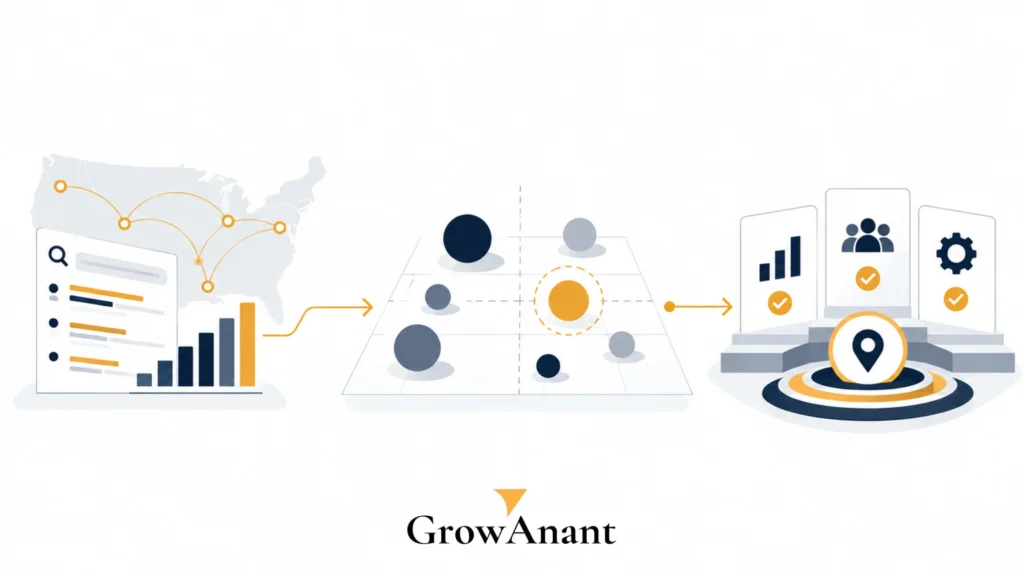
Choosing which vendors help validate new market entry by sizing search demand and competitive strength before launch is an important decision for founders evaluating expansion into the United States. The right research combines search demand, competitor intelligence, industry data, and direct customer evidence to support go to market strategy consulting and informed launch decisions.
No single tool can confirm whether a market will generate profitable customers. Search platforms estimate expressed demand, competitive intelligence tools reveal digital positioning, and customer research tests whether buyers recognize the problem and are willing to pay for a solution.
For example, a European SaaS company may discover substantial U.S. search volume for its product category. That does not establish whether its ideal customers have sufficient budgets, whether competitors dominate the market, or whether acquisition costs will support a viable business model.
A structured market entry strategy USA assessment helps answer these questions before significant spending on hiring, localization, advertising, and sales infrastructure begins.
Why Tool Selection Matters Before Committing to a Market
Market research tools measure different aspects of an opportunity. Search platforms estimate keyword demand, competitor tools analyze digital visibility, and industry datasets help estimate the number of potential customers.
The objective is to reduce uncertainty, not simply collect data. Before entering the United States, a company should understand four factors:
- Market demand: Are relevant customers actively looking for solutions?
- Competitive strength: Which alternatives already serve those customers?
- Commercial viability: Can customers be acquired and served at sustainable costs?
- Market accessibility: Can the company reach buyers with its current positioning, product, and resources?
Consider a cleantech startup planning a U.S. launch. Search data may indicate growing interest in its category, but regional regulations, procurement requirements, incentives, and distribution access could influence actual demand. These factors are especially important for cleantech us market entry.
A useful gtm strategy diagnostic distinguishes total market potential from the portion the business can realistically serve. A large market may still be unattractive if customer acquisition is expensive, established competitors have strong relationships, or the product requires significant adaptation.
Before selecting vendors, define the decisions the research must support. For example, determine whether the company needs to choose a target segment, validate a pricing assumption, identify competitors, or decide whether to launch immediately or conduct further testing.
Search Demand Sizing Tools
Search demand sizing estimates how frequently people search for relevant problems, products, services, and alternatives. It helps businesses understand customer language, identify commercial search intent, and estimate opportunities for search-driven acquisition.
However, search volume is not equivalent to total market size. Some buyers never search online, while other searches come from students, job seekers, competitors, or audiences outside the target market.
| Tool | Primary use | Best application |
| Google Keyword Planner | Keyword ideas, estimated search volume, advertising estimates | Assess U.S. search demand and potential paid-search costs |
| Semrush | Keyword research, competitor keywords, organic visibility | Identify competitor strengths and keyword opportunities |
| Google Trends | Relative search interest over time and across locations | Investigate seasonality and regional interest |
| U.S. Census Bureau data | Business counts and industry characteristics | Estimate potential business customers by industry and geography |
For a B2B SaaS business, begin by grouping keywords into problem-aware searches, solution searches, competitor searches, and commercial-intent searches. A workforce software provider, for example, could investigate searches related to employee scheduling, workforce productivity, and competing software solutions.
A practical process is to:
- Define the target customer, industry, and U.S. geography.
- Build keyword groups around customer problems and solutions.
- Compare search volume, trends, and advertising estimates.
- Identify terms that indicate meaningful purchase intent.
- Validate findings against customer interviews and industry data.
Use these estimates to understand the searchable opportunity, not to claim that the entire market has been measured.
Competitive Intelligence Platforms
Competitive intelligence platforms help companies identify competitors, compare positioning, analyze keyword visibility, and discover potential gaps in the market.
Tools such as Semrush can support competitor keyword research, organic visibility analysis, and digital market comparisons. These insights help businesses understand how established providers attract attention and which customer problems they address.
Before a U.S. launch, investigate:
- Direct competitors offering similar solutions.
- Indirect alternatives, including spreadsheets and internal processes.
- Competitor positioning, pricing, and target segments.
- Organic search visibility and paid advertising activity.
- Content gaps and underserved buyer questions.
- Differentiation that customers actually value.
For example, a startup offering analytics software to U.S. manufacturers may compete with specialist SaaS providers, enterprise platforms, and internal reporting systems. A keyword-only competitor list could miss alternatives that buyers already trust.
Digital intelligence also has limitations. Traffic estimates do not reveal actual revenue, profitability, conversion rates, or customer retention. A competitor with strong search visibility is not necessarily the market leader in commercial performance.
Use competitor data to develop hypotheses, then test those hypotheses through buyer interviews and sales research.
Combining Tool Data With Primary Research
Primary research involves gathering evidence directly from potential customers, partners, or other market participants. It helps establish whether patterns found in software tools reflect real buying behavior.
A reliable growth strategy consulting process combines secondary research with customer interviews, surveys, sales conversations, and limited demand tests.
| Research source | What it helps establish | Main limitation |
| Keyword tools | Search behavior and expressed interest | Does not prove willingness to buy |
| Competitor platforms | Estimated digital visibility | Does not establish actual profitability |
| Industry datasets | Potential business counts and characteristics | Does not prove product-market fit |
| Customer interviews | Pain points, buying criteria, objections | Small samples may not represent the entire market |
| Landing-page tests | Initial response to an offer | Does not prove long-term retention |
| Sales conversations | Qualification, objections, buying processes | Cannot establish total market size alone |
Imagine a SaaS startup identifying 20,000 U.S. businesses in its broad target industry. After filtering for company size, technology requirements, budget, and use case, the realistic target market may be substantially smaller.
The company should interview representative buyers to understand the problem, current alternatives, budget ownership, and purchasing triggers. A limited campaign can then test whether the proposed positioning generates qualified conversations.
This approach connects research to commercial decisions instead of treating market estimates as guaranteed revenue.
Interpreting Conflicting Signals
Different data sources can produce conflicting estimates because they use different methodologies, definitions, geographic coverage, and measurement periods. The correct response is to investigate the assumptions rather than automatically select the largest number.
Suppose keyword research indicates strong demand, competitor traffic estimates appear modest, and customer interviews reveal that buyers primarily rely on referrals. These findings may indicate that search captures only part of the buying journey.
Use this framework to interpret conflicting evidence:
- Check definitions: Determine whether each source measures searches, estimated traffic, business counts, or actual customer behavior.
- Check geography: Confirm that data represents the United States rather than global demand.
- Check time periods: Investigate seasonality and unusual market conditions.
- Check customer relevance: Exclude audiences that do not match the ideal customer profile.
- Seek independent confirmation: Compare findings with interviews, industry datasets, and controlled tests.
- Document uncertainty: Record assumptions and identify the evidence needed to improve confidence.
For companies evaluating startup consulting services USA, this process helps determine whether to enter the market, narrow the target segment, or revise the offer.
Do not treat an estimated market size as a revenue forecast. Instead, estimate the number of reachable target accounts, potential qualified conversations, opportunity conversion, and customer economics.
A Vendor Comparison Table
The best vendor shortlist depends on the launch decision, required data, and available budget. Most companies do not need every research platform at the beginning.
| Research need | Recommended starting point | Limitation |
| Search demand and paid-search estimates | Google Keyword Planner | Search volume does not prove purchase intent |
| Competitor keywords and digital visibility | Semrush | Traffic and visibility figures are estimates |
| Regional search-interest trends | Google Trends | Relative interest is not absolute market size |
| U.S. business and industry counts | U.S. Census Bureau | Business counts do not prove demand for a specific solution |
| Buyer needs and willingness to pay | Customer interviews | Requires careful sampling |
| Initial demand validation | Targeted outreach and landing-page tests | Early results may not predict long-term performance |
Before purchasing a platform or commissioning research, ask:
- Does the source cover the relevant U.S. geography and target segment?
- Can its data answer a specific market-entry question?
- Are the methodology and limitations clear?
- Can the findings be compared with independent evidence?
- Is the cost proportionate to the uncertainty being reduced?
- Will the results change a decision about targeting, positioning, investment, or launch timing?
A company entering a complex enterprise market may need specialist industry research. A business testing a narrower digital niche may begin with search tools and customer interviews.
GrowAnant’s strategy-first approach to business growth consulting connects market evidence with positioning, demand generation, and execution priorities. The objective is to make a better-informed launch decision rather than accumulate data without a clear commercial purpose.
CTA recommendation: Get a Market Sizing Vendor Shortlist
Build your shortlist around the target customer, launch geography, key competitors, and unresolved market-entry questions. Prioritize vendors that can resolve those questions and help determine whether further investment is justified.
References
- Google Ads Help, Use Keyword Planner
- Semrush, Market Analysis Tools
Frequently Asked Questions
Google Keyword Planner estimates search volume and advertising costs, while Semrush helps analyze keyword demand and competitor visibility. Google Trends reveals relative interest patterns, and U.S. Census Bureau datasets help estimate businesses in relevant industries and locations. Combine these tools with customer research to assess commercial viability.
No. Search tools measure online search behavior, not total market size, willingness to pay, or achievable revenue. They can miss buyers who rely on referrals, procurement processes, or established relationships. Validate search estimates using industry data, interviews, competitor research, and controlled demand tests.
Interview potential buyers who match the target customer profile. Ask about their problems, current alternatives, purchasing triggers, decision-makers, budgets, and adoption barriers. Then test the positioning through targeted outreach or a limited campaign. Measure qualified conversations and meaningful buying signals rather than relying only on clicks or unqualified leads.
Compare the definitions, geographic coverage, time periods, and methodologies behind each estimate. Identify which source is most relevant to the decision, then seek independent evidence through customer interviews, industry datasets, or controlled tests. Document unresolved uncertainty instead of treating the most optimistic estimate as the most accurate.