
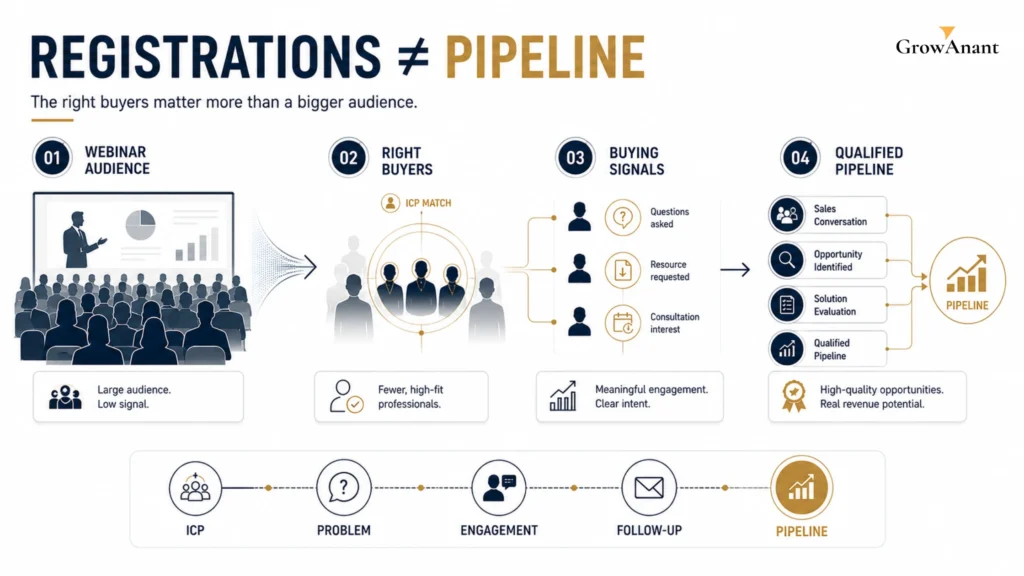
Webinars for demand generation still have a role in modern B2B growth, but their effectiveness depends on how strategically they are designed. A webinar that simply attracts registrations may create activity without creating meaningful pipeline. A well-designed program can educate buyers, establish expertise, identify buying intent, and create sales conversations.
For growth-stage companies, the question is therefore not whether webinars work in isolation. It is whether the webinar is connected to the company’s ICP, positioning, demand generation strategy, sales process, and revenue measurement.
Modern b2b events marketing should be treated as part of a broader growth system rather than as standalone campaigns.
The Case For and Against Webinars
Webinars work particularly well when a product requires education, trust, or multiple stakeholder conversations.
They can be useful for B2B SaaS companies, professional services firms, technology providers, and companies entering new markets.
Where Webinars Create Value
- Demonstrating subject-matter expertise
- Educating prospects about complex problems
- Engaging multiple stakeholders
- Capturing first-party audience information
- Identifying high-intent participants
- Creating reusable content
- Supporting sales conversations
- Building relationships with target accounts
However, webinars can underperform when the topic is too broad, promotion is weak, or the company measures success primarily through registrations.
| Webinar Approach | Likely Outcome |
| Broad educational topic | High but less-qualified registrations |
| Product demonstration only | Lower trust and engagement |
| ICP-specific problem | Stronger relevance |
| Executive-level discussion | Higher-quality engagement |
| Customer-led session | Greater credibility |
| Sales pitch disguised as webinar | Poor audience experience |
A webinar for a cybersecurity SaaS company targeting U.S. manufacturers, for example, could focus on a specific operational security problem rather than simply presenting the company’s software.
The objective should be to attract the right people, not the maximum number of people.
Planning a Pipeline-Generating Webinar
A pipeline-generating webinar starts with the commercial problem, not the presentation.
Use this framework:
ICP → Problem → Topic → Expertise → CTA → Follow-Up → Pipeline
1. Define the ICP
Identify the companies and decision-makers you want to attract.
For example:
- VP Marketing at B2B SaaS companies
- CIOs at mid-market manufacturers
- Founders of professional services firms
- Revenue leaders at growth-stage technology companies
2. Select a High-Value Problem
Choose a problem that already affects the buyer’s business.
Strong topics often address:
- Rising customer acquisition costs
- Weak demand generation
- Poor lead quality
- Funnel leakage
- U.S. market expansion
- GTM execution
- Revenue attribution
3. Build an Educational Agenda
A practical 45 to 60-minute structure might be:
| Segment | Purpose |
| 5 minutes | Context and problem |
| 15 minutes | Market insight |
| 15 minutes | Framework or methodology |
| 10 minutes | Business example |
| 5 minutes | Questions |
| 5 minutes | Relevant next step |
The content should solve part of the buyer’s problem while creating a logical reason to continue the conversation.
This is where growth strategy consulting and demand generation analytics should connect. The webinar should be designed around a measurable commercial objective.
Promotion & Registration Strategy
A strong webinar can fail because the right audience never sees it.
Promotion should begin several weeks before the event and use multiple touchpoints.
Promotion Framework
Owned → Earned → Paid → Partner
Owned: Email, website, newsletter, LinkedIn, existing customer database.
Earned: Speakers, customers, industry communities, partners, relevant publications.
Paid: LinkedIn advertising, retargeting, search campaigns, and other relevant channels.
Partner: Industry associations, technology partners, complementary businesses, and ecosystem organizations.
For a B2B company, LinkedIn can be particularly useful because audience targeting can be aligned with job roles, industries, company characteristics, and account lists.
However, promotion should not rely entirely on paid acquisition. A company with a strong executive network may generate more qualified attendance through founder-led distribution and partner promotion.
Registration Page Checklist
- Specific problem-focused title
- Clear audience definition
- Strong learning outcomes
- Speaker credibility
- Date and time
- Simple registration process
- Clear expectations
- Relevant privacy information
- Appropriate post-registration communication
Avoid making the registration page sound like a product brochure.
The buyer is giving you their time because they expect useful information.
Follow-Up That Converts
The webinar does not end when the session ends.
In many cases, follow-up is where the commercial value is created.
A practical follow-up sequence can segment attendees based on behavior.
| Audience | Suggested Follow-Up |
| Registered but did not attend | Recording + key insights |
| Attended most of session | Deeper resource |
| Asked a question | Personalized sales follow-up |
| Requested information | Relevant consultation |
| High-fit account | Account-specific outreach |
| Low engagement | Educational nurture |
This approach is more effective than sending the same sales email to everyone.
For example, someone who asked a detailed question about implementation may represent stronger buying intent than someone who registered but never attended.
A lead scoring model b2b can incorporate webinar behavior alongside company fit, role, website activity, content engagement, and other signals.
The goal is not to label every attendee as a lead. The goal is to identify meaningful buying signals.
A Simple Follow-Up Sequence
Day 0: Thank-you email and recording
Day 1 to 2: Key insights or framework
Day 3 to 5: Relevant case study or resource
Day 5 to 7: Personalized outreach for qualified participants
Later: Continue relevant lead nurturing through the broader demand generation program
This prevents the common mistake of treating every webinar participant as immediately sales-ready.
Measuring Webinar ROI
Webinar measurement should extend beyond registration volume.
A useful measurement framework is:
Reach → Engagement → Qualification → Pipeline → Revenue
Core Metrics
| Stage | Metrics |
| Reach | Impressions, traffic, invitations |
| Registration | Registrations, conversion rate |
| Engagement | Attendance, watch time, questions |
| Qualification | ICP fit, engagement score |
| Pipeline | Meetings, opportunities, influenced pipeline |
| Revenue | Closed revenue, customer acquisition economics |
A b2b marketing attribution model can help connect webinar participation to later marketing and sales activity.
However, attribution should not be interpreted as proof that the webinar alone generated revenue. B2B buying journeys usually involve multiple interactions.
For leadership reporting, consider tracking:
Cost per qualified attendee
Qualified meetings generated
Pipeline influenced
Pipeline created
Revenue influenced
Customer acquisition cost
Revenue per webinar
For example, a webinar with 500 registrations may look stronger than one with 120 registrations. But if the smaller event produces 15 qualified opportunities while the larger event produces two, the smaller event may be commercially superior.
This is why demand generation analytics should prioritize business quality over surface-level volume.
Common Mistakes
1. Optimizing for registrations
More registrations do not automatically mean more pipeline.
2. Choosing topics the company wants to discuss
The topic should start with a buyer problem, not an internal product priority.
3. Making the webinar a sales presentation
Education should come before promotion. Buyers can recognize when a webinar is simply an extended product pitch.
4. Inviting everyone
Broad audiences can increase volume while reducing relevance.
5. Ignoring follow-up
Without structured post-event engagement, valuable buying signals can disappear.
6. Treating attendance as qualification
Attendance indicates interest, not necessarily purchase intent.
7. Measuring only immediate conversions
Some B2B buyers require multiple interactions before entering a sales process.
8. Running webinars without a larger system
A webinar should connect to content, email, LinkedIn, sales enablement, account-based activity, and the company’s broader demand generation strategy.
For growth-stage businesses, a strategic partner such as GrowAnant can help connect growth marketing services, webinar programs, demand generation, sales alignment, and revenue measurement into a broader growth system.
Frequently Asked Questions
Yes, webinars can generate pipeline when they attract the right ICP, address meaningful business problems, provide useful education, capture engagement signals, and connect to structured sales and nurture processes. Their value should be evaluated through qualified engagement and pipeline rather than registrations alone.
Focus on a specific buyer problem, communicate clear learning outcomes, use credible speakers, promote through relevant owned and partner channels, and create multiple reminders. Personalized invitations to high-fit accounts can also improve attendance quality.
The strongest follow-up is usually behavior-based. Attendees who ask questions, engage deeply, request resources, or represent high-fit accounts should receive more personalized follow-up, while lower-intent participants can enter an educational nurture sequence.
Measure the complete path from promotion to revenue: registration, attendance, engagement, qualified participants, meetings, opportunities, pipeline, influenced revenue, and acquisition economics. A webinar should be evaluated as part of the wider B2B buying journey rather than as an isolated campaign.