
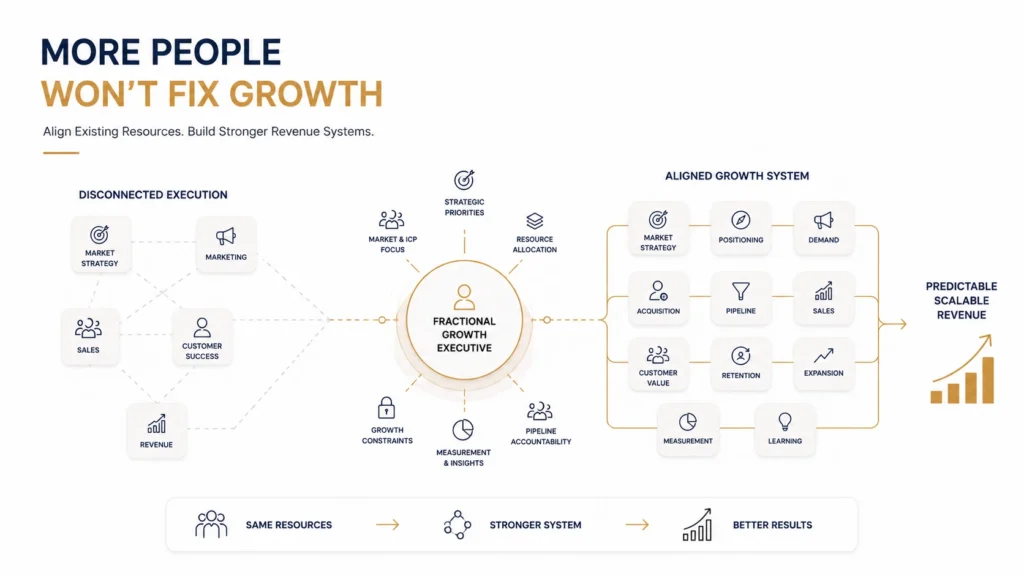
Many founders assume revenue challenges stem from insufficient marketing activity, limited sales outreach, or a lack of advertising spend. In reality, many growth-stage businesses already have capable teams, marketing tools, and customer acquisition channels. What they often lack is strategic leadership that aligns every growth function toward measurable business outcomes.
A Fractional Growth Executive fills this leadership gap by connecting strategy, execution, and accountability across the organization. Instead of focusing on isolated marketing tactics, this role develops integrated growth systems that improve pipeline quality, customer acquisition efficiency, and long-term revenue growth.
Whether you are a SaaS startup preparing for rapid expansion, a professional services firm struggling with inconsistent lead generation, or a company entering the U.S. market, investing in experienced fractional growth leadership can provide strategic direction without the commitment of a full-time executive hire.
This guide explains what a Fractional Growth Executive does, the warning signs that indicate your business is ready, how to evaluate organizational readiness, expected business outcomes, and common mistakes to avoid.
What Is a Fractional Growth Executive?
A Fractional Growth Executive is a senior strategic leader who works with an organization on a part-time or contract basis to oversee sustainable business growth. Unlike specialists who focus on a single marketing channel, this executive aligns every revenue-driving function, including marketing, sales, customer success, product positioning, pricing, and go-to-market execution.
Their objective is not simply to generate more leads. Instead, they build repeatable systems that improve customer acquisition, retention, operational efficiency, and overall business performance.
For growth-stage companies, hiring a full-time executive may not be financially practical. A Fractional Growth Executive provides executive-level expertise while allowing businesses to maintain operational flexibility.
Many organizations also engage experienced growth consulting services providers when they require strategic leadership but are not yet ready to establish a permanent executive role.
Core Responsibilities
A Fractional Growth Executive typically oversees:
| Strategic Responsibility | Business Impact |
| Revenue strategy development | Aligns growth activities with long-term business objectives |
| Growth strategy consulting | Creates scalable growth roadmaps |
| Go to market strategy consulting | Improves product launches and market expansion |
| Demand generation planning | Builds predictable demand instead of relying on short-term campaigns |
| Sales and marketing alignment | Improves lead quality and conversion efficiency |
| Funnel optimization | Identifies and removes revenue bottlenecks |
| KPI management | Creates measurable accountability across teams |
| Executive reporting | Provides founders with strategic visibility into growth performance |
Rather than acting as another marketing manager, this role serves as a business growth architect responsible for connecting every growth initiative to measurable commercial outcomes.
How This Role Differs from Functional Marketing Leadership
Many businesses mistakenly believe hiring another marketing manager will solve revenue challenges. However, execution alone rarely addresses deeper strategic issues.
A marketing team may successfully launch campaigns, create content, or manage advertising budgets, but without executive growth leadership, organizations often experience:
- Inconsistent pipeline generation
- Poor cross-functional collaboration
- Rising customer acquisition costs
- Weak positioning
- Misaligned sales and marketing goals
- Lack of executive accountability
A Fractional Growth Executive addresses these broader organizational challenges by coordinating multiple departments under a unified growth strategy.
For example, a B2B SaaS company may invest heavily in paid advertising while experiencing declining conversion rates. The issue may not be advertising performance but unclear positioning, poor onboarding, pricing friction, or weak sales qualification. Strategic leadership identifies these root causes before increasing marketing spend.
Companies seeking business growth consulting, revenue growth consulting, or growth consulting services USA frequently discover that sustainable growth depends on executive coordination rather than additional tactical execution.
Many growth-stage businesses partner with organizations such as GrowAnant to introduce strategic growth leadership that connects demand generation, B2B marketing, sales operations, and revenue planning into one integrated system.
Growth Warning Signs
Not every business requires a Fractional Growth Executive immediately. However, certain operational and commercial challenges consistently indicate the need for executive-level growth leadership.
The following warning signs suggest your organization may benefit from experienced fractional growth leadership.
1. Revenue Growth Has Plateaued
Revenue stagnation often occurs despite increased marketing investment.
Common indicators include:
- Website traffic continues growing while qualified opportunities decline.
- Customer acquisition costs increase.
- Sales productivity decreases.
- Growth forecasts become increasingly difficult to achieve.
This usually reflects strategic misalignment rather than insufficient marketing activity.
An experienced Fractional Growth Executive evaluates every stage of the revenue engine to identify systemic constraints before recommending new investments.
2. Marketing Generates Activity but Not Revenue
Many businesses measure marketing success through:
- Website visits
- Social media engagement
- Content production
- Advertising impressions
While these metrics provide operational insight, they do not necessarily indicate business growth.
Executive leadership shifts focus toward:
- Pipeline contribution
- Sales-qualified opportunities
- Customer acquisition efficiency
- Revenue attribution
- Lifetime customer value
This transition transforms marketing into a measurable business function rather than a collection of disconnected activities.
3. Sales and Marketing Operate Independently
One of the most common challenges in scaling organizations is departmental misalignment.
Signs include:
- Sales rejecting marketing-generated leads
- Different definitions of qualified opportunities
- Inconsistent customer messaging
- Lack of shared KPIs
- Poor feedback loops
A Fractional Growth Executive establishes shared accountability by aligning marketing objectives with sales outcomes.
This improves conversion efficiency while reducing unnecessary customer acquisition costs.
4. Founders Make Every Growth Decision
Founder-led businesses frequently experience decision bottlenecks.
The founder becomes responsible for:
- Marketing approvals
- Pricing decisions
- Campaign strategy
- Sales planning
- Product messaging
- Hiring priorities
While this approach works during early growth stages, it becomes unsustainable as organizations scale.
Delegating strategic growth ownership enables founders to focus on broader business priorities while maintaining visibility through executive reporting and clearly defined performance metrics.
5. Expansion Plans Lack Strategic Direction
Businesses entering new industries, launching additional products, or pursuing U.S. expansion often underestimate the complexity of scaling.
Without structured growth roadmap consulting, organizations risk:
- Weak positioning
- Poor market segmentation
- Inefficient channel selection
- High acquisition costs
- Low product adoption
Experienced executives help develop scalable market entry strategies supported by clear customer research, competitive positioning, demand generation planning, and measurable execution frameworks.
For international businesses targeting the United States, combining market entry strategy USA, business strategy consulting USA, and startup growth strategy consulting significantly improves the likelihood of successful expansion.
Business Readiness Checklist
Hiring a Fractional Growth Executive is most effective when a business has reached a stage where execution capacity exists but strategic coordination is missing. The goal is not simply to add another leader. It is to establish a unified growth function that aligns revenue strategy, marketing, sales, customer success, and executive decision-making.
Use the following checklist to evaluate whether your organization is ready.
Business Readiness Assessment
| Question | Yes | No |
| Revenue growth has slowed despite continued marketing investment | □ | □ |
| Marketing generates leads, but sales conversion remains inconsistent | □ | □ |
| Sales, marketing, and leadership teams operate with different priorities | □ | □ |
| Customer acquisition costs continue increasing | □ | □ |
| The founder remains involved in nearly every growth decision | □ | □ |
| Your company plans to launch a new product or enter a new market | □ | □ |
| Existing teams require strategic direction rather than additional headcount | □ | □ |
| Revenue forecasting lacks consistency and visibility | □ | □ |
If your organization answers “Yes” to four or more questions, executive-level growth consulting services may deliver greater value than hiring additional tactical specialists.
For many growth-stage companies, this represents the point where business growth consulting becomes more impactful than increasing advertising budgets or expanding marketing teams.
Business Readiness Framework
Rather than asking, “Do we need more marketing?” founders should evaluate whether they need stronger growth leadership.
| Business Situation | Typical Solution |
| Limited marketing execution | Additional specialists or agencies |
| Strong execution but inconsistent results | Fractional Growth Executive |
| Revenue growth has plateaued | Growth strategy consulting |
| Expansion into new markets | Go to market strategy consulting and executive leadership |
| Scaling beyond founder-led decision making | Fractional growth leadership |
| Multiple teams working independently | Executive growth alignment |
Organizations often discover that their existing marketing, sales, and customer success teams are capable of delivering results once strategic direction becomes consistent.
This is where experienced partners such as GrowAnant help businesses establish integrated growth systems that connect planning, execution, and revenue accountability across departments.
Expected Outcomes
A Fractional Growth Executive should not be measured by campaign activity alone. Their success is evaluated through stronger organizational alignment, improved operational efficiency, and more predictable commercial performance.
Rather than producing isolated marketing wins, executive growth leadership creates systems that continue generating value as the business scales.
Strategic Outcomes
Businesses typically experience improvements in several areas.
Improved Revenue Visibility
Leadership gains greater confidence in forecasting because growth decisions are supported by measurable KPIs rather than assumptions.
This includes:
- Pipeline forecasting
- Funnel conversion reporting
- Customer acquisition metrics
- Revenue attribution
- Growth planning
Better Cross-Functional Alignment
Growth rarely depends on marketing alone.
Instead, sustainable performance requires alignment between:
- Marketing
- Sales
- Customer Success
- Product
- Leadership
A Fractional Growth Executive creates shared goals, standardized reporting, and collaborative planning that improve execution across the organization.
Stronger Decision-Making
Instead of reacting to declining performance, executive leadership introduces structured planning through:
- Quarterly growth objectives
- Revenue planning
- Resource prioritization
- Channel evaluation
- Investment frameworks
This improves executive confidence while reducing unnecessary experimentation.
More Efficient Customer Acquisition
Many businesses attempt to reduce acquisition costs by cutting advertising budgets.
Strategic growth leaders instead improve efficiency through:
- Better ICP definition
- Clear positioning
- Funnel optimization
- Sales enablement
- Improved qualification processes
- Stronger demand generation
These improvements often create more sustainable business growth than simply increasing campaign spend.
Scalable Growth Systems
Perhaps the greatest long-term benefit is the development of repeatable systems.
These systems typically include:
- Revenue dashboards
- Growth scorecards
- Standard operating procedures
- Forecasting models
- Cross-functional planning
- Executive KPI reviews
This structured approach supports future expansion while reducing dependence on founder-led decision making.
Companies investing in growth consulting services USA, revenue growth consulting, and growth strategy consulting often prioritize system development because scalable businesses rely on repeatable processes rather than individual effort.
Expected Business Outcomes Checklist
A successful engagement should help businesses achieve greater operational maturity.
✔ Better strategic clarity
✔ Clear ownership across teams
✔ Improved executive reporting
✔ Stronger sales and marketing collaboration
✔ More efficient customer acquisition
✔ Better prioritization of growth initiatives
✔ Consistent revenue planning
✔ Scalable growth systems
Common Mistakes
Hiring a Fractional Growth Executive can create significant strategic value, but only when expectations are aligned with the role.
The following mistakes frequently reduce the effectiveness of executive growth leadership.
Mistake 1: Expecting Immediate Revenue Growth
Executive growth leadership focuses on building sustainable systems.
Initial work often includes:
- Business assessment
- Customer analysis
- Funnel evaluation
- Organizational alignment
- KPI development
- Strategic prioritization
These foundational improvements create stronger long-term performance than short-term tactical fixes.
Mistake 2: Treating the Role Like a Marketing Manager
A Fractional Growth Executive is responsible for strategic leadership rather than campaign execution.
Their responsibility includes:
- Growth strategy
- Revenue planning
- Organizational alignment
- Market positioning
- Executive decision support
- Cross-functional coordination
Execution remains the responsibility of internal teams or specialized partners.
Mistake 3: Ignoring Internal Collaboration
Growth leadership cannot succeed without support from:
- Sales leaders
- Marketing teams
- Product managers
- Customer Success
- Executive leadership
Organizations that encourage transparency and collaboration typically realize stronger outcomes.
Mistake 4: Measuring Success Only by Lead Volume
Lead quantity rarely reflects business success.
Instead, organizations should evaluate:
- Pipeline quality
- Conversion rates
- Customer acquisition efficiency
- Revenue contribution
- Sales velocity
- Customer retention
Executive leadership focuses on improving the entire revenue engine rather than one isolated metric.
Mistake 5: Waiting Too Long
Many businesses delay strategic leadership until growth has significantly declined.
Earlier investment allows organizations to:
- Prevent operational bottlenecks
- Build scalable systems
- Improve cross-functional alignment
- Prepare for expansion
- Increase organizational maturity
Rather than responding to declining performance, proactive businesses establish leadership before scaling challenges become difficult to manage.
Many founders working with GrowAnant discover that introducing executive fractional growth leadership before major expansion enables stronger execution, better planning, and greater organizational confidence.
References
1. HubSpot
https://blog.hubspot.com/sales/revenue-operations
FAQs
A business should consider hiring a Fractional Growth Executive when revenue growth has plateaued, marketing generates activity but not qualified pipeline, sales and marketing teams are misaligned, founders are making every strategic decision, or expansion plans lack clear direction. These signs often indicate that the organization needs executive-level growth leadership rather than additional tactical execution.
Yes. Small and mid-sized businesses often benefit the most from fractional growth leadership because they gain access to executive expertise without the financial commitment of a full-time C-suite hire. This model is particularly valuable for founder-led companies, B2B SaaS businesses, professional service firms, and organizations preparing for rapid growth or U.S. market expansion.
Engagement length depends on business objectives, growth stage, and organizational complexity. Many companies work with a Fractional Growth Executive for six to twelve months to establish strategy, align teams, implement growth systems, and build internal capabilities. Others continue the engagement longer for ongoing strategic guidance during periods of expansion.
A Fractional Growth Executive addresses challenges such as inconsistent revenue growth, weak demand generation, disconnected sales and marketing teams, inefficient customer acquisition, unclear go to market strategy consulting priorities, founder bottlenecks, poor forecasting, and the absence of a structured growth roadmap. Their focus is on creating scalable systems that improve long-term business performance.
Absolutely. A Fractional Growth Executive is designed to complement existing leadership rather than replace it. They collaborate with founders, CEOs, marketing leaders, sales teams, product managers, and customer success leaders to improve alignment, strengthen strategic decision-making, and ensure every growth initiative supports measurable business outcomes.
Founders should expect greater strategic clarity, stronger cross-functional alignment, improved pipeline visibility, more consistent revenue planning, clearer performance metrics, better prioritization of growth initiatives, and scalable growth systems. Rather than focusing only on short-term marketing performance, a Fractional Growth Executive helps build the operational foundation required for sustainable long-term growth.