
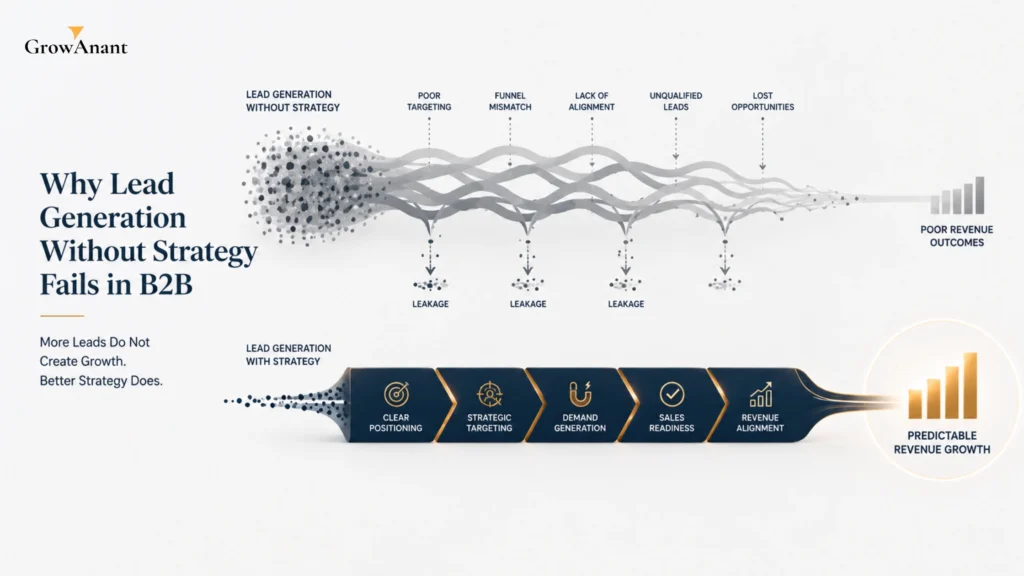
For many B2B companies, lead generation becomes the default growth objective.
Leadership asks for more leads.
Marketing launches campaigns.
Agencies generate contact lists.
Advertising budgets increase.
New software is implemented.
Yet despite increased activity, revenue often remains unchanged.
This is one of the most common growth challenges facing modern B2B organizations.
The problem is rarely lead volume.
The problem is usually strategy.
Businesses frequently invest in B2B lead generation services, lead generation for B2B services, and performance marketing services USA expecting growth to follow automatically. When results fail to materialize, the assumption is often that more leads are needed.
In reality, most B2B organizations do not suffer from a lead shortage.
They suffer from alignment problems.
Without clear positioning, customer targeting, funnel design, qualification criteria, and revenue accountability, lead generation becomes an activity rather than a growth system.
This is why companies increasingly seek support from a growth marketing agency USA, a demand generation agency, or a B2B growth marketing agency capable of connecting acquisition efforts directly to pipeline and revenue outcomes.
The difference between lead generation and business growth is strategy.
Understanding that distinction can prevent months of wasted effort and significant marketing spend.
The “More Leads” Trap
One of the most damaging assumptions in B2B marketing is the belief that growth problems can be solved simply by generating more leads.
At first glance, the logic appears reasonable.
If revenue depends on customers, and customers originate as leads, then increasing lead volume should increase revenue.
Unfortunately, B2B buying journeys are rarely that simple.
Why more leads often create more problems
When organizations focus exclusively on volume, they frequently experience:
- Lower lead quality
- Higher acquisition costs
- Increased sales workload
- Longer sales cycles
- Lower conversion rates
Sales teams become overwhelmed with prospects that do not fit the ideal customer profile.
Marketing reports success because lead numbers increase.
Revenue teams report frustration because pipeline quality declines.
The result is misalignment.
The lead volume illusion
Consider two scenarios:
| Scenario | Leads Generated | Closed Deals |
| Campaign A | 1,000 | 10 |
| Campaign B | 250 | 25 |
Campaign A generates more leads.
Campaign B generates more revenue opportunities.
Yet many organizations reward Campaign A because lead volume appears larger.
This is one reason businesses often engage growth consulting services, business growth consulting, and growth strategy consulting providers.
The objective shifts from generating activity to improving outcomes.
A better question
Instead of asking:
“How do we get more leads?”
Leadership teams should ask:
- Are we targeting the right buyers?
- Are leads sales-ready?
- Are acquisition channels aligned with our GTM strategy?
- Are we generating demand or simply collecting contacts?
The answers often reveal that lead generation is not the primary issue.
The growth system is.
Revenue-first lead generation framework
An effective framework starts with business outcomes.
| Stage | Strategic Question |
| Revenue Goal | What revenue are we targeting? |
| Pipeline Goal | How much pipeline is required? |
| Opportunity Goal | How many qualified opportunities are needed? |
| Lead Goal | How many qualified leads support those opportunities? |
| Channel Selection | Which channels can produce them efficiently? |
Businesses pursuing growth marketing services, revenue growth consulting, or business strategy consulting USA often see stronger results when lead generation is treated as part of a larger growth strategy rather than an isolated activity.
Funnel Mismatch Problems
Another major reason lead generation fails is funnel mismatch.
Many companies generate leads successfully but lose momentum because the acquisition process does not align with buyer behavior.
What is funnel mismatch?
Funnel mismatch occurs when the marketing process does not match the customer’s buying journey.
Examples include:
- Requesting sales calls from early-stage prospects
- Sending product demos before establishing trust
- Using enterprise sales motions for SMB buyers
- Offering gated assets to prospects who need direct consultation
The result is friction.
Leads enter the funnel but fail to progress.
SaaS example
A SaaS company investing in SaaS growth consulting may discover that website traffic is healthy and trial signups are increasing.
However, activation rates remain low.
The problem is not acquisition.
The problem is onboarding.
Marketing succeeds.
The funnel fails.
Professional services example
A consulting firm may generate leads through thought leadership content.
However, prospects are pushed immediately into sales conversations.
Many are still researching solutions and are not ready to engage.
Again, the issue is not lead generation.
The issue is funnel design.
Funnel alignment framework
| Buyer Stage | Required Experience |
| Awareness | Education |
| Consideration | Validation |
| Evaluation | Proof |
| Decision | Confidence |
| Purchase | Clear next steps |
Organizations investing in marketing strategy for service businesses, digital marketing consulting services, or growth roadmap consulting frequently discover that improving funnel alignment increases conversion rates without increasing lead volume.
Common funnel mismatch indicators
Leadership teams should evaluate whether:
✓ Lead quality appears inconsistent
✓ Sales cycles are extending
✓ Marketing and sales disagree on lead quality
✓ Conversion rates decline between funnel stages
✓ Pipeline growth lags behind lead growth
These signals often indicate structural funnel issues rather than lead generation deficiencies.
Sales-Ready vs Marketing Leads
One of the largest sources of friction in B2B organizations is confusion around lead quality.
Marketing generates leads.
Sales rejects them.
Leadership becomes frustrated.
The issue usually comes down to qualification.
Not all leads are equal
A lead who downloads an industry report is not equivalent to a prospect actively evaluating vendors.
Both may enter the CRM.
Only one may be ready for a sales conversation.
This distinction is critical.
Businesses investing in B2B lead generation services often focus on acquisition volume without defining what constitutes a sales-ready lead.
Marketing leads vs sales-ready leads
| Factor | Marketing Lead | Sales-Ready Lead |
| Awareness Level | Early Stage | Late Stage |
| Buying Intent | Low to Moderate | High |
| Sales Readiness | Limited | Strong |
| Conversion Probability | Lower | Higher |
| Revenue Impact | Indirect | Direct |
The difference influences everything from sales productivity to revenue forecasting.
The qualification challenge
Strong qualification frameworks often include:
- Industry fit
- Company size
- Budget availability
- Business urgency
- Decision-making authority
- Problem severity
Organizations working with a B2B growth marketing agency or growth marketing agency USA frequently improve performance by clarifying qualification standards before increasing lead volume.
Demand generation vs lead generation
This distinction is particularly important.
Lead generation creates contacts.
Demand generation creates buying intent.
Demand generation activities often include:
- Educational content
- Industry thought leadership
- Problem-awareness campaigns
- Market education initiatives
This explains why many organizations invest in a demand generation agency rather than focusing exclusively on lead acquisition.
Demand generation creates better leads because prospects arrive with stronger understanding and higher intent.
Lead quality improvement checklist
Before increasing lead generation budgets, leadership teams should confirm:
✓ Ideal customer profile is defined
✓ Qualification criteria are documented
✓ Sales and marketing agree on lead definitions
✓ Funnel stages are aligned
✓ Revenue attribution exists
✓ Pipeline quality is measured
✓ Demand generation supports acquisition efforts
Many growth-stage companies eventually realize that lead generation alone does not create sustainable growth.
Growth occurs when lead generation, demand creation, qualification, sales execution, and revenue planning operate as a unified system.
This is why growth partners such as GrowAnant focus on connecting strategy, demand generation, and revenue execution rather than treating lead generation as a standalone objective.
Businesses are not seeking more leads.
They are seeking predictable revenue.
The difference is strategic alignment.
References
Source: Gartner
Source: HubSpot
FAQs
Leads often fail to convert because of poor qualification, weak positioning, funnel misalignment, unclear messaging, or lack of buying intent. In many cases, the issue is not lead volume but the quality and readiness of those leads.
Lead quality improves when businesses clearly define their ideal customer profile, align sales and marketing around qualification criteria, strengthen demand generation efforts, improve funnel design, and focus acquisition efforts on buyers most likely to convert into revenue opportunities.