
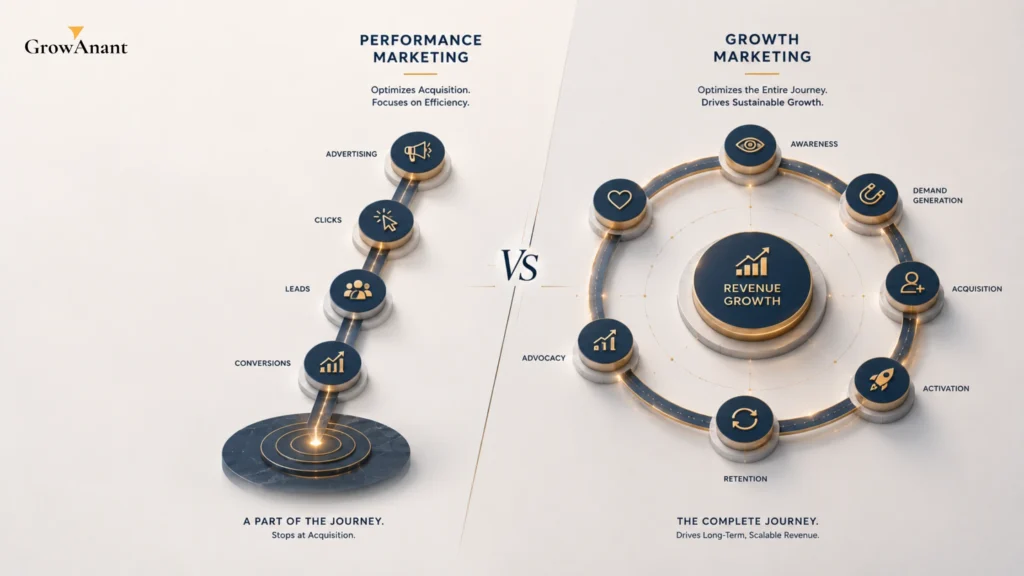
Many founders, CEOs, and marketing leaders use the terms performance marketing and growth marketing interchangeably.
At first glance, the confusion is understandable.
Both focus on customer acquisition.
Both use data.
Both measure results.
Both often involve paid media, analytics, conversion optimization, and demand generation activities.
However, the objectives behind each approach are fundamentally different.
This distinction becomes increasingly important as businesses grow. Companies that rely exclusively on performance marketing services USA often generate leads and short-term wins but struggle with predictable revenue, customer retention, and scalable growth systems.
On the other hand, businesses investing in growth marketing services, growth strategy consulting, and broader growth initiatives tend to focus on the entire customer journey rather than isolated campaign performance.
Understanding where performance marketing ends and growth marketing begins helps leadership teams make better decisions about customer acquisition, budget allocation, demand generation, and revenue growth.
This article explains how each approach works, where performance marketing delivers value, where it falls short, and how growth marketing expands beyond channel optimization to create long-term business outcomes.
What Performance Marketing Optimizes
Performance marketing is designed to generate measurable results from specific marketing activities.
The focus is typically on efficiency.
Performance marketers want to know:
- How many leads were generated?
- What did those leads cost?
- Which campaign performed best?
- Which channel produced the highest return?
The model is highly data-driven and often associated with paid acquisition channels.
Examples include:
- Google Ads
- LinkedIn Ads
- Meta Ads
- Programmatic advertising
- Paid search
- Paid social campaigns
Performance marketing works particularly well when businesses need rapid feedback and measurable outcomes.
CPA
CPA, or Cost Per Acquisition, is one of the most common performance marketing metrics.
It measures how much it costs to generate a customer, lead, or conversion.
Formula:
CPA = Total Spend ÷ Total Acquisitions
For example:
A SaaS company spends $10,000 on paid search and generates 50 qualified leads.
CPA = $200 per lead.
Performance marketing teams constantly optimize:
- Targeting
- Creative assets
- Landing pages
- Offers
- Bid strategies
The objective is to reduce acquisition costs while maintaining volume.
This is why many organizations engage performance marketing services USA providers to improve channel efficiency.
ROAS
ROAS (Return on Ad Spend) is another core performance metric.
Formula:
ROAS = Revenue Generated ÷ Advertising Spend
For example:
$20,000 spent on advertising generates $100,000 in revenue.
ROAS = 5:1
This metric helps marketers understand whether campaigns produce sufficient financial returns.
For eCommerce and transactional businesses, ROAS can be highly effective.
However, B2B organizations often face a challenge.
Long sales cycles make attribution more complicated.
This is where performance marketing begins to encounter limitations.
Short-term wins
One of the biggest strengths of performance marketing is speed.
Businesses can:
- Launch campaigns quickly
- Test offers rapidly
- Generate immediate traffic
- Identify early acquisition opportunities
This makes performance marketing useful for:
- New campaigns
- Product launches
- Market testing
- Demand capture
A startup entering a new market through a market entry strategy USA initiative may use performance marketing to validate messaging and identify audience segments.
Similarly, organizations investing in B2B lead generation services often rely on paid acquisition to accelerate pipeline creation.
However, speed alone does not guarantee sustainable growth.
The real question becomes:
What happens after the click?
Where Performance Marketing Breaks
Performance marketing excels at acquisition optimization.
The challenge is that business growth requires more than acquisition.
Many companies discover that despite increasing spend and improving campaign metrics, revenue growth eventually slows.
The reason is simple.
Performance marketing optimizes channels.
Businesses need systems.
No retention logic
Most performance marketing frameworks focus on acquiring customers.
They rarely address what happens after conversion.
Questions such as:
- How are customers retained?
- How is expansion revenue generated?
- How is customer lifetime value improved?
- How is churn reduced?
Often sit outside the scope of traditional performance marketing.
This creates a significant problem for SaaS companies.
A SaaS business can generate thousands of trial signups through paid acquisition.
If onboarding fails or retention declines, revenue growth remains limited.
This is why SaaS growth consulting frequently extends beyond acquisition channels and focuses on lifecycle performance.
No pipeline ownership
Another limitation is pipeline accountability.
Performance marketing teams typically own:
- Campaign performance
- Click-through rates
- Conversion rates
- Acquisition costs
But revenue depends on far more than marketing.
Revenue outcomes involve:
- Sales effectiveness
- Lead qualification
- Customer experience
- Positioning
- Product-market fit
- Retention
A common founder frustration looks like this:
Marketing reports success.
Sales reports poor lead quality.
Revenue remains flat.
The disconnect occurs because nobody owns the entire growth system.
This challenge is common among businesses investing in:
- digital marketing consulting services
- lead generation for B2B services
- growth marketing agency USA engagements
Without system-level accountability, optimization remains fragmented.
Performance Marketing vs Growth Marketing
| Category | Performance Marketing | Growth Marketing |
| Primary Focus | Acquisition Efficiency | Revenue Growth |
| Time Horizon | Short-Term | Long-Term |
| Success Metric | CPA, ROAS | Pipeline, Revenue, Retention |
| Funnel Coverage | Top & Mid Funnel | Entire Customer Lifecycle |
| Ownership | Campaigns | Growth System |
| Optimization Target | Channels | Business Outcomes |
This distinction becomes increasingly important as organizations mature.
The larger the company becomes, the less likely channel optimization alone will drive sustainable growth.
How Growth Marketing Expands Performance
Growth marketing includes performance marketing.
It does not replace it.
Instead, it expands the scope.
Rather than asking:
“How do we improve campaign performance?”
Growth marketing asks:
“How do we improve business growth?”
This shift changes priorities significantly.
Lifecycle thinking
Growth marketing views the customer journey as a connected system.
The lifecycle includes:
- Awareness
- Demand generation
- Acquisition
- Activation
- Retention
- Expansion
- Advocacy
Every stage influences revenue outcomes.
For example:
A B2B SaaS company may improve acquisition performance by 20%.
However, improving retention by 10% could create even greater long-term value.
Growth marketing evaluates both opportunities.
This lifecycle perspective is why organizations often engage a B2B growth marketing agency, growth consulting services, or business growth consulting partner when growth plateaus despite active marketing efforts.
Revenue metrics
Performance marketing often focuses on marketing metrics.
Growth marketing focuses on business metrics.
Examples include:
- Pipeline contribution
- Revenue growth
- Customer lifetime value
- Customer acquisition cost
- Payback period
- Expansion revenue
- Retention rates
A useful framework for growth-focused organizations is:
| Revenue Metric | Why It Matters |
| Pipeline Velocity | Measures sales efficiency |
| CAC | Evaluates acquisition economics |
| LTV | Measures long-term value |
| Win Rate | Assesses sales effectiveness |
| Retention Rate | Supports sustainable growth |
| Revenue Growth | Ultimate business outcome |
This approach aligns marketing activities with executive priorities.
Founders rarely ask:
“What was our click-through rate last quarter?”
They ask:
“Can we create predictable growth?”
Growth marketing attempts to answer that question.
This is why businesses increasingly seek growth consulting services USA, business growth agency USA, go to market strategy consulting, and B2B marketing strategy consulting support.
The objective is not simply generating more traffic.
The objective is creating systems that connect demand generation, customer acquisition, sales execution, retention, and revenue growth.
Many growth-stage businesses discover that isolated campaigns eventually reach a ceiling. Growth partners such as GrowAnant focus on building integrated growth systems that connect marketing activity directly to pipeline visibility, revenue accountability, and long-term scalability.
Organizations with strong growth systems do not abandon performance marketing.
They place it inside a broader framework where every acquisition activity contributes to sustainable business outcomes.
FAQs
Yes. Performance marketing is often one component of a broader growth marketing strategy. Growth marketing includes acquisition channels such as paid advertising but also incorporates retention, lifecycle optimization, demand generation, customer expansion, and revenue performance.
For most B2B companies, growth marketing is generally more effective because B2B buying journeys are longer, involve multiple stakeholders, and depend heavily on trust, positioning, and pipeline quality. Performance marketing remains valuable for acquisition but works best when integrated into a broader growth strategy.
References
Source: Gartner
https://www.gartner.com
Source: HubSpot
https://www.hubspot.com