
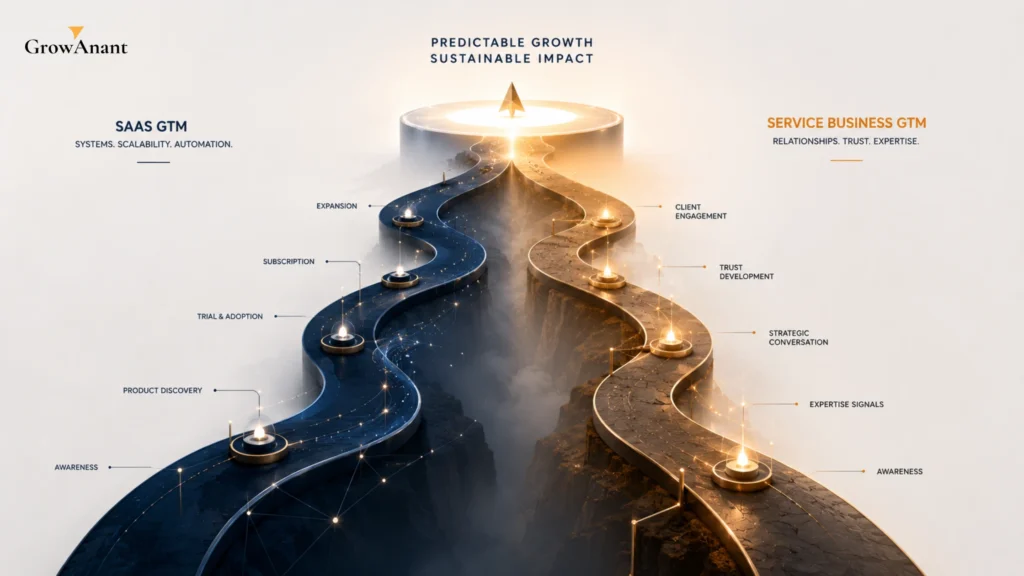
Many founders assume that go-to-market strategy follows a universal framework.
Identify the target audience, launch campaigns, generate leads, and convert customers.
In reality, successful go-to-market execution depends heavily on business model.
A B2B SaaS company selling subscriptions faces very different growth challenges than a professional services firm selling expertise and outcomes. The buying process, sales motion, funnel structure, customer expectations, and revenue model all influence how growth should be approached.
This is why SaaS growth consulting, B2B marketing strategy consulting, and go to market strategy consulting often begin with a fundamental question:
What type of business are we trying to grow?
A GTM strategy that works for a software platform may perform poorly for a consulting firm. Likewise, strategies designed for professional services often fail when applied directly to SaaS businesses.
Understanding these differences helps founders, CEOs, growth leaders, and revenue teams allocate resources more effectively, improve customer acquisition efficiency, and create more predictable revenue growth.
Sales Cycles: SaaS vs Services
One of the most important distinctions between SaaS and service businesses is the sales cycle.
The way buyers evaluate, purchase, and adopt solutions directly influences GTM strategy.
Self-serve vs sales-led
Many SaaS companies can support self-serve acquisition models.
Prospects may:
- Discover the product online
- Start a free trial
- Test functionality
- Upgrade independently
The sales process may involve little or no direct interaction.
However, as deal sizes increase, SaaS businesses often transition toward sales-assisted or sales-led models.
For example:
| SaaS Model | Typical GTM Motion |
| Low-cost SaaS | Self-serve |
| Mid-market SaaS | Product-led + Sales |
| Enterprise SaaS | Sales-led |
This distinction is a core focus of SaaS growth consulting because customer acquisition economics change significantly as complexity increases.
Service businesses typically operate differently.
Professional services, consulting firms, agencies, legal firms, accounting practices, and specialized advisors rarely sell through self-serve models.
Instead, buyers usually require:
- Discovery conversations
- Expertise validation
- Trust-building
- Proposal reviews
- Stakeholder approvals
The sale often depends on confidence in the provider rather than product functionality.
This difference affects every aspect of B2B marketing strategy consulting.
Deal velocity differences
Deal velocity refers to how quickly opportunities move through the sales process.
SaaS companies often benefit from:
- Standardized offerings
- Automated onboarding
- Predictable pricing
- Repeatable implementation
These characteristics can accelerate decision-making.
Service businesses frequently face longer buying cycles because prospects evaluate:
- Experience
- Methodology
- Industry expertise
- Team quality
- Risk reduction
A practical comparison:
| Factor | SaaS Business | Service Business |
| Purchase Complexity | Medium to High | High |
| Trust Requirement | Product Trust | Provider Trust |
| Sales Involvement | Moderate | High |
| Proposal Requirements | Limited | Frequent |
| Customization Expectations | Lower | Higher |
This distinction becomes especially important for companies entering new markets through a market entry strategy USA initiative.
Founders often underestimate how much trust influences service-based buying decisions.
Revenue implications
Sales cycle differences influence:
- Cash flow planning
- Forecasting accuracy
- Customer acquisition cost
- Pipeline management
Businesses pursuing revenue growth consulting often discover that improving deal velocity creates meaningful growth opportunities without increasing lead volume.
The objective is not simply generating more opportunities.
It is improving the efficiency of converting opportunities into revenue.
Funnel Design Differences
A GTM strategy is ultimately operationalized through a funnel.
However, SaaS and service businesses require very different funnel architectures.
Free trials vs consultations
For SaaS companies, the product often serves as the primary sales tool.
Common funnel stages include:
- Awareness
- Website visit
- Free trial
- Product activation
- Subscription conversion
- Expansion revenue
The objective is to allow prospects to experience value quickly.
This explains why many SaaS organizations prioritize:
- Product-led growth
- Self-service onboarding
- User activation metrics
A consulting firm or professional services company cannot typically follow the same model.
Instead, the funnel may look like:
- Awareness
- Educational content
- Discovery call
- Qualification
- Proposal
- Engagement
The sale depends heavily on trust and expertise.
As a result, business strategy consulting USA and growth strategy consulting engagements often emphasize authority building rather than product demonstrations.
Lead qualification models
Lead qualification also differs significantly.
SaaS businesses frequently qualify based on:
- Company size
- Usage patterns
- Product engagement
- Team adoption
- Technology fit
Service businesses typically qualify based on:
- Budget
- Urgency
- Strategic need
- Organizational readiness
- Decision-making authority
A useful framework:
| Qualification Factor | SaaS | Services |
| Product Usage | High Importance | Low Importance |
| Budget | Important | Critical |
| Business Need | Important | Critical |
| Team Size | Often Relevant | Sometimes Relevant |
| Buying Urgency | Moderate | High |
For businesses investing in growth consulting services, understanding qualification criteria can significantly improve lead quality and sales efficiency.
Funnel optimization priorities
SaaS businesses often focus on:
- Trial conversion
- Product adoption
- Customer retention
- Expansion revenue
Service businesses frequently prioritize:
- Consultation conversion
- Proposal acceptance
- Sales cycle reduction
- Client retention
This is why growth roadmap consulting should always align with business model rather than relying on generic funnel frameworks.
Many organizations mistakenly adopt tactics from unrelated industries and then struggle when results fail to materialize.
Channel Prioritization by Business Type
Choosing channels is one of the most misunderstood aspects of GTM strategy.
Many businesses ask:
“Which channel works best?”
The better question is:
“Which channel aligns with our business model, buyer behavior, and revenue objectives?”
SEO, outbound, partnerships (comparison table)
Different channels perform differently depending on the nature of the business.
| Channel | SaaS Companies | Service Businesses |
| SEO | High Priority | High Priority |
| Outbound | Medium to High | High Priority |
| Partnerships | Medium | High |
| Paid Search | High | Medium |
| Referral Programs | Medium | High |
| Thought Leadership | Medium | High |
| Product-Led Growth | High | Low |
SEO as a long-term asset
For both SaaS and service businesses, SEO remains valuable.
However, objectives differ.
SaaS companies often target:
- Product-category searches
- Feature comparisons
- Solution-based keywords
Service businesses may focus on:
- Expertise-driven content
- Industry insights
- Problem-solving resources
This is where growth marketing agency USA, growth marketing services, and digital marketing consulting services frequently intersect with broader GTM planning.
SEO should support the overall growth strategy rather than operate independently.
Outbound strategy differences
Outbound remains important, but execution varies.
SaaS companies often use outbound to:
- Accelerate pipeline generation
- Reach specific ICP segments
- Support account-based strategies
Service businesses often rely more heavily on outbound because trust-building frequently begins through direct engagement.
Organizations investing in B2B lead generation services or lead generation for B2B services often achieve better outcomes when outbound messaging aligns with business challenges rather than service descriptions.
Partnerships as a growth lever
Partnerships frequently create strong leverage for service businesses.
Examples include:
- Referral relationships
- Strategic alliances
- Industry associations
- Complementary providers
For SaaS companies, partnerships may involve:
- Technology integrations
- Channel partnerships
- Reseller programs
- Marketplace ecosystems
Businesses pursuing business growth consulting, startup growth strategy consulting, or growth consulting services USA often overlook partnerships despite their potential impact on customer acquisition efficiency.
Channel prioritization framework
Before investing heavily in any channel, leadership teams should evaluate:
✓ Customer buying behavior
✓ Revenue goals
✓ Sales cycle complexity
✓ Available resources
✓ Internal capabilities
✓ Competitive landscape
✓ Attribution visibility
This approach prevents businesses from selecting channels based solely on trends or competitor activity.
Many growth-stage organizations discover that growth challenges are not caused by channel selection alone. The underlying issue is often a lack of alignment between strategy, demand generation, sales execution, and revenue goals.
Growth partners such as GrowAnant frequently help companies address these foundational challenges before scaling acquisition efforts. The focus remains on building repeatable systems that support predictable growth rather than chasing isolated marketing wins.
FAQs
Yes. SaaS businesses typically require GTM strategies built around product adoption, customer onboarding, retention, and recurring revenue models. Their acquisition channels, funnel design, qualification criteria, and growth metrics often differ significantly from service-based businesses.
Not always, but outbound is often highly effective for service businesses because it supports relationship building, trust development, and direct engagement with decision-makers. The need for outbound depends on market conditions, referral strength, positioning, and growth objectives.
References
Source: Gartner
https://www.gartner.com