
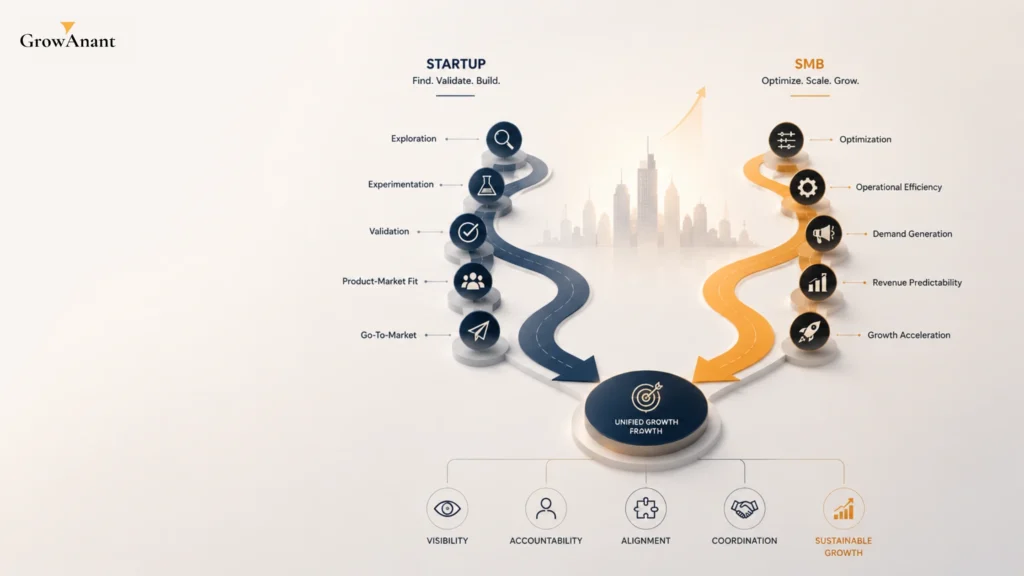
Growth is a universal business objective, but the path to achieving it looks very different depending on the stage and structure of a company.
A venture-backed startup preparing for rapid expansion faces different challenges than an established small business trying to create predictable revenue growth. Both may invest in startup growth strategy consulting, small business growth consulting, or broader growth consulting services, but the underlying growth problems are rarely the same.
This distinction matters because many growth initiatives fail when businesses adopt strategies designed for companies at a completely different stage.
A startup struggling with product-market fit should not operate like a mature SMB focused on operational efficiency. Likewise, an established business with stable revenue should not pursue growth strategies designed primarily for venture-funded expansion.
Effective consulting starts with understanding context.
It starts with identifying growth constraints, resource limitations, customer acquisition challenges, and organizational readiness.
This article explores how growth consulting changes between startups and SMBs, the differences in budget and team dynamics, and how consulting engagement models evolve as businesses mature.
Growth constraints by company stage
The biggest difference between startups and SMBs is not size.
It is the nature of the growth constraint.
Growth consulting is ultimately about removing constraints that prevent revenue expansion. The challenge is that those constraints change significantly as businesses evolve.
Startup growth constraints
Most startups face uncertainty.
Common challenges include:
- Product-market fit validation
- Positioning refinement
- Customer acquisition experimentation
- Go-to-market development
- Market category definition
- Revenue model validation
In these situations, startup growth strategy consulting often focuses on learning.
The goal is to answer questions such as:
- Who is the ideal customer?
- What problem matters most?
- Which channels generate traction?
- What messaging resonates?
For example, a B2B SaaS startup entering the U.S. market may need:
- go to market strategy consulting
- Positioning development
- Customer discovery
- Demand generation planning
The challenge is not scaling.
The challenge is finding repeatability.
SMB growth constraints
SMBs usually face a different set of problems.
Instead of uncertainty, they often face complexity.
Typical challenges include:
- Revenue plateaus
- Inconsistent lead generation
- Rising acquisition costs
- Marketing inefficiency
- Operational bottlenecks
- Weak demand generation systems
In these cases, small business growth consulting often focuses on optimization and scalability.
The business already knows:
- Who its customers are
- What services it provides
- Which channels generate revenue
The challenge becomes improving efficiency and predictability.
For example, a professional services firm generating $3M annually may depend heavily on referrals.
The business is proven.
The issue is building a repeatable growth engine that supports long-term expansion.
Startup vs SMB Growth Constraints Comparison
| Area | Startup | SMB |
| Primary Challenge | Uncertainty | Scalability |
| Revenue Predictability | Low | Moderate |
| Growth Focus | Discovery | Optimization |
| Marketing Objective | Validation | Efficiency |
| Customer Acquisition | Experimentation | Consistency |
| Leadership Need | Strategic direction | Growth system improvement |
This distinction is important because business growth consulting should always align with the company’s actual stage rather than applying generic frameworks.
The founder perspective
Many founders assume their challenge is marketing.
In reality, the challenge is often strategic.
A startup founder may believe more advertising will solve growth problems when positioning remains unclear.
An SMB owner may believe more leads are required when conversion inefficiencies are the true bottleneck.
Effective growth strategy consulting identifies these constraints before recommending solutions.
Budget, team, and timeline differences
Growth decisions are heavily influenced by available resources.
Budget, team structure, and growth expectations shape what is realistically achievable.
Budget differences
Startups and SMBs typically approach budgets differently.
Startups often allocate resources toward:
- Customer acquisition experiments
- Market validation
- Product adoption
- Growth testing
SMBs usually focus on:
- Revenue efficiency
- Demand generation consistency
- Operational scalability
- Margin improvement
This changes how consulting recommendations are prioritized.
For example:
A startup may benefit from:
- Lean testing frameworks
- Customer discovery programs
- Rapid experimentation
An SMB may benefit from:
- Funnel optimization
- Attribution systems
- Pipeline forecasting
- Revenue operations improvements
Organizations investing in revenue growth consulting often see stronger results when recommendations align with available resources rather than idealized growth models.
Team structure differences
Startups typically operate with smaller teams.
One person may manage:
- Marketing
- Sales
- Partnerships
- Customer success
As a result, growth systems need simplicity.
By contrast, SMBs often have:
- Marketing managers
- Sales teams
- Operations staff
- Department leaders
The challenge becomes coordination rather than execution capacity.
This is why many SMBs seek growth consulting services USA support focused on alignment and accountability.
Timeline expectations
Timeline expectations vary significantly.
Startups often pursue aggressive growth goals because:
- Investors expect progress
- Funding milestones matter
- Market opportunities may be time-sensitive
SMBs generally prioritize:
- Sustainable growth
- Profitability
- Resource efficiency
A useful decision framework is:
| Business Stage | Growth Horizon |
| Early Startup | 3–12 months |
| Growth Startup | 6–18 months |
| SMB | 12–36 months |
The appropriate consulting strategy should reflect these realities.
Strategic planning checklist
Before selecting a growth approach, leadership teams should evaluate:
✓ Revenue goals clearly defined
✓ Customer acquisition challenges identified
✓ Team capabilities assessed
✓ Market opportunity understood
✓ Growth constraints documented
✓ Success metrics established
This process improves alignment and helps ensure consulting initiatives support business objectives.
Consulting engagement models by stage
Not every business needs the same consulting structure.
The most effective engagement model depends on organizational maturity, internal capabilities, and growth priorities.
Startup consulting models
Startups often benefit from project-based or advisory engagements.
Common examples include:
- startup consulting services USA
- market entry strategy USA
- go to market strategy consulting
- Positioning workshops
- Customer acquisition strategy development
The objective is typically to create clarity.
Leadership needs guidance on:
- Market opportunities
- Growth priorities
- Customer acquisition
- Product positioning
For SaaS businesses, SaaS growth consulting often focuses on creating repeatable acquisition systems before scaling investments.
SMB consulting models
SMBs frequently require more operational involvement.
Consulting engagements may include:
- Demand generation systems
- Revenue operations support
- Growth roadmap implementation
- Funnel optimization
- Sales and marketing alignment
The goal is often to improve execution rather than validate direction.
Organizations investing in growth consulting services, B2B marketing strategy consulting, or business strategy consulting USA support commonly focus on scalability and operational efficiency.
Fractional leadership model
An increasingly popular option is fractional growth leadership.
This model works particularly well for businesses that:
- Have execution teams
- Lack strategic growth ownership
- Need senior-level guidance
- Cannot justify a full-time executive hire
Fractional leaders often help coordinate:
- growth marketing services
- Demand generation systems
- Revenue operations
- Strategic planning
- Team alignment
This approach is especially valuable for businesses facing growth plateaus despite active marketing investments.
Many organizations discover that adding more campaigns does not solve growth problems when leadership, accountability, and strategic clarity remain unresolved.
Growth partners such as GrowAnant often support companies through this model, helping connect strategy, execution, and revenue outcomes into a unified growth system.
Consulting Model Comparison
| Model | Best For | Primary Outcome |
| Advisory | Early-stage startups | Strategic clarity |
| Project-Based | Specific growth challenges | Targeted improvements |
| Fractional Leadership | Growth-stage companies | Ongoing growth ownership |
| Strategic Growth Partnership | Scaling organizations | Long-term growth systems |
Ultimately, the right consulting model depends on the stage of the business, the complexity of growth challenges, and the level of internal expertise available.
Businesses do not need more tactics.
They need the right level of strategic support for their current stage.
FAQs
Many SMBs benefit from growth consultants when growth becomes inconsistent, customer acquisition costs increase, revenue plateaus emerge, or internal teams lack strategic growth leadership. Consulting often helps create clearer priorities, stronger demand generation systems, and more predictable revenue outcomes.
Startups often benefit from consulting support when preparing for market entry, refining positioning, validating go-to-market strategies, building demand generation systems, or scaling customer acquisition. The ideal time is typically before significant growth investments are made, allowing strategy and execution to align early.
References
Source: Harvard Business Review
https://hbr.org
Source: McKinsey & Company
https://www.mckinsey.com