
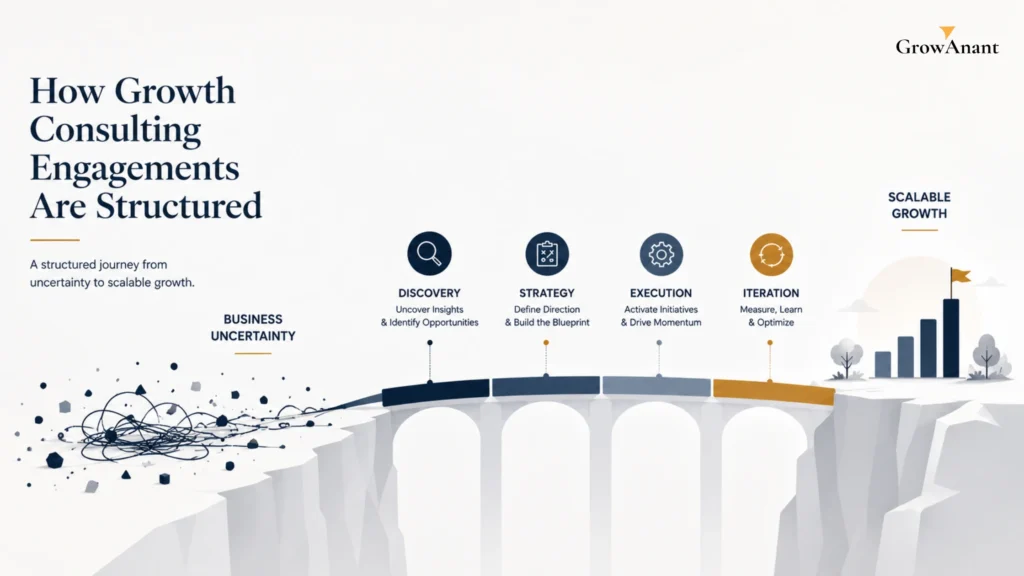
Many founders begin exploring startup consulting services USA after reaching a familiar point in their growth journey.
Revenue becomes less predictable.
Lead generation efforts produce inconsistent results.
Marketing activity increases, but business outcomes remain difficult to forecast.
Internal teams stay busy, yet growth feels slower than expected.
At this stage, the challenge is rarely a lack of effort. More often, the business lacks strategic clarity, alignment, or a repeatable system that connects marketing, sales, operations, and revenue.
This is where structured consulting engagements become valuable.
Unlike project-based vendor relationships, effective growth consulting services follow a defined framework designed to identify growth constraints, prioritize opportunities, and create systems that support sustainable business performance.
Whether a company is evaluating business growth consulting, growth strategy consulting, startup consulting, or a specialized digital growth agency, understanding how engagements are typically structured helps leadership teams set realistic expectations and make better decisions.
While every organization is different, most successful growth consulting engagements follow three core stages:
- Discovery
- Strategy
- Execution and Iteration
Each phase serves a specific purpose and builds on the previous one.
Discovery Phase
The discovery phase is the foundation of any effective consulting engagement.
Many businesses rush past this stage because leadership wants immediate action. However, implementing solutions before understanding the actual problem often leads to wasted time, budget inefficiencies, and poor results.
The objective of discovery is simple:
Understand how the business currently grows.
What consultants evaluate during discovery
A comprehensive discovery process typically reviews:
- Revenue performance
- Lead generation systems
- Customer acquisition costs
- Sales processes
- Market positioning
- Competitive landscape
- Marketing performance
- Team structure
- Operational bottlenecks
For example, a SaaS company pursuing SaaS growth consulting may initially believe paid acquisition is the primary challenge.
After analysis, the real issue may be onboarding friction, low activation rates, or weak customer retention.
Similarly, a professional services firm investing in marketing strategy for service businesses may assume it needs more traffic when the actual problem is poor lead qualification.
Discovery helps separate symptoms from root causes.
Discovery framework
| Area | Questions Answered |
| Revenue | Where is growth slowing? |
| Pipeline | Where do prospects drop off? |
| Positioning | Why do buyers choose competitors? |
| Marketing | Which channels create opportunities? |
| Sales | What blocks conversions? |
| Operations | What limits scalability? |
Common discovery deliverables
A discovery phase often produces:
- Growth assessment
- Funnel analysis
- Competitive review
- Opportunity mapping
- Risk assessment
- Revenue bottleneck analysis
Organizations working with firms such as GrowAnant frequently discover that the largest growth constraints are not tactical problems but strategic alignment issues between marketing, sales, and leadership.
Discovery mistakes businesses make
Common mistakes include:
✓ Jumping directly into advertising
✓ Changing channels before understanding performance
✓ Hiring vendors without defining growth priorities
✓ Scaling lead generation before validating conversion processes
Discovery may feel slower than immediate execution, but it often prevents months of ineffective activity.
Strategy Phase
Once discovery identifies growth constraints, the engagement moves into strategy development.
This phase answers a critical question:
“What should the business do next, and why?”
Strategy is not a list of tactics.
Strategy is a decision-making framework.
It determines where resources should be allocated and which opportunities deserve attention.
Core components of a growth strategy
Effective growth strategy consulting typically includes:
- Market prioritization
- Ideal customer profile refinement
- Positioning strategy
- Revenue planning
- Funnel architecture
- Channel prioritization
- Demand generation planning
- Measurement frameworks
For companies entering new markets, strategy may also involve market entry strategy USA planning and go to market strategy consulting initiatives.
Strategic decision framework
| Decision Area | Strategic Objective |
| Market Focus | Prioritize highest-value segments |
| Positioning | Improve differentiation |
| Channel Mix | Increase efficiency |
| Demand Generation | Create pipeline consistency |
| Revenue Operations | Improve forecasting |
| Measurement | Track growth accurately |
Example: SaaS company
A B2B SaaS company generating 500 monthly leads may assume growth requires additional advertising.
The strategy phase might reveal:
- ICP targeting is too broad
- Messaging lacks differentiation
- Sales qualification criteria are inconsistent
- Customer retention opportunities are underutilized
The resulting roadmap could focus on positioning improvements rather than increasing advertising spend.
Example: Professional services firm
A consulting firm seeking lead generation for B2B services may discover:
- Referral dependency creates revenue volatility
- Content strategy is inconsistent
- Sales follow-up processes vary by team member
The recommended strategy could prioritize demand generation systems before increasing lead acquisition.
Strategic outputs
A strong strategy phase often produces:
✓ Revenue roadmap
✓ Growth priorities
✓ Funnel design
✓ Demand generation plan
✓ Measurement framework
✓ Execution sequence
Many organizations mistakenly believe strategy is a one-time document.
In reality, strategy serves as an operating system that guides future decisions.
This is why businesses increasingly seek revenue growth consulting, business strategy consulting USA, and B2B marketing strategy consulting support before investing heavily in execution.
Execution & Iteration
The execution phase transforms strategic recommendations into operational reality.
This is where plans encounter market conditions, customer behavior, and organizational constraints.
The purpose of execution is not simply implementation.
The purpose is learning.
What execution typically includes
Depending on business needs, execution may involve:
- Funnel optimization
- Content programs
- Demand generation campaigns
- Sales process improvements
- Revenue operations enhancements
- Marketing automation
- Reporting systems
- Conversion optimization
Companies engaging a B2B growth marketing agency, growth marketing agency USA, or demand generation agency often operate within this phase.
However, execution works best when guided by a clear strategy.
Growth execution model
| Phase | Objective |
| Launch | Implement priorities |
| Measure | Track performance |
| Learn | Identify bottlenecks |
| Optimize | Improve efficiency |
| Scale | Increase investment where proven |
Why iteration matters
Growth rarely happens in a straight line.
Market conditions change.
Buyer expectations evolve.
Competitive pressure increases.
Customer behavior shifts.
As a result, consulting engagements must continuously adapt.
The most successful organizations treat growth as a learning process rather than a fixed plan.
Example of iterative improvement
A company investing in growth marketing services launches a content-driven demand generation initiative.
Initial performance reveals:
- Strong traffic growth
- Moderate lead generation
- Low sales conversion
Instead of increasing budget immediately, the team investigates:
- Lead quality
- Funnel alignment
- Messaging relevance
- Sales readiness
The resulting adjustments improve pipeline performance without increasing acquisition costs.
Execution metrics that matter
Many businesses focus on vanity metrics.
Effective consulting engagements focus on business outcomes.
Important measurements include:
- Pipeline value
- Opportunity creation
- Customer acquisition cost
- Sales velocity
- Conversion rates
- Revenue contribution
- Customer retention
This distinction separates meaningful growth from marketing activity.
Consulting engagement lifecycle
The overall engagement typically follows this progression:
| Stage | Primary Goal |
| Discovery | Identify growth constraints |
| Strategy | Prioritize opportunities |
| Execution | Implement initiatives |
| Iteration | Improve performance |
| Scaling | Expand proven systems |
Whether working with small business growth consulting, startup growth strategy consulting, digital marketing consulting services, or broader growth consulting services USA, the most effective engagements focus on building repeatable systems rather than isolated campaigns.
Many growth-stage businesses initially seek tactical support.
Over time, they realize their biggest need is strategic coordination.
Marketing, sales, operations, and revenue planning must work together.
That coordination is often where the greatest growth opportunities exist.
References
Source: Harvard Business Review
FAQs
The duration varies based on business objectives, complexity, and growth stage. Discovery and strategy work may take several weeks, while execution and optimization often continue for several months. Many organizations maintain ongoing advisory relationships as growth priorities evolve.
Consulting onboarding typically includes stakeholder interviews, revenue analysis, marketing and sales audits, funnel reviews, competitive assessments, and goal alignment sessions. The objective is to build a clear understanding of the business before recommendations are developed.