
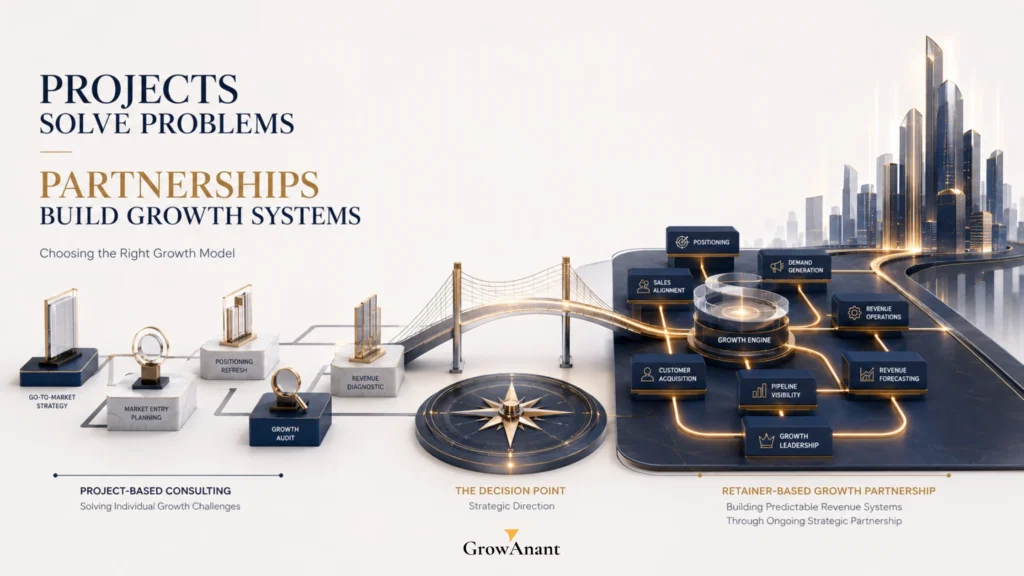
Many businesses exploring growth consulting services face an important decision before any engagement begins:
Should they hire a consultant on a project basis or engage through an ongoing retainer relationship?
The answer depends on growth objectives, organizational maturity, internal capabilities, and the nature of the challenges being addressed.
A company preparing for a market launch may require a focused project engagement to build a go-to-market plan. Another organization struggling with inconsistent pipeline generation, weak demand creation, and revenue unpredictability may benefit from an ongoing strategic partnership.
This distinction is important because the consulting model directly influences outcomes.
The right structure can improve execution, accountability, strategic alignment, and business performance. The wrong structure can create fragmented initiatives, stalled momentum, and disconnected growth efforts.
Organizations evaluating business growth consulting, growth strategy consulting, revenue growth consulting, or a digital growth agency relationship should understand how these engagement models differ before making an investment.
A useful starting point is this:
- Project engagements solve defined problems.
- Retainer engagements build ongoing growth systems.
Understanding that difference helps founders, CEOs, growth leaders, and revenue teams make better decisions.
Pros & Cons Table
Both consulting models create value when aligned with the right business situation.
The challenge is selecting the structure that matches the company’s current growth requirements.
| Factor | Retainer Model | Project-Based Model |
| Engagement Length | Ongoing | Fixed duration |
| Strategic Involvement | High | Moderate |
| Flexibility | High | Limited to project scope |
| Accountability | Continuous | Milestone-based |
| Cost Structure | Recurring | One-time investment |
| Growth System Development | Strong | Limited |
| Execution Support | Ongoing | Often project-specific |
| Revenue Visibility | Higher over time | Varies |
| Suitable for Scaling Companies | Yes | Sometimes |
| Suitable for Defined Initiatives | Sometimes | Yes |
Advantages of Retainer Engagements
Retainers provide continuous strategic support.
Businesses engaging growth consulting services USA, growth roadmap consulting, or growth marketing services often choose retainers because growth rarely occurs through isolated initiatives.
Benefits include:
- Ongoing strategic guidance
- Continuous optimization
- Leadership accountability
- Cross-functional alignment
- Better demand generation coordination
- Improved forecasting visibility
- Faster decision-making
For example, a B2B SaaS company pursuing SaaS growth consulting may require ongoing support across:
- Positioning
- Demand generation
- Pipeline management
- Customer acquisition
- Revenue operations
These challenges evolve continuously, making a retainer model more practical.
Advantages of Project-Based Engagements
Project engagements are ideal when the objective is clearly defined.
Examples include:
- go to market strategy consulting
- Market research initiatives
- Growth audits
- Positioning projects
- Market expansion planning
- market entry strategy USA development
- Revenue assessment initiatives
For example, an international software company entering the United States may hire a consultant to develop a market-entry roadmap.
The project has a clear beginning, deliverables, and completion point.
In these situations, a project-based structure often creates efficiency.
Potential Limitations
Both models have trade-offs.
Retainer challenges may include:
- Higher long-term commitment
- Greater organizational involvement
- Longer implementation horizons
Project engagement challenges may include:
- Limited continuity
- Reduced accountability after completion
- Execution gaps
- Difficulty adapting to changing growth priorities
The decision should be based on business needs rather than budget alone.
When Retainers Win
Retainers typically create stronger outcomes when growth challenges are ongoing rather than isolated.
This is particularly true when businesses face:
- Revenue unpredictability
- Weak demand generation systems
- Inconsistent lead quality
- Marketing inefficiency
- Cross-functional alignment issues
- Scaling complexity
Many organizations assume they need more marketing.
In reality, they often need better growth leadership.
This is why companies investing in growth consulting, growth strategy consulting, B2B marketing strategy consulting, and revenue growth consulting frequently prefer retainer relationships.
Situations Where Retainers Create More Value
| Business Challenge | Why Retainers Work |
| Inconsistent pipeline | Continuous optimization |
| Scaling revenue | Ongoing strategic oversight |
| Multiple growth initiatives | Better prioritization |
| Team misalignment | Continuous coordination |
| Demand generation gaps | Long-term system building |
| Growth leadership shortages | Fractional growth support |
Founder Scenario
Consider a founder-led software company generating $5 million annually.
Marketing generates leads.
Sales pursues opportunities.
Operations manages delivery.
However:
- Pipeline visibility is weak
- Positioning lacks clarity
- CAC is increasing
- Forecasting remains inconsistent
Launching another campaign may not solve these issues.
Instead, ongoing strategic support can help build:
- Demand generation systems
- Revenue operations frameworks
- Funnel visibility
- Growth accountability
This is where retainers often outperform project engagements.
Many growth-stage businesses discover that firms such as GrowAnant create the greatest value when they operate as strategic growth partners rather than short-term project vendors.
Retainer Decision Checklist
A retainer model is often appropriate when:
✓ Growth challenges are ongoing
✓ Revenue predictability matters
✓ Leadership requires strategic guidance
✓ Multiple departments influence growth
✓ Demand generation systems need improvement
✓ Customer acquisition efficiency is declining
✓ Long-term scalability is a priority
The more complex the growth environment becomes, the more valuable ongoing strategic support tends to be.
When Projects Make Sense
Not every organization requires an ongoing engagement.
Many businesses benefit from focused projects designed to solve a specific challenge.
Project-based consulting often works best when:
- The objective is clearly defined
- Internal teams can execute recommendations
- Strategic clarity is needed before implementation
- Leadership seeks expert guidance on a specific initiative
Common Project-Based Engagements
Organizations frequently engage consultants for:
- startup growth strategy consulting
- startup consulting services USA
- Positioning projects
- Market assessments
- Growth audits
- Revenue diagnostics
- business strategy consulting USA
- go to market strategy consulting
- Growth opportunity mapping
Startup Example
A startup preparing to launch a new SaaS platform may need:
- ICP development
- Positioning strategy
- GTM planning
- Pricing recommendations
- Demand generation roadmap
These deliverables can often be completed through a structured project engagement.
Once the framework is established, internal teams may execute independently.
SMB Example
A company pursuing small business growth consulting may need to identify why growth has plateaued.
A project-based engagement might include:
- Funnel analysis
- Marketing audit
- Revenue diagnostics
- Competitive review
- Growth opportunity assessment
The outcome is a strategic roadmap rather than ongoing implementation.
Project Suitability Framework
| Situation | Recommended Model |
| Growth audit | Project |
| Positioning refresh | Project |
| Market-entry planning | Project |
| GTM development | Project |
| Revenue system improvement | Retainer |
| Demand generation optimization | Retainer |
| Ongoing growth leadership | Retainer |
| Scaling customer acquisition | Retainer |
Decision-Making Framework
Leadership teams should evaluate:
- Is the challenge temporary or ongoing?
- Does the business need strategy or leadership?
- Can internal teams execute independently?
- Will priorities change frequently?
- Is long-term accountability required?
The answers typically reveal which engagement model is appropriate.
Businesses working with a growth marketing agency USA, B2B growth marketing agency, demand generation agency, or professional services marketing agency often find that projects solve specific challenges while retainers create continuous momentum.
The most effective model is the one aligned with the company’s stage, objectives, resources, and growth complexity.
References
Source: Harvard Business Review
FAQs
Retainers can provide significant value when growth challenges require ongoing strategic guidance, continuous optimization, demand generation support, revenue visibility, and cross-functional alignment. They are often most effective for businesses seeking scalable systems rather than isolated project outcomes.
Yes. Many organizations begin with a project engagement to assess growth opportunities, evaluate market conditions, refine positioning, or build a strategic roadmap. As growth initiatives become more complex, some businesses later transition into ongoing advisory or retainer-based relationships.