
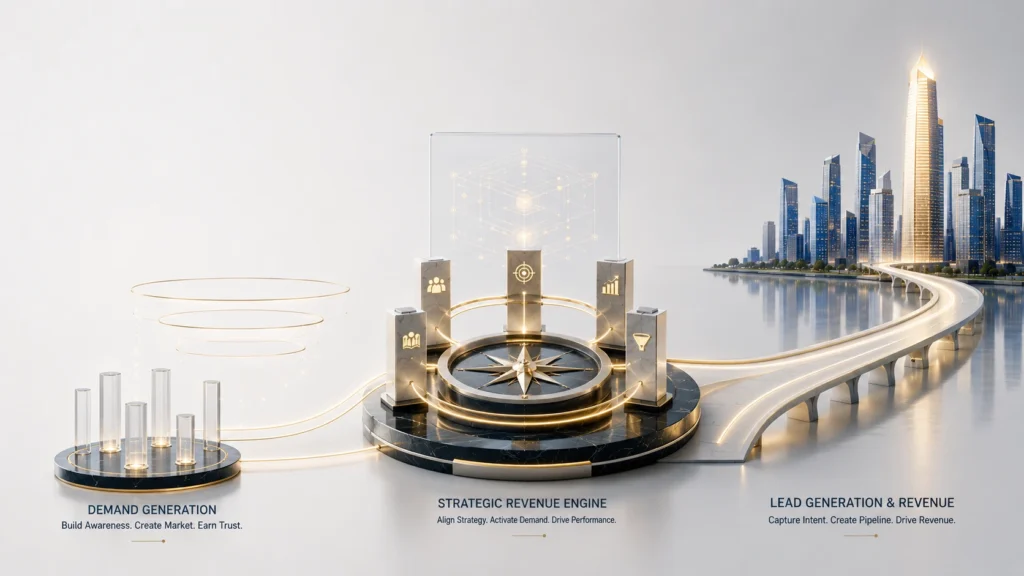
Many B2B companies invest heavily in marketing but still struggle with inconsistent pipeline, low-quality leads, and unpredictable revenue. One of the biggest reasons is confusion between demand generation and lead generation. Although these terms are often used interchangeably, they solve different business problems and serve different stages of the buyer journey.
A Demand Generation Agency focuses on creating awareness, educating buyers, building trust, and generating market demand long before prospects are ready to purchase. B2B lead generation services, on the other hand, concentrate on identifying and converting interested prospects into qualified sales opportunities. Businesses that understand how demand generation, lead generation, growth marketing services, and B2B marketing work together typically build stronger pipelines than those relying on isolated campaigns.
For founders, CEOs, and revenue leaders, the objective is not simply acquiring more leads. The goal is building a predictable revenue engine supported by effective growth marketing, strategic positioning, qualified opportunities, and measurable business outcomes.
Why demand generation and lead generation are often confused
Many organizations measure marketing success by the number of leads generated each month. While lead volume is easy to report, it rarely tells the complete story about business growth.
Without consistent market awareness and buyer education, even the best B2B lead generation services produce diminishing returns. Prospects may download a resource or request a demo without understanding the business problem the solution addresses, resulting in lower conversion rates and higher acquisition costs.
A Demand Generation Agency works earlier in the customer journey by helping organizations create demand before prospects actively begin evaluating vendors. This includes building authority, educating target audiences, strengthening brand credibility, and improving buyer confidence.
Lead generation begins after demand already exists.
Think of it this way:
| Business Objective | Demand Generation | Lead Generation |
| Build market awareness | ✓ | |
| Educate potential buyers | ✓ | |
| Create buying intent | ✓ | |
| Capture contact information | ✓ | |
| Qualify opportunities | ✓ | |
| Support sales conversations | ✓ | ✓ |
| Generate predictable pipeline | ✓ | ✓ |
For example, consider a U.S.-based B2B SaaS company launching a cybersecurity platform. Running paid campaigns immediately may generate form submissions, but if buyers are unfamiliar with the company’s expertise or differentiators, conversion rates often remain low.
Instead, the company first invests in educational content, webinars, industry reports, LinkedIn thought leadership, and targeted growth marketing services. Once demand develops, lead generation for B2B services becomes significantly more efficient because prospects already recognize the brand and understand the value proposition.
This illustrates why successful B2B growth marketing agency strategies rarely separate awareness from lead capture.
Executive Framework: Demand Before Capture
Before investing heavily in acquisition campaigns, leadership teams should evaluate whether the market is ready to buy.
Checklist
- Is the target audience aware of the business problem?
- Does the company have clear market positioning?
- Are buyers actively engaging with educational content?
- Does marketing establish trust before requesting contact information?
- Are sales conversations starting with educated prospects rather than cold introductions?
If the answer to most of these questions is “no,” increasing advertising budgets alone is unlikely to produce sustainable results.
What is demand generation?
Demand generation is the strategic process of creating awareness, educating potential customers, building trust, and increasing purchase intent before prospects enter the buying stage.
Unlike traditional lead generation, demand generation focuses on influencing the entire buying journey rather than simply collecting contact information.
An effective Demand Generation Agency aligns marketing with long-term revenue growth by combining positioning, content strategy, audience education, thought leadership, account-based marketing, and customer insights into a unified growth system.
Core Objectives of Demand Generation
Successful demand generation programs aim to:
- Increase awareness among ideal customers.
- Establish industry authority.
- Educate buyers about business challenges.
- Create trust before sales engagement.
- Improve conversion rates across the funnel.
- Support sustainable revenue growth.
- Strengthen alignment between marketing and sales.
Typical Demand Generation Activities
Organizations investing in growth marketing services commonly use:
- Executive thought leadership
- SEO-driven educational content
- Webinars and virtual events
- Industry reports and original research
- Email nurturing programs
- LinkedIn content distribution
- Podcast appearances
- Strategic partnerships
- Community building
- Targeted B2B marketing campaigns
These initiatives generate demand by helping prospects understand their problems before presenting a solution.
Business Example
Imagine a professional services firm expanding into the U.S. market.
Instead of immediately purchasing advertising, the firm publishes executive guides, shares client success frameworks, hosts webinars on industry challenges, and develops SEO-focused resources around buyer pain points.
As visibility and credibility increase, inbound inquiries become more qualified because buyers already understand the firm’s expertise.
This is where companies often work with strategic partners such as GrowAnant. Rather than focusing solely on campaigns, a growth partner integrates growth consulting services, business growth consulting, growth strategy consulting, go to market strategy consulting, digital marketing consulting services, and B2B marketing strategy consulting into a revenue-focused demand generation framework.
Demand Generation Framework
| Stage | Primary Objective | Typical Activities |
| Awareness | Reach ideal buyers | SEO, content marketing, social thought leadership |
| Education | Build understanding | Guides, webinars, case studies, newsletters |
| Consideration | Increase buying confidence | Product comparisons, ROI resources, customer stories |
| Intent | Prepare prospects for sales | Demo content, nurturing campaigns, buying guides |
Unlike isolated marketing campaigns, demand generation builds long-term momentum. It strengthens every future lead generation initiative because prospects enter the funnel with greater awareness, trust, and purchase intent.
Ultimately, organizations seeking predictable pipeline growth benefit from treating demand generation as an ongoing business strategy rather than a one-time marketing campaign.
What is lead generation?
While demand generation creates market awareness and buyer intent, lead generation focuses on converting interested prospects into identifiable opportunities for the sales team.
Lead generation is the process of attracting, capturing, qualifying, and nurturing prospects who have demonstrated interest in a product or service. Successful B2B lead generation services emphasize quality over quantity by identifying buyers who closely match the company’s Ideal Customer Profile (ICP).
For many B2B organizations, lead generation begins only after demand has already been established. Prospects may download an eBook, register for a webinar, request a demo, complete a contact form, or engage with a sales representative. These actions signal buying intent and allow marketing and sales teams to begin qualification.
Unlike awareness-focused initiatives, lead generation for B2B services is designed to move prospects further down the funnel toward revenue.
Common Lead Generation Channels
An effective lead generation strategy often combines multiple channels, including:
- SEO landing pages
- Google Search campaigns
- LinkedIn Ads
- Email outreach
- Referral programs
- Webinars with registration
- Account-Based Marketing (ABM)
- Content downloads
- Product demonstrations
- Contact forms and consultation requests
Many organizations also combine performance marketing services USA, CRM automation, and sales enablement tools to improve lead qualification and pipeline efficiency.
Lead Qualification Framework
Not every lead deserves immediate attention. Growth-focused organizations qualify opportunities before passing them to sales.
| Qualification Area | Questions to Ask |
| Fit | Does the company match the Ideal Customer Profile? |
| Need | Is there a clear business challenge to solve? |
| Authority | Is the decision-maker involved? |
| Budget | Is investment realistically available? |
| Timeline | Is there an active buying timeframe? |
This structured approach reduces wasted sales effort and improves close rates by focusing on high-quality opportunities instead of maximizing lead volume.
Business Example
Consider a B2B SaaS company offering HR software.
Its demand generation program educates HR leaders through blogs, webinars, benchmark reports, and LinkedIn thought leadership. After engaging with this content, interested prospects request a product demonstration.
At this point, B2B lead generation services capture prospect information, qualify the opportunity, and route it to the sales team for follow-up.
Without the earlier demand-building activities, many of these prospects might never have entered the buying journey.
Key differences between the two
Although demand generation and lead generation support the same revenue objective, they perform different roles within the customer acquisition process.
Demand Generation vs Lead Generation Comparison
| Category | Demand Generation | Lead Generation |
| Primary Objective | Build awareness and buying intent | Capture and qualify prospects |
| Funnel Stage | Top and middle of funnel | Middle and bottom of funnel |
| Success Metrics | Brand awareness, engagement, content consumption, pipeline influence | Qualified leads, conversion rate, opportunities, pipeline |
| Time Horizon | Long-term growth | Short to medium-term revenue |
| Primary Activities | Content marketing, thought leadership, SEO, webinars | Paid search, landing pages, forms, outreach, demos |
| Sales Involvement | Limited during awareness stage | High after qualification |
| Business Outcome | Market demand | Sales-ready opportunities |
Decision Framework
Use demand generation when your business needs to:
- Increase market awareness.
- Improve brand credibility.
- Educate buyers.
- Enter a new market.
- Shorten future sales cycles.
- Build a predictable pipeline.
Use lead generation when your business needs to:
- Capture buying intent.
- Increase qualified opportunities.
- Support sales teams.
- Fill near-term pipeline gaps.
- Improve opportunity creation.
The strongest B2B organizations integrate both rather than treating them as competing strategies.
When B2B companies need demand generation
Many businesses attempt to solve every growth problem with more advertising or additional outbound prospecting. However, there are situations where increasing lead volume actually masks deeper strategic issues.
A Demand Generation Agency becomes particularly valuable when organizations experience:
- High traffic but low conversion rates.
- Expensive customer acquisition costs.
- Limited brand recognition.
- Weak inbound pipeline.
- Long enterprise sales cycles.
- Difficulty entering new industries or geographic markets.
- Low trust among prospective buyers.
- Poor alignment between marketing and sales.
Decision Checklist
Your company likely needs stronger demand generation if you answer “yes” to several of the following questions:
- Are prospects unfamiliar with your brand?
- Do sales teams spend significant time educating buyers from scratch?
- Are paid campaigns becoming increasingly expensive?
- Is pipeline heavily dependent on outbound outreach?
- Are marketing-qualified leads rarely converting into sales opportunities?
- Is thought leadership largely absent from your growth strategy?
Real-World Scenario
A U.S.-focused IT consulting company generated hundreds of leads each quarter through paid advertising. Despite this, pipeline growth remained inconsistent because prospects viewed the company as interchangeable with competitors.
Rather than increasing advertising spend, leadership invested in growth marketing services, executive content, industry research, customer success stories, and educational webinars. Within months, sales conversations shifted from explaining basic capabilities to discussing business outcomes and implementation strategies.
This demonstrates why companies frequently combine growth consulting services, business growth consulting, growth marketing, digital marketing consulting services, and revenue growth consulting to strengthen long-term market demand before aggressively scaling lead acquisition.
Demand generation does not replace lead generation. Instead, it creates an environment where every future lead generation effort performs more effectively, producing higher-quality opportunities, stronger conversion rates, and a more predictable revenue pipeline.
How both work together
The highest-performing B2B organizations do not choose between demand generation and lead generation. Instead, they integrate both into a single revenue engine where each stage supports the next.
Think of demand generation as creating market readiness and lead generation as converting that readiness into qualified sales opportunities. Without demand, lead generation becomes increasingly expensive. Without lead generation, demand rarely translates into measurable pipeline or revenue.
A modern B2B growth marketing agency builds a connected system rather than isolated campaigns.
Revenue Growth Framework
| Stage | Primary Goal | Typical Activities | Success Metric |
| Awareness | Build market visibility | SEO, thought leadership, webinars, industry reports | Brand awareness, website engagement |
| Education | Build trust | Case studies, newsletters, guides, email nurturing | Content engagement, returning visitors |
| Consideration | Generate buying intent | Product comparisons, ROI calculators, success stories | Marketing Qualified Leads (MQLs) |
| Lead Generation | Capture demand | Landing pages, demos, contact forms, paid search | Sales Qualified Leads (SQLs) |
| Sales | Convert opportunities | Discovery calls, proposals, product demos | Pipeline and revenue |
| Customer Growth | Retain and expand | Customer success, upselling, advocacy | Retention and expansion revenue |
This framework enables marketing and sales to operate toward a shared revenue objective rather than separate departmental goals.
Strategic Implementation Checklist
A scalable B2B revenue engine should include:
- Clearly defined Ideal Customer Profiles (ICPs)
- Strong market positioning
- Educational content aligned to buyer stages
- Consistent growth marketing services
- High-quality B2B lead generation services
- Sales and marketing alignment
- CRM and marketing automation
- Revenue reporting dashboards
- Continuous optimization based on pipeline performance
Many growth-stage businesses engage strategic partners such as GrowAnant to design these systems because sustainable growth requires more than campaign execution. By combining growth consulting services, growth strategy consulting, business growth consulting, and go to market strategy consulting, organizations can connect marketing activities directly to revenue outcomes.
Common mistakes companies make
Even well-funded organizations often struggle with growth because they focus on tactics before strategy. The following mistakes repeatedly reduce marketing efficiency and slow revenue growth.
1. Treating demand generation and lead generation as the same thing
Generating leads without first creating demand often results in low conversion rates, poor engagement, and increasing acquisition costs.
2. Measuring success by lead volume alone
Large numbers of leads do not necessarily create pipeline. Revenue-focused businesses prioritize qualified opportunities, conversion rates, sales velocity, and customer value.
3. Scaling paid advertising too early
Many businesses increase spending before validating positioning or messaging. This frequently amplifies inefficiencies instead of accelerating growth.
4. Poor marketing and sales alignment
When marketing measures leads and sales measures revenue, priorities become disconnected. Shared KPIs improve collaboration and accountability.
5. Ignoring buyer education
B2B buyers complete significant research before contacting vendors. Companies that fail to educate prospects early often lose opportunities to competitors with stronger thought leadership.
6. Focusing on channels instead of systems
SEO, paid media, outbound prospecting, webinars, and email marketing perform best when integrated into a coordinated growth strategy rather than managed independently.
Executive Decision Checklist
Before increasing marketing investment, leadership teams should ask:
- Is our positioning differentiated?
- Do buyers understand our value proposition?
- Are marketing and sales aligned around pipeline?
- Are qualified opportunities increasing?
- Is revenue becoming more predictable?
- Are we building long-term market demand alongside lead generation?
If several answers are “no,” the priority should be strengthening the overall growth system rather than simply generating more leads.
References
HubSpot
McKinsey & Company
Frequently Asked Questions
Demand generation is a long-term strategy that creates awareness, educates buyers, builds trust, and increases purchase intent before prospects enter the buying process. It supports sustainable pipeline development and revenue growth.
Neither is inherently better. Demand generation creates market demand, while B2B lead generation services convert interested prospects into qualified opportunities. Businesses achieve the strongest results when both strategies work together.
Yes. Startups can use demand generation to establish credibility, educate potential customers, validate market positioning, and build awareness before scaling lead acquisition efforts. This often reduces customer acquisition costs over time.
No. Demand generation and lead generation for B2B services serve different purposes. Demand generation creates interest, while lead generation captures and qualifies that interest for sales. Together they create a predictable, scalable revenue pipeline.