
Many businesses invest heavily in marketing but struggle to connect those activities to predictable revenue.
Traffic increases. Campaigns generate clicks. Leads enter the CRM.
Yet sales teams continue to face pipeline inconsistency, poor lead quality, and unpredictable revenue forecasts.
This challenge is one reason demand generation agency services have become increasingly important for growth-stage businesses.
Demand generation is not simply about creating leads.
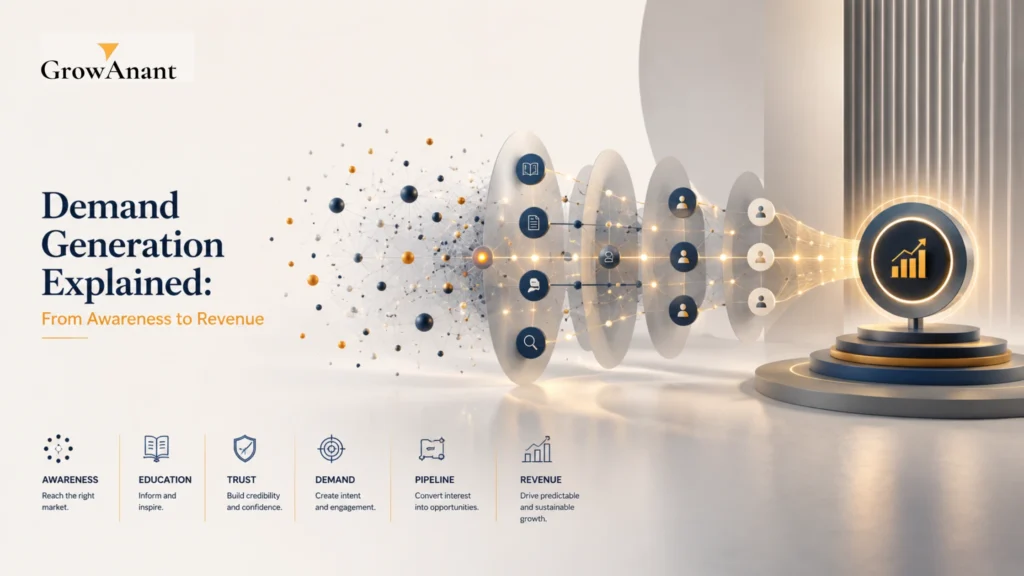
It is about creating awareness, building trust, educating buyers, generating demand, and converting that demand into qualified pipeline and revenue.
For founders, CEOs, and growth leaders, demand generation helps solve a common problem:
How do you create a repeatable system that consistently attracts the right buyers before they are ready to purchase?
The answer lies in understanding how modern buyers make decisions and building systems that support those journeys.
Organizations investing in growth marketing agency USA expertise often discover that sustainable growth comes from creating demand before attempting to capture it.
This article explains what demand generation really means, how it differs from lead generation, the systems that support it, and how it contributes directly to revenue outcomes.
What Demand Generation Really Means
Demand generation is a strategic approach to creating market awareness, buyer interest, and purchasing intent before prospects enter the sales process.
Rather than focusing exclusively on immediate lead capture, demand generation focuses on influencing future buying decisions.
This distinction matters because most B2B buyers are not actively searching for solutions at any given moment.
They may be:
- Researching challenges
- Evaluating priorities
- Exploring alternatives
- Building internal business cases
- Identifying future investments
A successful demand generation strategy helps companies become visible during these early stages.
For businesses investing in growth consulting services, business growth consulting, or growth strategy consulting, demand generation often serves as the foundation for long-term pipeline growth.
Demand vs lead generation (table)
Although the terms are frequently used interchangeably, demand generation and lead generation serve different purposes.
| Demand Generation | Lead Generation |
| Creates awareness | Captures contact information |
| Educates buyers | Converts interest into inquiries |
| Builds trust over time | Focuses on immediate actions |
| Supports long sales cycles | Supports near-term pipeline |
| Influences future demand | Converts existing demand |
A practical example illustrates the difference.
Imagine a B2B SaaS company targeting operations leaders.
Demand generation activities might include:
- Educational content
- Industry research
- Thought leadership
- Webinar programs
Lead generation activities might include:
- Demo requests
- Contact forms
- Free trial signups
- Consultation bookings
Both are important.
However, companies that focus only on lead generation often struggle because they have not created sufficient demand first.
This is why many B2B growth marketing agency engagements begin with demand creation rather than lead capture.
The Demand Generation Framework
A practical demand generation framework includes:
- Awareness
- Education
- Engagement
- Trust Building
- Demand Capture
- Sales Conversion
Each stage contributes to revenue growth.
Skipping early stages often increases customer acquisition costs and reduces conversion efficiency.
Core Demand Gen Components
Strong demand generation systems combine multiple channels and activities into a unified growth engine.
Successful organizations avoid isolated campaigns and instead focus on creating systems that continuously influence buyers.
Content
Content remains one of the most important demand generation assets.
Its purpose is not simply to attract traffic.
Its purpose is to help buyers understand:
- Their challenges
- Potential solutions
- Strategic priorities
- Market opportunities
For example, a professional services firm targeting CFOs may publish:
- Industry reports
- Benchmark studies
- Strategic planning guides
- Financial transformation insights
A SaaS company may create:
- Product education resources
- Operational frameworks
- Implementation guides
- Industry trend analysis
Content performs best when aligned with buyer questions rather than company messaging.
Organizations using growth marketing services often discover that educational content improves both lead quality and sales conversion rates.
Content Evaluation Checklist
✓ Addresses real customer problems
✓ Supports buyer decision-making
✓ Demonstrates expertise
✓ Aligns with business objectives
✓ Connects to pipeline generation
Paid distribution
Even exceptional content often requires distribution.
Paid distribution helps accelerate visibility among target audiences.
Common channels include:
- LinkedIn advertising
- Paid search
- Industry publications
- Sponsored newsletters
- Account-based marketing campaigns
The key mistake many businesses make is scaling paid media before validating positioning and messaging.
A strong performance marketing services USA strategy works best when:
- ICP clarity exists
- Messaging is validated
- Funnel tracking is established
- Sales readiness is confirmed
Paid distribution should amplify proven demand generation assets rather than compensate for weak fundamentals.
Sales enablement
Demand generation does not stop when a lead enters the pipeline.
Sales teams need support throughout the buying process.
Sales enablement includes:
- Case studies
- Competitive comparisons
- Buyer guides
- Industry-specific resources
- ROI frameworks
These assets help sales conversations progress more efficiently.
For example, a company investing in B2B lead generation services may generate strong lead volume but struggle with conversion if sales teams lack supporting materials.
Demand generation bridges this gap.
It aligns marketing activity with sales effectiveness.
Many businesses engaging a digital growth agency discover that sales enablement significantly improves pipeline conversion without increasing lead volume.
How Demand Gen Supports Revenue Teams
Demand generation is often viewed as a marketing function.
In reality, it is a revenue function.
Its purpose is to improve pipeline quality, increase conversion efficiency, and support sustainable growth.
Pipeline velocity
Pipeline velocity measures how quickly opportunities move through the sales process.
Slow-moving pipelines create:
- Revenue forecasting challenges
- Budget uncertainty
- Growth unpredictability
Demand generation improves velocity by ensuring prospects enter the funnel better informed.
When buyers understand:
- The problem
- Available solutions
- Expected outcomes
Sales conversations become more productive.
This often results in:
- Faster qualification
- Shorter evaluation periods
- Improved conversion rates
Businesses pursuing revenue growth consulting, go to market strategy consulting, or SaaS growth consulting frequently focus on demand generation because it improves pipeline efficiency, not just volume.
Pipeline Velocity Drivers
| Driver | Impact |
| Buyer education | Faster decision-making |
| Strong positioning | Reduced confusion |
| Trust signals | Increased confidence |
| Sales enablement | Improved conversion |
| Consistent messaging | Better buyer alignment |
Deal quality
Not all opportunities contribute equally to growth.
High lead volume can still produce disappointing results if deal quality is poor.
Demand generation helps improve quality by:
- Attracting better-fit buyers
- Clarifying positioning
- Setting expectations early
- Reducing unqualified inquiries
This becomes particularly important for:
- professional services marketing agency models
- B2B SaaS companies
- Founder-led businesses
- Companies pursuing market entry strategy USA initiatives
A practical example:
Two companies generate 100 leads.
Company A focuses exclusively on lead capture.
Company B combines awareness-building, educational content, trust-building, and lead capture.
Company B often produces fewer leads but higher-quality opportunities because demand generation improves buyer readiness.
This is one reason why many growth-stage organizations view partners such as GrowAnant as growth system builders rather than traditional service providers. The focus is not simply on generating activity but on creating systems that connect awareness, demand, pipeline, and revenue.
As organizations mature, demand generation becomes increasingly important because growth depends less on individual campaigns and more on repeatable systems.
Another reason demand generation matters is that it creates resilience. Companies relying solely on outbound sales or short-term acquisition tactics often face inconsistent results. Businesses that build demand generation systems create a stronger foundation for long-term growth.
Growth leaders evaluating business growth agency USA, B2B marketing strategy consulting, or startup growth strategy consulting options frequently discover that demand generation serves as the connective layer between strategy and revenue execution.
Frequently Asked Questions
Demand generation and lead generation serve different purposes. Demand generation creates awareness, trust, and buyer interest, while lead generation converts that interest into identifiable opportunities. Most successful growth strategies require both.
Demand generation is typically a medium-to-long-term growth investment. Initial engagement signals may appear within weeks, but meaningful pipeline impact often develops over several months as awareness and trust accumulate.
Yes. Small and mid-sized businesses often benefit significantly from demand generation because it helps establish market visibility, improve lead quality, and create sustainable acquisition systems. Demand generation can be scaled based on available resources and business objectives.
References
Source: HubSpot: https://www.hubspot.com